
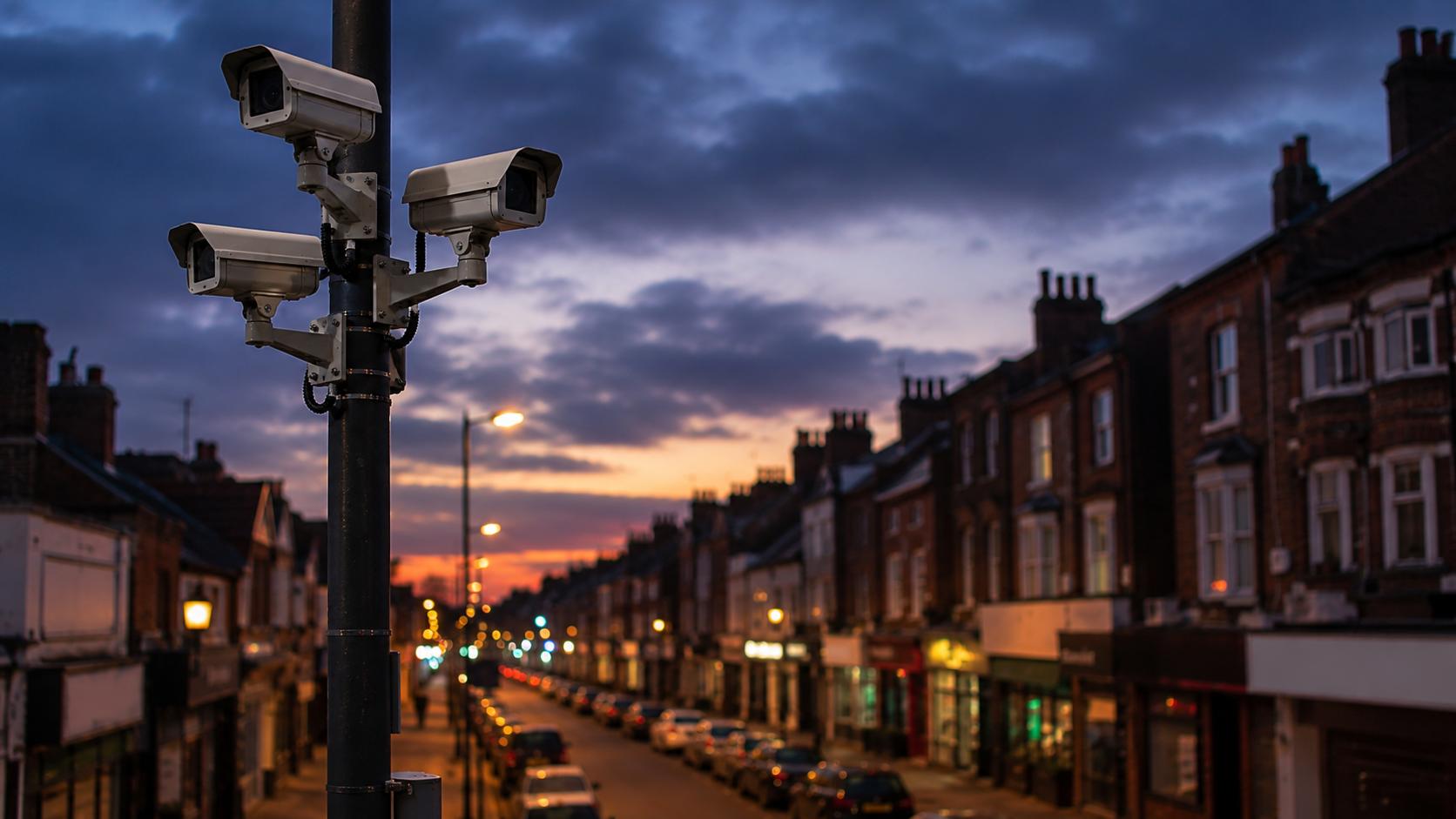
Britain is one of the most watched societies on earth, its town centres, car parks and transport hubs studded with cameras. The promise is simple: more surveillance, less crime. The reality, when the evidence is examined carefully, is more interesting and more qualified, and it raises a stubborn question about whether cameras prevent crime or merely push it somewhere else.
What the Evidence Says.
The single most authoritative source on this is a body of research drawing together decades of studies from around the world. The headline finding is genuinely positive but modest: across a wide range of settings, the presence of CCTV is associated with a statistically significant fall in crime of around 13 per cent compared with similar places without it. That is a real effect and a useful one, but it is an average across many schemes, some of which worked well and a small number of which were associated with no benefit or even a slight increase. CCTV, in other words, helps, but it is no silver bullet.
Where It Works Best.
The evidence is far from uniform across different places and crimes, and the pattern is instructive. The strongest and most consistent effects are found in car parks, where cameras have a marked impact, and to a lesser but real degree in residential areas, where reductions of around 12 per cent have been observed. By crime type, the biggest reductions show up for vehicle crime, property crime and drug-related offending, the kinds of calculated, acquisitive crimes where an offender might weigh the risk of being caught on camera. This fits a simple logic: CCTV works best where would-be offenders pause to consider the chance of detection.
Where It Falls Short.
Just as telling is where CCTV does not appear to help. The research finds little or no measurable effect on violent crime and disorder. That makes intuitive sense, because much violence is impulsive, fuelled by alcohol or emotion, and committed by people who are not weighing up the presence of a camera in the heat of the moment. For the kind of late-night town-centre violence that worries many people most, cameras may assist in identifying offenders after the event and supporting prosecutions, but the evidence that they prevent such incidents from happening is weak.
The Displacement Question.
This brings us to the central worry: if cameras stop crime in one place, do criminals simply move to another. It is a serious concern, because a scheme that merely shifts offending around delivers no real benefit to society as a whole. The reassuring news from most of the research is that wholesale displacement to nearby areas is not commonly found; in many studies, crime falls in the camera-covered area without a matching rise next door. Some evaluations have detected a degree of territorial displacement, and a small number of studies raise the possibility that benefits can be undone elsewhere, so the issue cannot be dismissed. But the more frequent finding, encouragingly, is the opposite effect, a so-called diffusion of benefits, where areas near the cameras also see crime fall, perhaps because offenders are unsure exactly how far the surveillance reaches.
Why Implementation Matters.
One of the clearest lessons is that whether CCTV works depends heavily on how it is done. Cameras dropped into a location without thought, poorly positioned, badly maintained or not actively monitored, are far less effective than a scheme designed around the specific problems of a specific place, integrated with patrols and other measures, and properly run. The technology is a tool, not a solution in itself, and the same camera can be near-useless or highly effective depending on the planning, monitoring and follow-up around it. The research base is much stronger on whether CCTV works than on the practical details of how to make it work best, which is itself a gap worth noting.
A Balanced Verdict.
So does CCTV reduce crime or just move it. The honest, evidence-based answer is that well-designed CCTV does genuinely reduce crime, modestly overall and substantially in the right settings such as car parks, and that wholesale displacement to neighbouring areas is the exception rather than the rule, with crime more often falling nearby than rising. At the same time, cameras are not effective against impulsive violence and disorder, and their value depends greatly on thoughtful implementation. For a city weighing investment in surveillance, the sensible conclusion is neither blind faith nor blanket scepticism, but a targeted approach: put cameras where the evidence says they work, design and run the schemes properly, and pair them with the patrols and policing that address the crimes cameras alone cannot.
Privacy and the Price of Surveillance.
Any honest discussion of CCTV has to reckon with more than its effect on crime, because cameras come with costs that are not only financial. A society blanketed in surveillance trades away a measure of privacy and anonymity in public space, and reasonable people disagree about where the balance should lie.
Supporters argue that those with nothing to hide have nothing to fear, and that the reassurance and crime-reduction benefits justify the watching eye, particularly in places with a genuine problem. Critics counter that pervasive monitoring can have a chilling effect, that footage can be misused or inadequately protected, and that the steady normalisation of being watched is itself a change worth pausing over, especially as cameras grow more capable and are increasingly paired with technologies such as automated facial recognition.
There is also the question of cost and opportunity: money spent installing and running cameras is money not spent on officers, lighting, youth services or other measures that might do as much or more to prevent crime. The evidence that CCTV works modestly and selectively, rather than universally, sharpens these trade-offs, because it means surveillance cannot simply be assumed to be worth it everywhere.
A thoughtful approach treats CCTV as one option among several, to be deployed where the evidence supports it and where the privacy cost is proportionate to the benefit, rather than as a default response to every public concern about crime. Getting that balance right is a matter of democratic judgement as much as of criminology.
Have your say.
Well-designed CCTV modestly reduces crime and rarely just displaces it, but it does little against impulsive violence and depends on how it is implemented.
Do you feel safer in places covered by CCTV cameras?
Crime News
Watching the Watchers: Does CCTV Actually Cut Crime?
Decades of research show CCTV cuts crime by around 13% overall and rarely just displaces it, but it does little against violence. We weigh the evidence.
Advertisement




Comments (0)
You must be logged in to post comments.
Don't have an account? Register here
No comments yet. Be the first to share your thoughts!