
Anyone who regularly visits Newcastle city centre will have seen it happen.
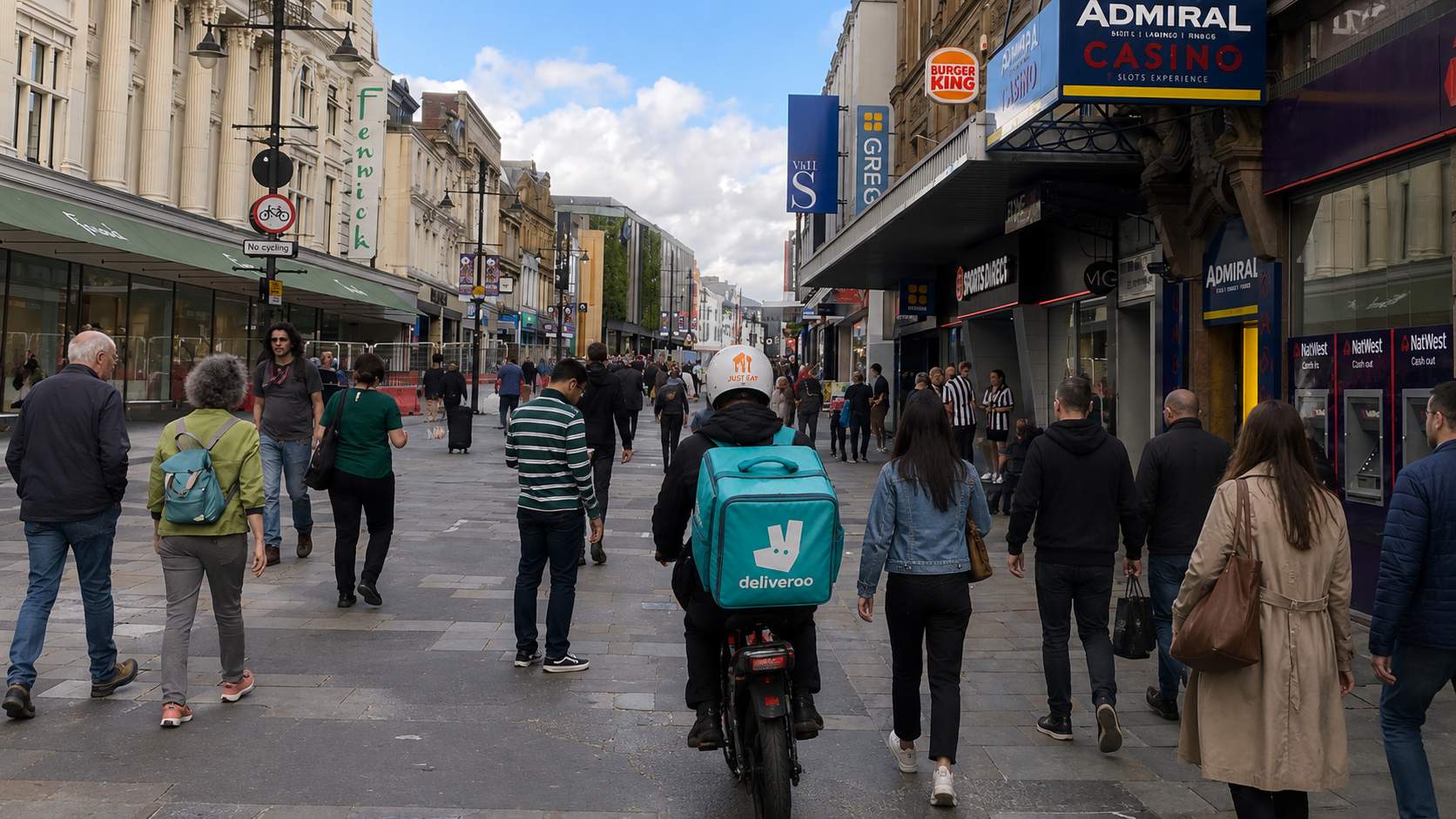
A cyclist rides through Northumberland Street weaving between shoppers. An e-bike passes close to pedestrians. A food delivery rider cuts through a busy crowd outside Eldon Square.
For many people, it has become such a common sight that it barely raises an eyebrow anymore.
Yet what many residents may not realise is that cycling on Northumberland Street is prohibited. The city's most famous shopping street was designed as a pedestrianised zone where people can move safely without the presence of vehicles.
Despite this, cyclists continue to use the street daily, often during the busiest shopping hours, with little sign of enforcement action being taken.
The situation has left some Newcastle residents asking a simple question. If the rules are clear, why do they appear to be ignored so often?
One Of The Busiest Shopping Streets In The UK.
Northumberland Street is not an ordinary road.
Stretching through the heart of Newcastle city centre, it attracts thousands of visitors every day and is widely regarded as one of the busiest shopping streets outside London.
The street was pedestrianised to create a safer and more welcoming environment for shoppers, workers, tourists and families.
The principle is straightforward. Pedestrianised streets exist because people on foot should be able to move freely without worrying about traffic.
However, many visitors now say they frequently encounter cyclists travelling through crowded sections of the street, particularly during peak shopping periods.
For elderly residents, parents with young children and people with mobility issues, the experience can be unsettling.
While most cyclists ride responsibly, concerns are often raised about those travelling at speed or attempting to navigate through dense crowds.
The Rise Of E-Bikes Has Changed The Debate.
The issue has become even more noticeable with the growth of electric bikes.
Across Newcastle and the wider North East, e-bikes have become increasingly popular for commuting and delivery work.
Many residents support greener transport options and recognise the environmental benefits that cycling can bring.
However, the increased speed and acceleration of some electric bikes has added a new dimension to the debate.
Pedestrians who may previously have been able to react to a traditional bicycle approaching now face faster moving vehicles in crowded public spaces.
Several city centre businesses have also reported concerns from customers who feel uncomfortable sharing busy pedestrian areas with cyclists.
The issue is no longer simply about convenience. It has become a public safety discussion.
Enforcement Appears Difficult To Find.
What frustrates many residents is not necessarily the existence of cyclists in the city centre.
Instead, it is the apparent lack of visible enforcement.
Northumbria Police and local authorities have numerous responsibilities competing for resources, from tackling anti-social behaviour to addressing more serious crime.
Yet critics argue that the complete absence of meaningful enforcement sends the wrong message.
When people see rules being ignored day after day without consequences, confidence in those rules can begin to erode.
The perception among some residents is that cyclists have effectively been given a free pass to ignore restrictions that would not be tolerated if committed by other road users.
Whether that perception is fair or not, it is becoming increasingly common among people who regularly use Newcastle city centre.
The Numbers Raise Questions.
National statistics show that collisions involving cyclists and pedestrians remain relatively uncommon compared with other road incidents.
However, incidents do occur.
Government figures show that in 2023, four pedestrians lost their lives following collisions involving cyclists in Great Britain, while 185 people suffered serious injuries.
At the same time, only a small number of cyclists faced prosecution for dangerous or careless cycling offences.
Those figures have prompted some commentators to question whether enforcement is keeping pace with changing travel habits.
The concern is not that every cyclist should face a penalty.
Instead, critics argue that consistent enforcement of existing rules would help encourage safer behaviour while reassuring pedestrians that restrictions are meaningful.
Could Newcastle Be Missing Out On Revenue?
Another aspect of the debate concerns local finances.
Councils across the country continue to face significant budget pressures, with many warning of difficult financial decisions in the years ahead.
Some residents question whether greater enforcement of existing offences could generate additional income while improving public safety and while Newcastle City Council would not directly benefit financially from most cycling fines, critics argue that visible enforcement by police or authorised officers could improve compliance and pedestrian safety in one of the city's busiest shopping areas.
Fixed penalty notices are already used for a range of offences including littering, fly-tipping and anti-social behaviour.
While enforcement should never be viewed primarily as a revenue source, supporters argue that any income generated could be reinvested into public services, road safety campaigns or improvements to cycling infrastructure.
At a time when every pound matters, some wonder why available enforcement powers appear to be used so sparingly.
Cyclists Say The Real Problem Is Infrastructure.
Many cyclists argue that the focus should not be on punishment.
Instead, they point to gaps in Newcastle's cycling network.
Campaigners have long argued that some routes into the city centre remain intimidating for less experienced riders, forcing difficult choices between busy roads and pedestrian areas.
From this perspective, Northumberland Street is not the cause of the problem but a symptom of wider infrastructure shortcomings.
Many cycling groups support better segregation between pedestrians, cyclists and vehicles, believing this would reduce conflict for everyone.
It is an argument that has gained support as cities across the UK invest heavily in active travel projects.
Residents Want Clearer Action.
Regardless of where people stand on the debate, one thing appears increasingly clear.
Many Newcastle residents want greater clarity.
If cycling restrictions on Northumberland Street are important, they expect to see them enforced consistently.
If enforcement is not considered a priority, some believe authorities should explain why.
The current situation leaves many people feeling caught in the middle, with pedestrians frustrated by perceived inaction and cyclists frustrated by infrastructure they believe remains incomplete.
As Newcastle City Council continues investing in the city centre, the question remains whether pedestrian-only spaces will continue to function as intended or whether cycling through crowded shopping streets will simply become accepted as part of everyday life.
For now, Northumberland Street remains one of the clearest examples of a rule that exists on paper but appears increasingly difficult to spot in practice.
Share your thoughts.
Have you seen cyclists or e-bike riders using Northumberland Street despite the restrictions?
Crime News
Could Stricter Pedestrian Zone Enforcement Help Fund Newcastle's City Services?
Advertisement




Comments (0)
You must be logged in to post comments.
Don't have an account? Register here
No comments yet. Be the first to share your thoughts!