
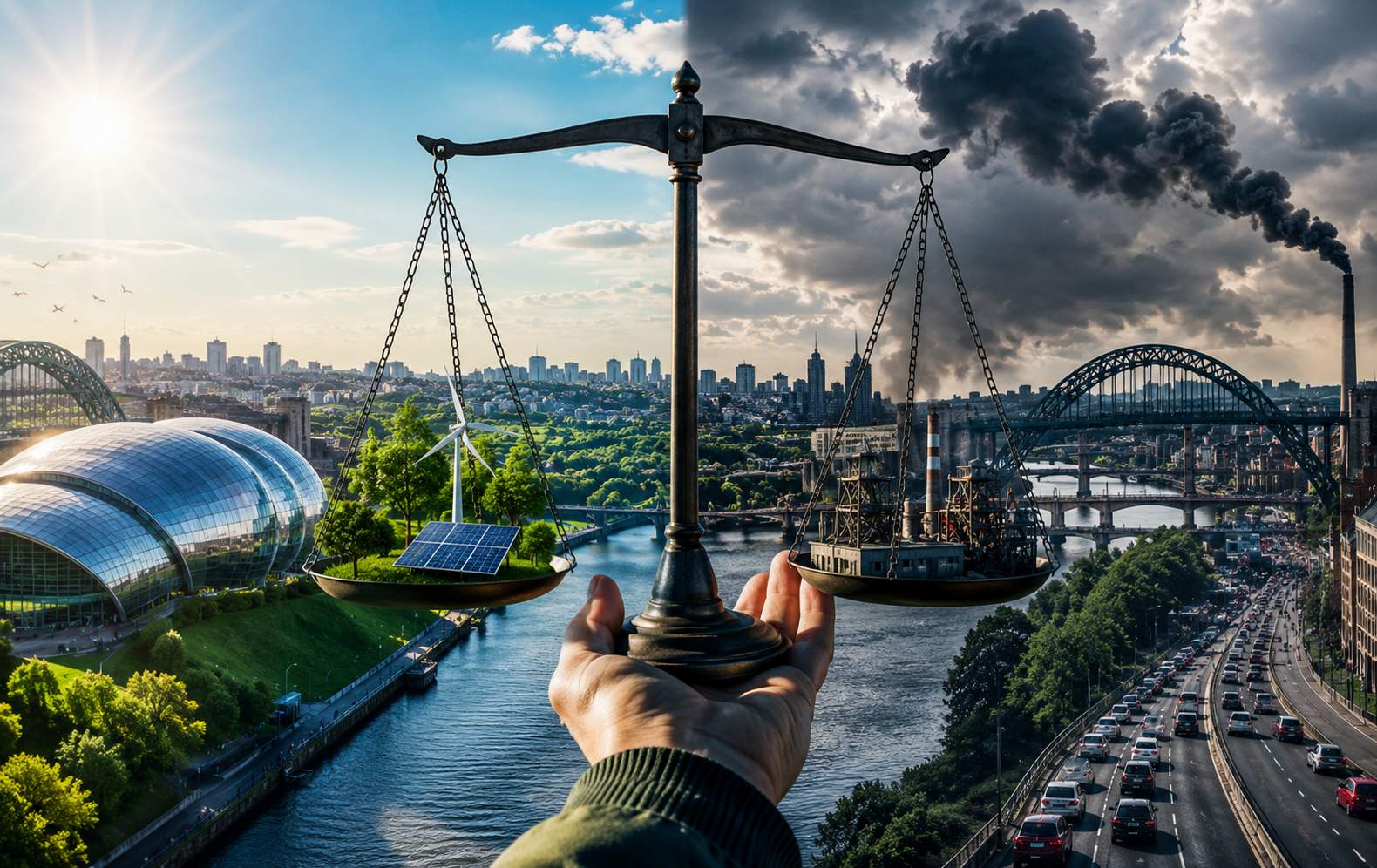
In 2019, Newcastle City Council made one of the boldest environmental commitments of any local authority in the UK.
The council declared a Climate Emergency and pledged to help make Newcastle carbon neutral by 2030. It was an ambitious target that placed the city 20 years ahead of the UK Government's legally binding national net zero deadline of 2050.
At the time, the announcement was widely welcomed by environmental campaigners and positioned Newcastle as one of the country's leading cities on climate action.
Five years later, the city has undoubtedly made progress.
Carbon emissions have fallen, renewable energy projects have expanded, transport policies have changed and climate action plans have been rolled out across multiple sectors.
But as the city moves closer to its self-imposed deadline, a far more difficult question is beginning to emerge.
Can Newcastle realistically achieve carbon neutrality by 2030?
What Newcastle Actually Promised.
Newcastle's Net Zero 2030 Action Plan was launched following the climate emergency declaration and outlined a roadmap designed to reduce emissions across transport, housing, businesses and public infrastructure.
Unlike many council climate pledges that focus only on council-owned buildings and operations, Newcastle's target covers emissions across the entire city.
That immediately makes the challenge far greater.
While councils can directly control their own offices, fleet vehicles and public buildings, they have much less influence over emissions generated by private homes, businesses and personal transport choices.
The scale of the task becomes clear when examining Newcastle's emissions profile.
Council climate documents show around 64 to 65 per cent of Newcastle's emissions come from energy use in homes, businesses and buildings. Transport accounts for roughly another 29 to 30 per cent. Together, those two sectors generate more than 90 per cent of the city's carbon emissions.
That means Newcastle's net zero ambitions depend heavily on factors extending far beyond council operations alone.
The Progress Newcastle Has Made So Far.
The council argues that meaningful progress is already happening.
According to Newcastle City Council, emissions from its own operations have fallen by 41 per cent since 2010. The authority says this equates to around 39,000 tonnes of carbon dioxide reductions from council buildings and travel.
The city has also introduced a range of climate-focused initiatives including:
The Clean Air Zone.
Expansion of electric vehicle charging infrastructure.
Active travel and cycling projects.
Renewable energy investments.
Food waste collection trials.
Tree planting programmes.
Council progress reports published this year state that 68 per cent of the original Net Zero Action Plan measures have either been completed, embedded into everyday operations or replaced by updated measures. The council describes overall delivery as being "ahead of schedule".
The city also retained an "A" grade from the Carbon Disclosure Project, placing Newcastle among a relatively small number of locations globally recognised for climate transparency and environmental leadership.
On paper, those achievements appear significant.
However, climate experts often point out that the easiest carbon reductions tend to happen first.
The Hardest Emissions Are Still Ahead.
One of the biggest realities facing Newcastle is that early emissions reductions are often cheaper and easier to achieve.
Switching lighting systems, improving council building efficiency, reducing operational energy use and upgrading vehicle fleets can generate meaningful reductions relatively quickly.
The problem comes later.
The remaining emissions are frequently tied to issues that are much harder to solve.
Private housing remains one of the biggest challenges. Thousands of homes across Newcastle still rely on gas heating systems. Retrofitting properties with heat pumps, insulation upgrades and low-carbon heating solutions requires substantial investment from homeowners, landlords and housing providers.
Transport presents another major obstacle.
Although the city's Clean Air Zone has reduced emissions and improved air quality, private vehicles remain a dominant form of transport across large parts of Newcastle and the wider region.
Achieving net zero by 2030 would require significant shifts in travel behaviour, public transport use and vehicle electrification.
The reality is that these are some of the most difficult emissions reductions any city can attempt.
Gateshead Has Reduced Emissions Faster Than Newcastle.
Perhaps the most interesting comparison comes from neighbouring Gateshead.
Gateshead Council reports that emissions from its own activities have fallen by 55 per cent since 2010, substantially higher than Newcastle's reported 41 per cent reduction.
Like Newcastle, Gateshead has committed to becoming carbon neutral by 2030 and has introduced a Climate Emergency Action Plan covering energy use, planning policy and clean energy generation.
However, Gateshead has also openly acknowledged an important limitation.
Council operations account for only around 2.5 per cent of Gateshead's overall carbon footprint.
That highlights a challenge Newcastle faces as well.
Even if councils successfully decarbonise their own operations, most emissions come from wider communities rather than council buildings.
Sunderland Has Already Beaten One Major Target.
Sunderland provides another interesting comparison.
The city committed to becoming carbon neutral by 2040 and set interim emissions reduction targets designed to measure progress.
According to Sunderland's own reporting, the city aimed to reduce emissions by 16.1 per cent by 2020 compared with 2015 levels.
Actual reductions reached 26.1 per cent.
That means Sunderland exceeded one of its early targets.
The challenge now is maintaining that pace.
Council figures suggest annual emissions reductions of approximately 14.4 per cent will be needed going forward to remain aligned with longer-term net zero ambitions.
Durham Has Also Exceeded Earlier Goals.
Durham County Council has similarly reported progress ahead of previous targets.
The authority says it exceeded its original goal of a 60 per cent operational emissions reduction by achieving a 61 per cent reduction.
Like Newcastle and Gateshead, Durham continues investing in climate programmes and emissions reduction initiatives.
However, political debate around climate policies has become increasingly prominent, demonstrating how environmental targets are becoming more controversial as deadlines approach.
Funding Remains One of Newcastle's Biggest Problems.
Perhaps the greatest threat to Newcastle's 2030 ambition is not political opposition or public resistance.
It is money.
Climate action requires major investment.
Building retrofits, renewable energy infrastructure, electric transport systems and low-carbon heating projects all require substantial funding before long-term savings can be realised.
Newcastle's own documents highlight wider financial pressures facing the authority, including hundreds of millions of pounds lost through austerity measures over the last decade.
Like many councils across the UK, Newcastle must balance climate spending against demands for social care, housing, education, highways maintenance and public services.
That balancing act becomes increasingly difficult as climate deadlines move closer.
Is Newcastle Actually on Track?
The answer depends on what is being measured.
If the focus is council operations, Newcastle has made significant progress. A 41 per cent reduction in operational emissions is substantial and demonstrates genuine movement rather than symbolic climate commitments.
If the focus is delivery of climate action measures, the council can point to 68 per cent of planned actions being completed, embedded or superseded.
However, if the question is whether Newcastle can fully decarbonise transport, housing, energy use and wider city emissions by 2030, the answer becomes far less certain.
The city's biggest emissions sources remain its hardest to solve.
Experts from the Climate Change Committee have repeatedly warned that emissions reductions across transport and buildings will need to accelerate sharply throughout the second half of this decade if net zero targets are to remain achievable.
That challenge applies to Newcastle as much as it does to the rest of the UK.
The Next Five Years Could Define Newcastle's Climate Legacy.
The reality is that Newcastle has already achieved more climate progress than many critics acknowledge.
Emissions have fallen. Policies have changed. Projects have been delivered. National recognition has followed.
Yet the most difficult phase is still ahead.
The success or failure of Newcastle's 2030 promise will likely depend on whether the city can tackle transport emissions, decarbonise housing and maintain a pace of change significantly faster than it has achieved historically.
For residents, businesses and policymakers alike, the next five years may ultimately determine whether Newcastle becomes one of Britain's net zero success stories or whether one of the country's most ambitious climate promises proves harder to deliver than expected.
Do you think Newcastle can realistically become carbon neutral by 2030, or was the target always too ambitious?
Local News
Is Newcastle Really on Track to Become Carbon Neutral by 2030?
Advertisement



Comments (0)
You must be logged in to post comments.
Don't have an account? Register here
No comments yet. Be the first to share your thoughts!