
Kedgeree occupies an unusual position in British cookery. It is unmistakably a British dish, associated with Victorian breakfast sideboards and country house weekends, yet its name and its foundation come from the Indian subcontinent.
It is one of the clearest surviving examples of how empire changed British eating, and of how a dish can be transformed almost beyond recognition while keeping its name.
Here is where it came from and how it became what it is.
The original is khichri.
Khichri, also written khichdi and in various other transliterations, is a dish of rice and lentils cooked together with spices, eaten across the Indian subcontinent for many centuries.
It is a staple rather than a delicacy: nourishing, economical and easily digestible, frequently given to those recovering from illness and to young children.
Regional versions vary enormously in consistency, spicing and additions, from soupy to firm, plain to heavily spiced.
The British encountered it and changed it.
British administrators, soldiers and their households in India adopted khichri and adapted it to their own tastes and to the ingredients they preferred.
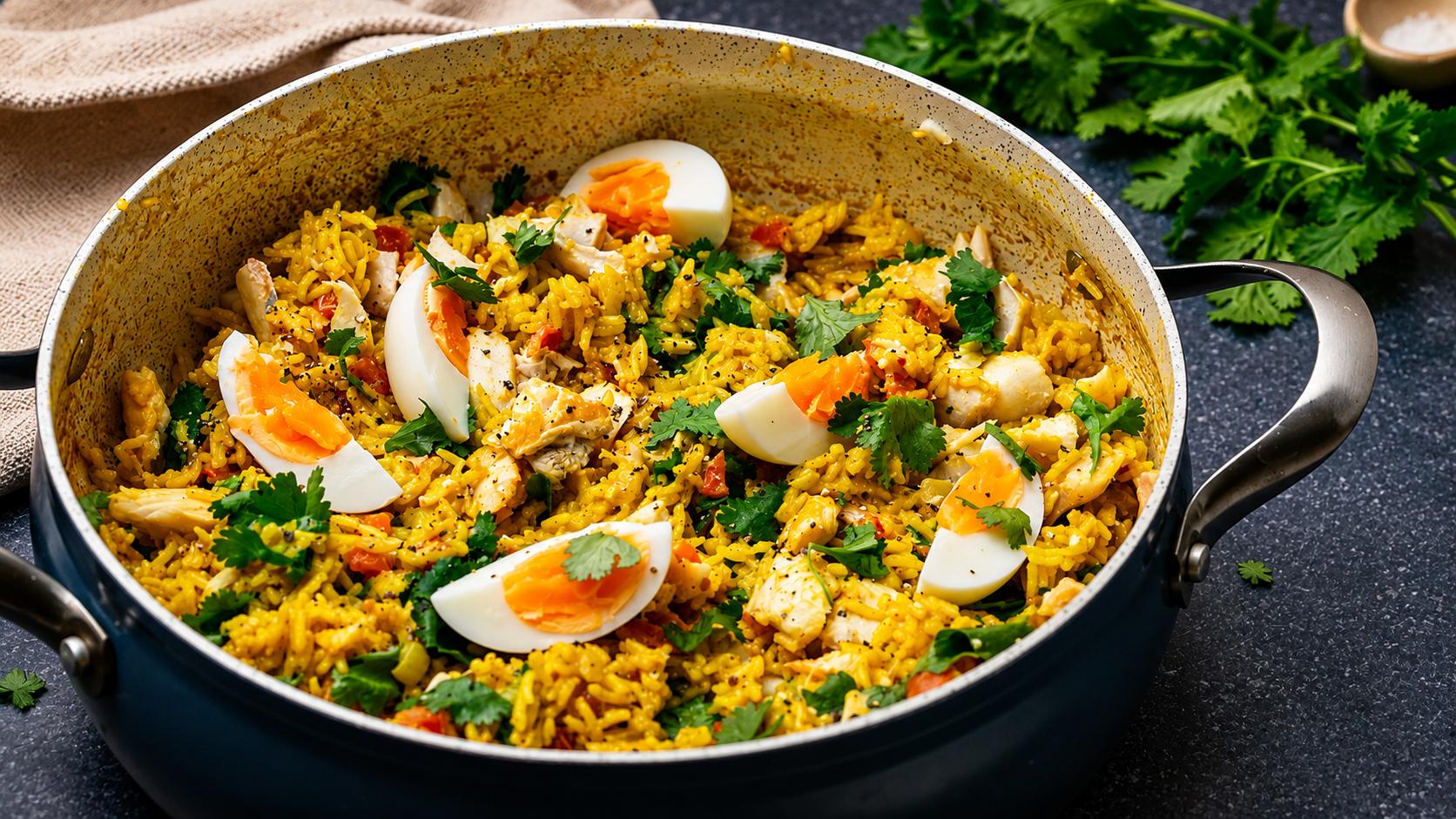
The most significant change was the addition of fish, which does not appear in the traditional dish. Hard-boiled eggs were also introduced, and the lentils were frequently dropped altogether.
Butter or cream sometimes replaced the ghee, and the spicing was generally moderated. What returned to Britain was, in effect, a new dish wearing an old name.
Smoked haddock became the standard.
Once established in Britain, kedgeree settled around smoked haddock as the fish of choice, and that remains the classic version.
Smoked haddock suited the dish well. It was widely available, kept better than fresh fish before refrigeration, and its salty, smoky flavour stood up to the rice and spices.
Naturally smoked undyed haddock is generally preferred by cooks over the bright yellow dyed variety, though both are widely sold.
The Victorian breakfast made its name.
Kedgeree's peak coincided with the Victorian and Edwardian country house breakfast, a substantial meal served from covered dishes on a sideboard.
Guests helped themselves from a spread that might include eggs prepared several ways, kidneys, bacon, kippers, cold meats and one or two composite dishes. Kedgeree fitted this format perfectly, since it could be prepared in advance and kept warm.
It also appealed to households with Indian connections, of which there were a great many among the professional and military classes.
It fell out of fashion and came back.
The large breakfast declined through the twentieth century, and with it the setting that had sustained kedgeree. It became a dish people had heard of rather than eaten.
Its revival came partly through restaurant chefs interested in reviving British classics, and partly through renewed appetite for spiced food generally.
It now appears on brunch menus far more often than breakfast ones, and it is as likely to be eaten in the evening as in the morning.
Making it well depends on a few details.
The rice should be cooked so the grains remain separate. Basmati is the usual choice, rinsed before cooking to remove excess starch.
The haddock is typically poached gently in milk, which is then sometimes used in the dish, and the fish flaked in large pieces rather than shredded. Poaching liquid infused with bay and peppercorns adds considerably to the flavour.
Spicing usually involves a mild curry powder, turmeric for colour, and sometimes whole spices such as cardamom and cloves cooked with the rice. Restraint matters, since the smoked fish is assertive.
Hard-boiled eggs are quartered and folded through at the end, along with plenty of chopped parsley or coriander and a good squeeze of lemon.
Variations are numerous.
Some cooks return the lentils, moving the dish back towards its origins. Others use smoked salmon, kippers or fresh salmon in place of haddock.
Cream or crème fraîche stirred through at the end produces a richer result, favoured by some chefs and disliked by others.
A soft-boiled egg placed on top, rather than hard-boiled eggs folded through, has become a common restaurant presentation.
Serving it well matters.
Kedgeree is best assembled just before serving, since rice left sitting in a warm pan becomes claggy and the eggs lose their texture.
It reheats poorly for the same reason, so cooking the components ahead and combining them at the last moment works considerably better than making the whole dish in advance.
Accompaniments are simple. Lemon wedges, mango chutney and a spoonful of yoghurt all work, and a sprinkling of fresh herbs at the table lifts the whole plate.
Its history is worth acknowledging.
Kedgeree belongs to a group of dishes, alongside mulligatawny soup and various chutneys and pickles, that entered British cookery through colonial contact.
That history is not straightforwardly comfortable, and discussion of Anglo-Indian food has become considerably more thoughtful in recent years about the circumstances in which these exchanges took place.
What is not in doubt is the influence. British food would look substantially different without it, and kedgeree is among the most direct surviving examples on a breakfast table.
Share your thoughts.
Do you like kedgeree and if so, do you prefer it for breakfast or later in the day?
Food & Drink News
Kedgeree: The Breakfast That Came Home From India
A dish of rice, lentils and spices from the Indian subcontinent returned to Britain transformed, with smoked haddock and hard-boiled eggs.
Advertisement


Comments (0)
You must be logged in to post comments.
Don't have an account? Register here
No comments yet. Be the first to share your thoughts!