
Marmalade is the odd one out among British preserves. Jams aim for sweetness and fruit; marmalade deliberately keeps the bitterness of the peel, and its admirers value it precisely for that.
It also carries more folklore per jar than almost any other food, most of it demonstrably untrue.
Here is where marmalade actually came from, and why the season for making it lasts only a few weeks.
The word originally meant quince.
Marmalade derives from the Portuguese marmelada, meaning a preserve made from quince, from marmelo, the Portuguese word for the fruit.
Quince paste, dense enough to be cut with a knife, was being imported into England by the late fifteenth century and was treated as a luxury, served in slices at the end of a meal as a sweetmeat rather than spread on anything.
The shift from solid quince paste to a spreadable citrus preserve took place gradually over the following centuries, as sugar became cheaper and citrus fruit more available.
The Mary Queen of Scots story is nonsense.
The most repeated marmalade legend holds that the name comes from the French phrase Marie est malade, said to have been used when a seasick or unwell Mary Queen of Scots was given the preserve as a restorative.
It is a charming story and it is entirely false. The word marmelada predates Mary by a considerable margin and has a clear Portuguese derivation.
Similar folk etymologies attach to a great many foods, and they tend to survive because they are more memorable than the truth.
The Dundee story is more plausible but still disputed.
The best known origin account concerns Janet Keiller of Dundee, whose husband is said to have bought a consignment of Seville oranges cheaply from a storm-damaged Spanish ship around 1700, after which she made them into preserve.
The Keiller family did establish a successful marmalade business in Dundee, and it became one of the earliest commercial producers, so the family's importance is real.
Historians are more doubtful about the shipwreck. Recipes for citrus marmalade appear in English and Scottish cookery well before 1700, so the Keillers commercialised something already established rather than inventing it.
Seville oranges make the difference.
The classic marmalade orange is the Seville, a bitter variety grown mainly in southern Spain and largely unsuitable for eating raw.
Its bitterness is exactly what marmalade needs, and it is unusually high in pectin, the substance that makes preserves set. That combination means Seville marmalade sets well without added pectin.
The fruit has a very short season, generally arriving in British shops for a few weeks in January and February. That narrow window is why marmalade making has traditionally been a midwinter activity, and why cooks buy in bulk and freeze fruit for later.
Other varieties are used, including blood oranges, limes, lemons and grapefruit, and three fruit marmalade combines several. None quite replicates the Seville.
Making it is a two-day affair.
The traditional method involves simmering whole oranges until soft, then halving them, scooping out the flesh and pips, and shredding the peel.
The pips and pith are crucial. They contain most of the pectin, and they are usually tied in muslin and cooked with the mixture, then squeezed and removed before the sugar goes in.
Sugar is added after the peel has softened, because adding it too early prevents the peel from tenderising further. The mixture is then boiled hard until setting point.
Testing for a set involves chilling a spoonful on a cold saucer and pushing it with a finger. If the surface wrinkles, it is ready. Overboiling produces a dark, treacly result and can cause the peel to sink.
Cut determines the style.
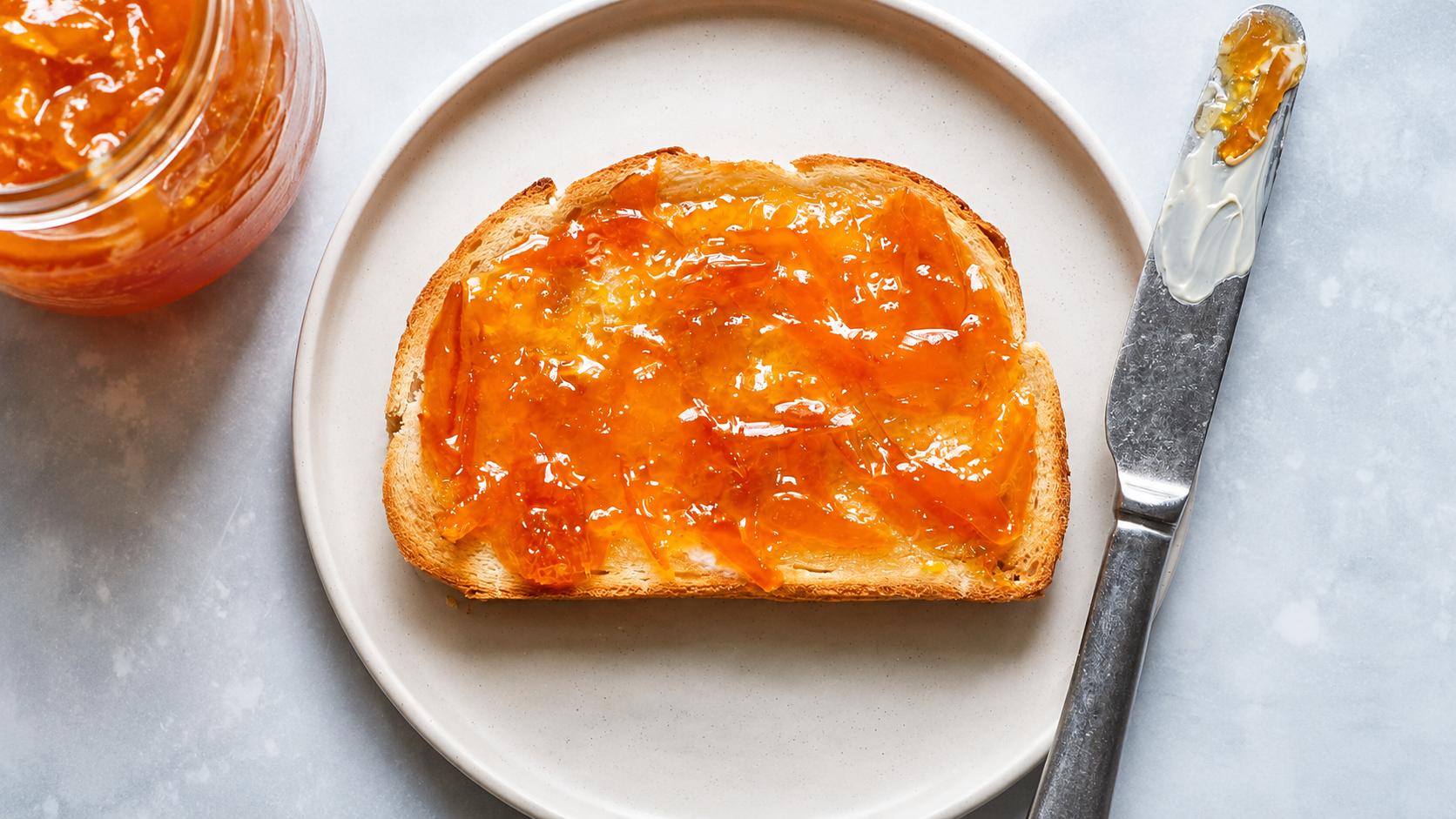
Marmalade styles are defined largely by how the peel is prepared. Fine cut has thin shreds, thick cut has substantial pieces, and jelly marmalade contains little or no peel at all.
Preferences are strongly held. Some people want peel they can chew, others want the flavour with minimal texture.
Colour varies with cooking time and sugar type. Dark marmalades, made with brown sugar or a longer boil, are more bitter and treacly, while pale ones are fresher and sharper.
Oxford and Dundee became brand names.
Frank Cooper's marmalade, produced in Oxford from the late nineteenth century, became strongly associated with a dark, coarse-cut style and with university and expedition life, having been carried on polar expeditions.
Dundee marmalade, from the Keiller tradition, gave its name to a thick-cut style. Both names now describe styles as much as specific products.
Commercial marmalade production remains substantial, though consumption has declined over recent decades as breakfast habits have changed, and producers have worked hard to interest younger buyers.
There is a competition for it.
The World's Original Marmalade Awards, held at Dalemain near Penrith in Cumbria, attract thousands of entries from across the world each year, in categories covering amateur and artisan makers alike.
It has become a genuine fixture of the preserving calendar and has done a good deal to sustain interest in home marmalade making.
For a preserve that depends on a fruit too bitter to eat and a technique that takes two days, marmalade has proved remarkably persistent.
Share your thoughts.
Thick cut or fine cut, and is marmalade strictly a breakfast food?
Food & Drink News
Marmalade: The Bitter Preserve With a Disputed Story
Marmalade began as a solid quince paste, acquired a false origin story involving a seasick queen, and became the one British preserve that celebrates bitterness.
Advertisement

Comments (0)
You must be logged in to post comments.
Don't have an account? Register here
No comments yet. Be the first to share your thoughts!