
Many unusual phrases and tools have disappeared from everyday life, but few are as intriguing as the butcher's dollar. While the term may sound like a form of currency, it actually refers to a small bone token that played an important role in Britain's meat industry for generations.
Long before computers, barcode scanners and electronic inventory systems became commonplace, slaughterhouses and meat processing facilities relied on simple methods to keep track of production. One of those methods was the butcher's dollar, a practical tool that helped workers count carcasses accurately during busy working days.
Although largely forgotten outside the trade, the butcher's dollar remains a fascinating piece of British industrial history and has connections to places such as Newcastle, where meat markets and livestock trading once formed an important part of the local economy.
What Is A Butcher's Dollar?.
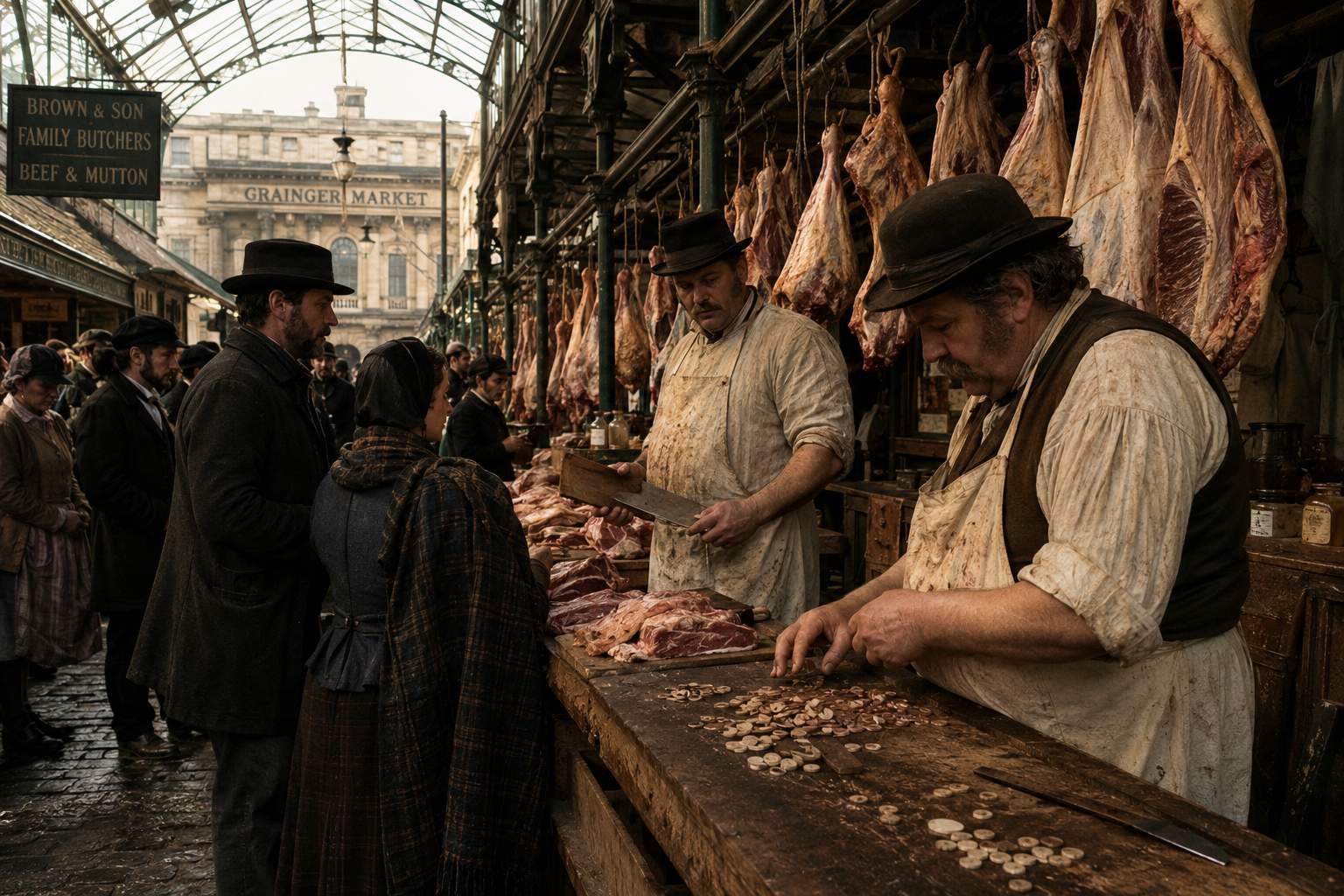
A butcher's dollar was a small piece of bone, usually cut from animal remains during processing, that served as a counting token within slaughterhouses, abattoirs and meat processing facilities.
Each token represented a carcass or unit that had been processed. Workers would collect, move or store these bone markers throughout the day to maintain accurate counts of livestock that had passed through various stages of production.
The system was simple but effective. In an era before digital records, butchers needed a reliable way to ensure that carcass numbers matched orders, inspections and deliveries. The butcher's dollar provided a durable and readily available solution.
Unlike paper records, which could become damaged in wet working environments, bone tokens were robust and easy to handle even in demanding conditions.
Why Were Bone Tokens Used?.
The meat industry of the nineteenth and early twentieth centuries was built around practicality.
Bone was a natural choice because it was readily available as a by-product of slaughtering operations. Instead of purchasing manufactured counting devices, workers could create markers from materials already present within the workplace.
The tokens were often shaped into small discs or identifiable pieces that could be quickly counted and transferred between workers. Their simplicity helped reduce mistakes during busy periods when hundreds of animals could be processed in a single day.
For businesses operating on tight margins, the butcher's dollar represented an inexpensive but highly effective management tool.
Newcastle's Historic Meat Trade Connection.
The history of the butcher's dollar fits naturally into Newcastle's rich commercial heritage.
For centuries, Newcastle served as a major trading centre for the North East. Livestock from surrounding rural communities was regularly brought into the city for sale, processing and distribution.
Grainger Market, which opened in 1835, became one of Newcastle's most important commercial hubs. Alongside fishmongers, greengrocers and general traders, butchers occupied a prominent position within the market.
Throughout the Victorian period and well into the twentieth century, Newcastle's growing population created significant demand for fresh meat products. Behind the scenes, slaughterhouses and meat processors worked to supply local shops, markets and restaurants.
While records specifically mentioning butcher's dollars in Newcastle are scarce, similar counting methods were widely used throughout Britain's meat industry during this period, making it highly likely that workers in the region would have been familiar with such tools.
Life Inside A Traditional Slaughterhouse.
Modern meat processing facilities rely on sophisticated technology, but working conditions a century ago were vastly different.
Much of the record keeping depended on manual systems. Workers counted livestock, tracked carcasses and recorded production figures using handwritten ledgers and physical markers.
A butcher's dollar helped bridge the gap between production and administration. Instead of relying entirely on paperwork, workers could physically account for each carcass using the tokens collected throughout the day.
The system reduced errors and allowed managers to verify totals more easily when comparing production figures with sales records.
How Technology Made The Butcher's Dollar Obsolete.
Like many traditional trade tools, the butcher's dollar gradually disappeared as technology advanced.
The introduction of improved record keeping systems, mechanical counting devices and eventually computerised inventory management removed the need for physical counting tokens.
By the late twentieth century, electronic systems had become standard across much of the meat industry. Barcodes, digital databases and automated tracking systems offered far greater accuracy and efficiency than manual methods.
Today, most younger workers entering the industry have never encountered a butcher's dollar, and many have never heard the term at all.
The Modern British Meat Industry By The Numbers.
While the butcher's dollar belongs largely to history, the industry it served remains a major contributor to the British economy.
According to industry figures, the UK meat processing sector employs tens of thousands of workers across slaughterhouses, processing plants and retail operations. The wider food and drink manufacturing sector supports hundreds of thousands of jobs nationwide and contributes billions of pounds annually to the economy.
The British meat industry processes millions of cattle, sheep and pigs each year, highlighting just how much production has expanded compared with the era when counting was carried out using simple bone tokens.
For readers interested in industrial heritage, these figures offer a reminder of how dramatically the sector has evolved over the last century.
A Forgotten Piece Of Working-Class History.
The butcher's dollar may seem insignificant by modern standards, but it represents an important chapter in Britain's industrial and agricultural story.
These humble bone tokens helped workers maintain accuracy in an industry that supplied food to millions of people. They also provide a fascinating glimpse into the practical ingenuity that characterised traditional trades before the arrival of modern technology.
In Newcastle, a city with deep roots in commerce, markets and industry, the story of the butcher's dollar serves as a reminder of the countless tools and traditions that helped build local businesses and support communities for generations.
Although few survive today, the butcher's dollar remains a unique symbol of Britain's rich meat-trading heritage and the workers whose skills kept the industry running long before the digital age.
Have you ever heard of a butcher's dollar before?
Food & Drink News
The Forgotten Bone Token Once Used By Newcastle's Butchers
Advertisement





Comments (0)
You must be logged in to post comments.
Don't have an account? Register here
No comments yet. Be the first to share your thoughts!