
For centuries, inventors have looked to nature for inspiration. Long before artificial intelligence, advanced robotics or modern engineering existed, nature had already spent millions of years perfecting solutions to complex problems. From surviving extreme environments to sensing danger and collecting resources, animals and plants evolved designs that often outperform human-made technology.
Today, scientists call this process biomimicry - the practice of studying nature's designs and applying them to engineering, medicine and technology. Some of the world's most innovative breakthroughs have emerged from researchers asking a simple question: how does nature solve this problem?
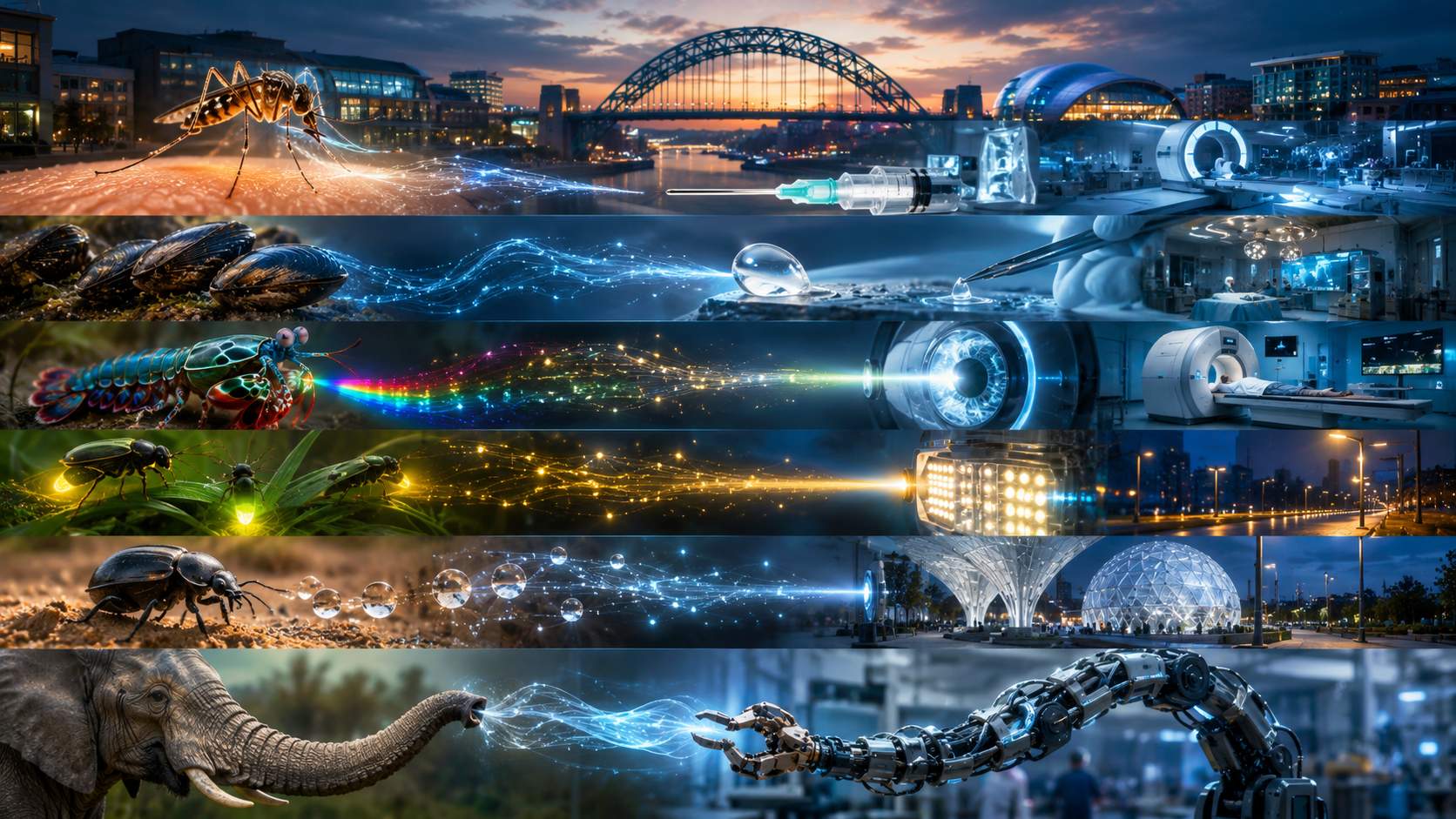
From medical needles inspired by mosquitoes to robotic arms modelled on elephant trunks, nature's influence can now be found in hospitals, laboratories, factories and research centres around the world. Even cities such as Newcastle, with its growing reputation for innovation, advanced manufacturing and scientific research, are increasingly benefiting from technologies rooted in the natural world.
The mosquito proboscis inspired less painful medical needles.
Few creatures are as universally disliked as mosquitoes. Yet despite their reputation, these insects possess one remarkable ability that has fascinated medical researchers for decades.
A mosquito can pierce human skin and draw blood while causing surprisingly little pain. This is possible because its proboscis is not a single needle but a sophisticated collection of microscopic structures that vibrate and penetrate tissue with minimal resistance.
Researchers studying mosquito anatomy have used these principles to develop thinner and less invasive medical needles. The aim is to reduce discomfort during injections, blood tests and drug delivery procedures.
This innovation matters because fear of needles remains extremely common. Studies suggest around one in four adults experience some degree of needle anxiety, while a significant percentage actively avoid medical procedures because of it.
As healthcare providers continue searching for ways to improve patient experience, the mosquito's feeding mechanism may help shape the next generation of medical technology.
Mussels inspired surgical glues that work underwater.
Mussels spend their lives attached to rocks in some of the harshest coastal environments on Earth.
Strong waves, salt water and changing weather conditions constantly attempt to dislodge them, yet they remain firmly attached thanks to a highly specialised natural adhesive.
Scientists have spent years studying how mussels achieve this remarkable grip. The result has been the development of bio-inspired surgical adhesives capable of working in wet conditions where traditional glues often fail.
This breakthrough has enormous medical potential. Human tissue is naturally moist, making it difficult for many adhesives to perform effectively. Mussel-inspired glues offer the possibility of closing wounds, repairing tissues and reducing the need for stitches in certain procedures.
Researchers believe these technologies could eventually improve outcomes for millions of surgical patients worldwide while reducing complications associated with conventional wound closure methods.
For a region such as Newcastle, which has a strong healthcare and medical research presence, innovations like these highlight the growing connection between biology and medicine.
Mantis shrimp vision is helping improve imaging technology.
The mantis shrimp possesses one of the most extraordinary visual systems in the animal kingdom.
Humans have three types of colour receptors. Some species of mantis shrimp possess up to sixteen.
This incredible visual capability allows them to detect forms of light and polarisation invisible to human eyes. Scientists studying these abilities have used the findings to improve imaging systems, medical diagnostics and optical technologies.
One promising area involves cancer detection. Researchers have explored how mantis shrimp-inspired optical systems may help identify abnormalities that conventional imaging struggles to detect.
Security screening, underwater exploration and environmental monitoring could also benefit from these advances.
Although the animal itself rarely exceeds the size of a human hand, its influence on future imaging technology could be enormous.
Fireflies helped create more efficient LED lighting.
On warm summer evenings, fireflies create one of nature's most recognisable displays.
What many people do not realise is that their light-producing structures have also inspired improvements in LED technology.
Scientists discovered that the microscopic surface patterns found on firefly lanterns help maximise light extraction. By applying similar structural principles to LED design, engineers have been able to improve efficiency and reduce wasted energy.
This matters because lighting represents a significant portion of global electricity consumption. Even small improvements in efficiency can lead to substantial energy savings when applied across millions of homes, offices and public buildings.
As cities continue pursuing sustainability goals, firefly-inspired lighting technologies demonstrate how natural solutions can contribute to modern environmental challenges.
For urban areas such as Newcastle, where energy efficiency and carbon reduction remain key priorities, these innovations could play an increasingly important role in future infrastructure projects.
Desert beetles inspired water harvesting technology.
One of nature's most impressive survival strategies belongs to the Namib Desert beetle.
Living in one of the driest places on Earth, this insect has evolved a remarkable way of collecting water from fog.
The beetle's shell contains microscopic structures that attract moisture while simultaneously directing collected droplets towards its mouth.
Engineers have studied these surfaces extensively and used them to develop water-harvesting technologies designed for regions facing water scarcity.
Prototype systems based on beetle-inspired designs can capture moisture directly from the atmosphere without requiring conventional water infrastructure.
With climate change increasing pressure on freshwater resources worldwide, these technologies could become increasingly valuable.
Some estimates suggest that by 2050, more than half of the global population may live in water-stressed regions. Solutions inspired by a small desert insect may help address part of that challenge.
Elephant trunks inspired a new generation of robots.
Elephants possess one of the most versatile appendages in nature.
Their trunks can uproot trees, lift heavy objects, pick up tiny items and perform delicate tasks with remarkable precision. Despite having no bones, the trunk combines strength, flexibility and control in ways that conventional robotic systems have struggled to replicate.
Researchers developing soft robotics have turned to elephant trunks for inspiration.
Unlike traditional industrial robots, which often rely on rigid structures, elephant-inspired robotic arms can bend, twist and adapt to complex environments.
These systems are already being explored for manufacturing, healthcare, search and rescue operations and space exploration.
The ability to handle fragile objects safely makes soft robotics particularly attractive for industries where precision matters.
As advanced manufacturing continues to expand across the UK, including within the North East, biomimetic robotics could become increasingly important for future industrial applications.
Why biomimicry is becoming a major innovation trend.
Biomimicry is no longer a niche scientific discipline.
The global biomimicry market is expected to grow significantly over the coming decade as industries search for more efficient, sustainable and resilient solutions. Researchers, engineers and businesses are increasingly recognising that nature represents the largest research and development programme ever conducted.
Unlike many human inventions, natural designs have been refined through millions of years of evolutionary testing. Every successful adaptation represents a solution that has survived countless challenges.
This makes nature an incredibly valuable source of inspiration.
Universities, research institutions and technology companies around the world are investing heavily in biomimetic innovation. The UK remains an active participant in this field, with researchers exploring applications across healthcare, energy, manufacturing and environmental science.
Nature may hold the answers to tomorrow's challenges.
Many of the technologies shaping the future were not invented entirely from scratch. Instead, they began with careful observation of the natural world.
A mosquito helped inspire medical needles. A mussel contributed to surgical adhesives. A shrimp influenced imaging systems. A firefly improved lighting efficiency. A desert beetle offered new approaches to water collection. An elephant helped redefine robotics.
What connects these innovations is a recognition that nature often solves problems long before humans realise they exist.
For cities such as Newcastle, where innovation, research and technology continue to drive economic growth, biomimicry represents a fascinating reminder that some of tomorrow's biggest breakthroughs may already exist in the natural world around us.
As scientists continue exploring nature's designs, the next revolutionary technology may come not from a laboratory whiteboard, but from a creature that has quietly been perfecting its solution for millions of years.
Share your thoughts on biomimicry below.
Which nature-inspired invention surprised you the most, and are there any animals or plants you think scientists should study next?
Tech News
The Incredible Technologies Humans Stole From Nature
Advertisement





Comments (0)
You must be logged in to post comments.
Don't have an account? Register here
No comments yet. Be the first to share your thoughts!