
For years, illegal immigration has remained one of the most divisive political and social issues facing Britain. Successive governments have pledged to reduce the number of migrants entering the country through unauthorized routes, yet the figures continue to rise. The most visible symbol of the crisis is the steady stream of overcrowded inflatable boats crossing the English Channel from northern France to England.
According to official Home Office figures, more than 41,000 migrants arrived in the UK via small boats during 2025, marking one of the highest annual totals ever recorded. Experts, law enforcement agencies and migration researchers say the situation has evolved into a sophisticated international smuggling operation involving criminal networks stretching from the Middle East, Africa and Asia to the beaches of northern France.
While political debate often focuses on border enforcement, the reality behind illegal migration is considerably more complex. From the routes migrants take to the fees paid to smugglers, understanding how people reach Britain helps explain why the problem has proven so difficult to solve.
The Main Route Into Britain.
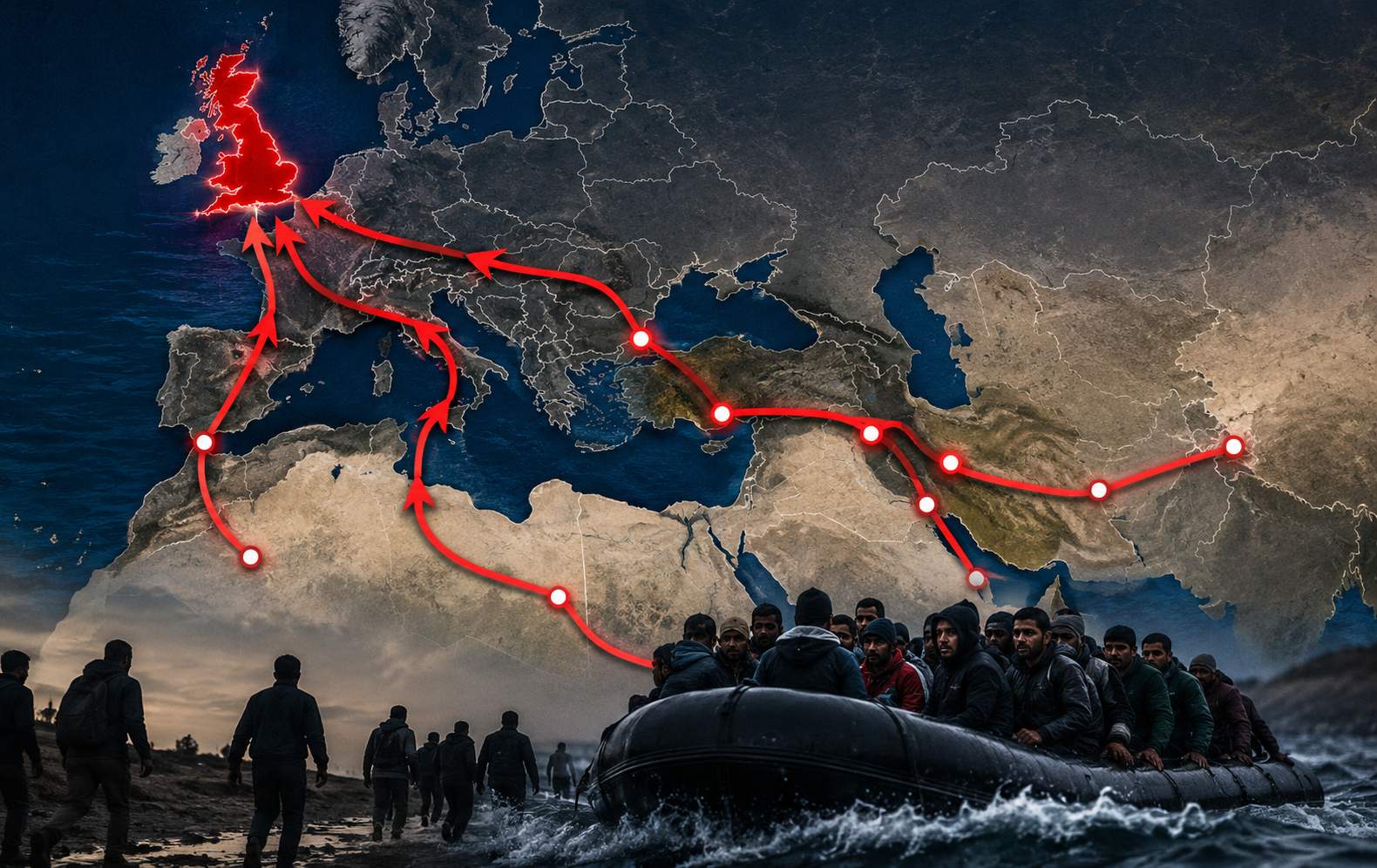
Today, the overwhelming majority of illegal migrants entering the UK arrive through small boat crossings across the English Channel. The journey typically begins hundreds or even thousands of miles away from Britain.
Many migrants first travel through multiple countries before reaching Europe. Depending on their country of origin, routes often pass through Turkey, Libya, Tunisia, Greece, Italy, the Balkans, Germany and Belgium before eventually leading to migrant camps and temporary accommodation in northern France.
Once in France, migrants often spend weeks or months waiting for an opportunity to cross. Smuggling gangs coordinate departures from beaches near Calais, Dunkirk and other coastal areas where the Channel crossing is shortest.
The actual journey across the Channel can take several hours and is frequently carried out in overcrowded inflatable boats carrying dozens of passengers. The route is considered one of the busiest shipping lanes in the world, creating significant risks for those attempting the crossing.
How Much Does It Cost To Reach The UK.
The financial cost of reaching Britain illegally varies considerably depending on the route, country of origin and services provided by smuggling gangs.
Migration experts and law enforcement agencies estimate that migrants can pay anywhere from £3,000 to more than £10,000 for a complete journey from their home country to the UK. Those travelling from conflict zones or countries further away often face even higher costs.
The final Channel crossing itself typically costs several thousand pounds. Investigations by authorities have found that migrants regularly pay between £1,000 and £5,000 for a place on a small boat, although prices fluctuate based on demand, weather conditions and enforcement activity. Some criminal groups charge premium rates for what they claim are safer crossings or faster departures.
Payments are frequently handled through informal money transfer systems such as hawala networks, making transactions difficult for authorities to trace. In many cases, families pool savings, borrow money or sell assets to finance the journey.
The result is a multi-million-pound criminal industry that continues to generate enormous profits for smuggling organizations operating across Europe and beyond.
Which Countries Do Migrants Come From.
The nationalities of migrants arriving in Britain have changed over time.
Recent Home Office and parliamentary data show arrivals coming from a wide range of countries including Afghanistan, Sudan, Eritrea, Iran, Syria, Somalia, Ethiopia, Iraq and Turkey. The number of nationalities represented among Channel arrivals has expanded significantly in recent years.
Many migrants come from countries affected by war, political instability, economic hardship or persecution. Afghanistan remains a significant source country following years of conflict and the Taliban's return to power. Sudan has also seen increasing numbers of migrants due to ongoing violence and humanitarian crises.
Migration researchers note that motivations vary considerably. Some migrants are fleeing conflict or persecution, while others are seeking better economic opportunities or attempting to reunite with family members already living in Britain.
Why Britain Remains A Popular Destination.
Despite the dangers of the journey, Britain continues to attract migrants from around the world.
Several factors contribute to the country's appeal. English is widely spoken internationally, making integration easier for many migrants compared with other European nations. Existing family connections and established migrant communities also play a major role.
The UK's labour market is another attraction. Many migrants believe they will find employment opportunities, even if they initially arrive without legal status. Some are also influenced by social media content and information shared through migrant networks that portray Britain as offering better prospects than other European countries.
Researchers have found that perceptions about asylum policies, economic opportunities and community support often influence migrants' decisions when choosing a destination country.
Why Stopping Illegal Immigration Is So Difficult.
The challenge facing authorities goes far beyond simply intercepting boats in the Channel.
Law enforcement agencies describe people-smuggling as a highly adaptable international criminal enterprise. Networks frequently change tactics, routes and launch locations in response to enforcement efforts. When one route becomes harder to use, smugglers often develop alternatives.
The Channel itself presents unique challenges. The coastline between northern France and southern England spans a vast area, making constant surveillance difficult. Smugglers often launch boats at night or during periods of favourable weather when enforcement resources are stretched.
Criminal groups have also become increasingly organized. Europol and the National Crime Agency have reported sophisticated networks operating across multiple countries, coordinating logistics, transportation, payments and recruitment.
Another obstacle is the international legal framework governing asylum claims. Many migrants who arrive in Britain immediately apply for asylum. Their cases must then be assessed individually, a process that can take months or years.
Even when applications fail, removals are not always straightforward. Political instability, diplomatic challenges and legal barriers can complicate efforts to return individuals to their countries of origin. Some countries refuse enforced returns altogether, while others have ongoing conflicts that make deportations difficult.
The Growing Business Of People Smuggling.
Experts increasingly describe Channel crossings as an industrialized criminal market.
Research suggests that organized smuggling operations generate hundreds of millions of pounds in revenue. Networks recruit customers through social media platforms, encrypted messaging apps and local contacts in migrant communities. Some groups advertise crossing opportunities almost like commercial services.
Authorities have dismantled numerous networks, yet new groups frequently emerge to replace them. The demand for migration routes, combined with the potential profits, continues to attract criminal organizations.
National Crime Agency investigations have uncovered links between people-smuggling operations and other forms of organized crime, including drug trafficking, money laundering and arms smuggling.
Government Efforts To Tackle The Crisis.
Successive British governments have introduced a range of measures aimed at reducing illegal migration.
These efforts include increased cooperation with France, enhanced surveillance technology, additional funding for law enforcement and legislation targeting smuggling gangs. Britain has committed hundreds of millions of pounds to joint border security initiatives with French authorities.
The National Crime Agency has expanded international operations and increased intelligence-sharing with European partners. Officials report hundreds of disruptions against organized immigration crime networks over recent years.
However, despite these measures, crossings continue. Critics argue that enforcement alone cannot solve the problem and that greater emphasis should be placed on international cooperation, asylum system reform and the creation of safe legal migration routes.
Supporters of tougher enforcement maintain that stronger deterrents are necessary to break the business model of smuggling gangs.
What Happens Next.
Illegal immigration is likely to remain a major political issue for years to come.
While authorities continue investing heavily in enforcement operations, the factors driving migration remain deeply rooted in global instability, conflict, poverty and international criminal activity.
As long as demand for routes into Britain exists and criminal gangs can profit from facilitating those journeys, experts believe the challenge will persist. The debate now centres on whether future solutions should focus primarily on stronger border controls, expanded legal pathways, international agreements or a combination of all three.
What remains clear is that the Channel migration crisis is no longer simply a border issue. It is a complex international problem involving security, humanitarian concerns, organized crime and geopolitics, with no easy solution currently in sight.
What do you think is the most effective way to reduce illegal immigration into the UK? Share your views in the comments and join the debate.
Political News
The Secret Routes Bringing Thousands of Migrants Into Britain
Advertisement




Comments (0)
You must be logged in to post comments.
Don't have an account? Register here
No comments yet. Be the first to share your thoughts!