
For generations, older people have complained that younger generations are becoming less intelligent, less informed and less capable of critical thinking. Yet in 2026, the debate feels more serious than ever. Across Newcastle and the wider UK, concerns are growing over falling attention spans, declining literacy levels, poor educational outcomes and the impact of social media on everyday thinking.
But are people really getting dumber, or are we simply measuring intelligence differently than previous generations?
The answer is more complicated than a simple yes or no. While there is little evidence that human intelligence is collapsing, there are growing signs that education systems, technology habits and societal changes are affecting how people learn, process information and make decisions.
The Growing Concern Over Intelligence.
Walk through Newcastle city centre, speak with employers, teachers or university lecturers, and a common theme often emerges. Many believe young people are struggling with skills that previous generations took for granted.
These concerns range from reading comprehension and basic numeracy to critical thinking and problem solving. Employers increasingly report difficulties finding workers with strong communication skills, while teachers face the challenge of educating students raised in an age of constant digital distraction.
The issue is not unique to Newcastle, but local factors make the debate particularly relevant. Like many parts of the North East, Newcastle has experienced economic transformation over several decades. Traditional industries have disappeared, while new sectors demand increasingly advanced skills and qualifications.
The result is a growing pressure on schools, colleges and universities to prepare young people for a rapidly changing world.
What The Statistics Actually Show.
The idea that people are becoming less intelligent may sound dramatic, but there is evidence that some cognitive measures are no longer improving as they once did.
For much of the twentieth century, IQ scores rose steadily across developed countries in what became known as the "Flynn Effect". Researchers found that average intelligence test scores increased significantly between the 1940s and the early 2000s. However, some studies have suggested this trend has slowed or even reversed in parts of Europe and other developed nations.
At the same time, educational inequality remains a major concern. Research examining the North East of England highlights persistent regional educational disadvantages and attainment gaps compared with other parts of the country. Experts have identified geographic inequality as a key challenge affecting educational outcomes across the region.
Government figures also show that while educational attainment has improved overall, significant disparities remain between regions and socioeconomic groups. Around 50 percent of UK adults aged 19 to 64 hold qualifications at Level 4 or above, but attainment levels vary considerably depending on location and background.
Is Education Failing Young People?
Many critics argue that the education system itself is partly responsible.
Teachers today face challenges that previous generations never encountered. Smartphones, social media platforms and on-demand entertainment compete constantly for students' attention.
Some educational experts argue that schools are increasingly forced to teach for examinations rather than genuine understanding. Memorisation often takes priority over critical analysis, while creativity and independent thinking can receive less attention than measurable results.
The disruption caused by the Covid-19 pandemic also continues to affect learning outcomes. Studies have shown that educational inequalities widened significantly after school closures, with some groups falling further behind than others.
In Newcastle, many schools perform strongly, but educational leaders across the North East continue to highlight challenges linked to disadvantage, funding pressures and attainment gaps.
The concern is not necessarily that schools are producing less intelligent students. Rather, many observers believe students are developing different skills than previous generations, with digital literacy growing while traditional literacy and concentration skills face new pressures.
The Role Of Social Media And Technology.
If education is one side of the debate, technology is the other.
The average person now consumes more information in a single day than previous generations might have encountered in weeks. Yet much of that information arrives in short-form content designed for rapid consumption.
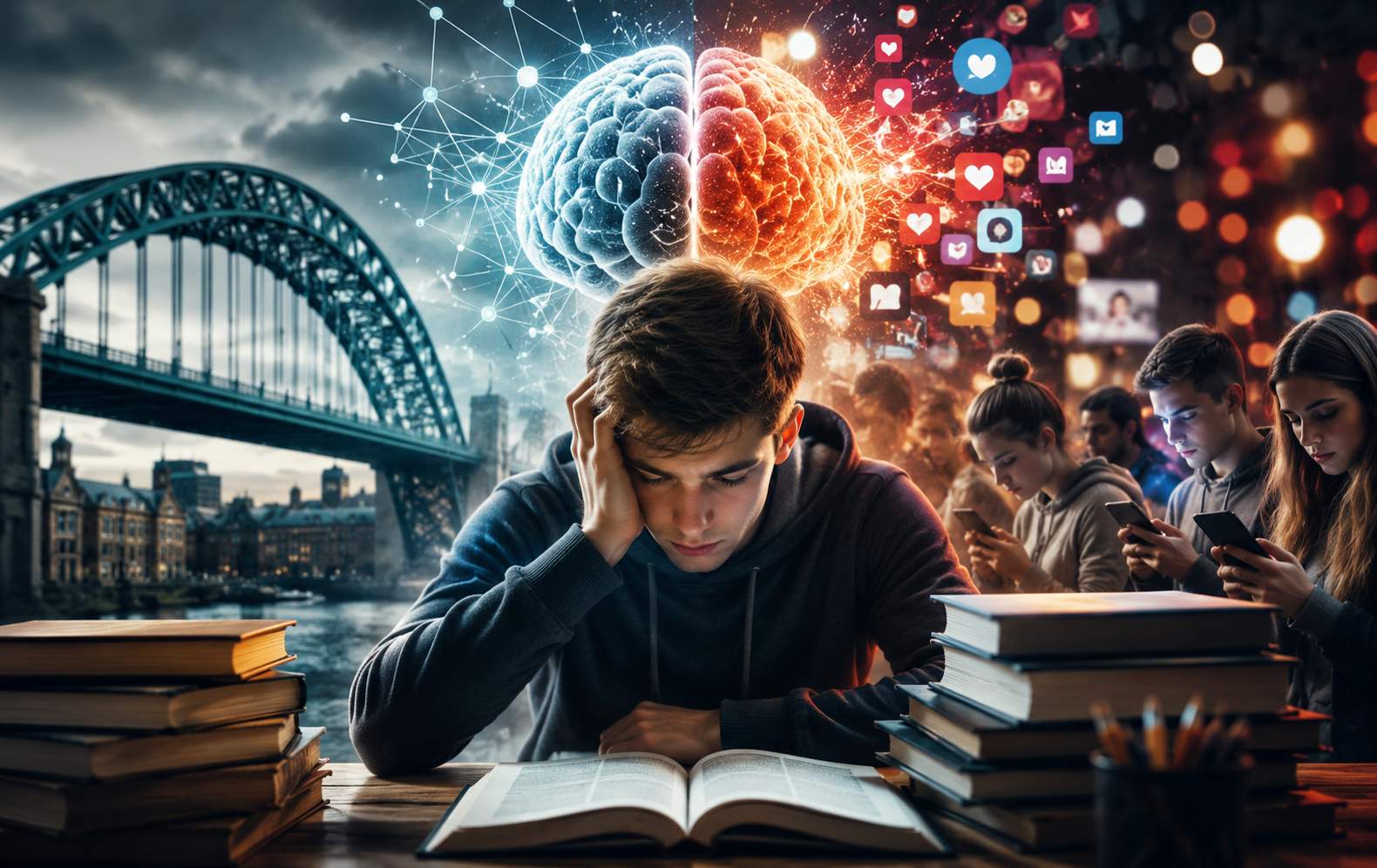
TikTok videos, Instagram reels and endless scrolling have fundamentally changed how people interact with information. Studies have suggested that constant exposure to fast-moving digital content may reduce attention spans and encourage surface-level engagement rather than deeper understanding.
Many Newcastle residents will recognise this trend in daily life. Whether on public transport, in cafes or walking through the city centre, people spend increasing amounts of time glued to screens.
Technology itself is not inherently harmful. It provides access to knowledge on a scale unimaginable a generation ago. The challenge lies in how that knowledge is consumed.
Knowing a fact instantly through a search engine is not the same as understanding it, questioning it or applying it effectively.
Why Newcastle Matters In This Debate.
Newcastle offers a fascinating case study because it combines world-class educational institutions with some of the socioeconomic challenges facing modern Britain.
Newcastle University and Northumbria University attract students from around the globe and contribute significantly to research, innovation and skills development. At the same time, parts of the city continue to face issues linked to deprivation, health inequalities and educational disadvantage.
Data from local and national sources show that outcomes can vary dramatically between neighbourhoods. This suggests that intelligence and educational success are influenced heavily by environment, opportunity and social conditions rather than any decline in human capability.
In other words, the issue may be less about people becoming less intelligent and more about unequal access to the conditions that help intelligence develop.
Are We Measuring Intelligence The Wrong Way?
Another important question is whether traditional measures of intelligence still reflect modern reality.
Today's young people can navigate complex technologies, manage multiple streams of information simultaneously and adapt quickly to changing digital environments.
Those skills did not exist in previous generations.
A teenager who struggles with handwriting or mental arithmetic may still possess advanced technological abilities that would have seemed extraordinary twenty years ago.
This raises an uncomfortable possibility. Perhaps intelligence itself has not declined. Instead, society may be experiencing a mismatch between old methods of measuring ability and the realities of modern life.
However, critics argue that digital skills should not come at the expense of reading comprehension, reasoning ability and critical thinking. These remain essential foundations for success in education, employment and civic life.
What Happens Next?
The debate over whether people are getting dumber is unlikely to disappear anytime soon.
For Newcastle, the bigger question may be how the city ensures future generations have the skills needed to thrive. That means addressing educational inequalities, supporting literacy, encouraging critical thinking and helping young people navigate an increasingly digital world.
The evidence suggests that intelligence itself is not disappearing. Yet there are genuine concerns about how people engage with information, develop knowledge and maintain concentration in a fast-moving technological age.
Whether the root cause is education failure, societal influence or a combination of both, the conversation is one that Newcastle cannot afford to ignore.
What do you think is the biggest factor affecting intelligence and learning in Newcastle today?
Lifestyle News
Why More People Think Society Is Getting Dumber
Advertisement





Comments (0)
You must be logged in to post comments.
Don't have an account? Register here
No comments yet. Be the first to share your thoughts!