
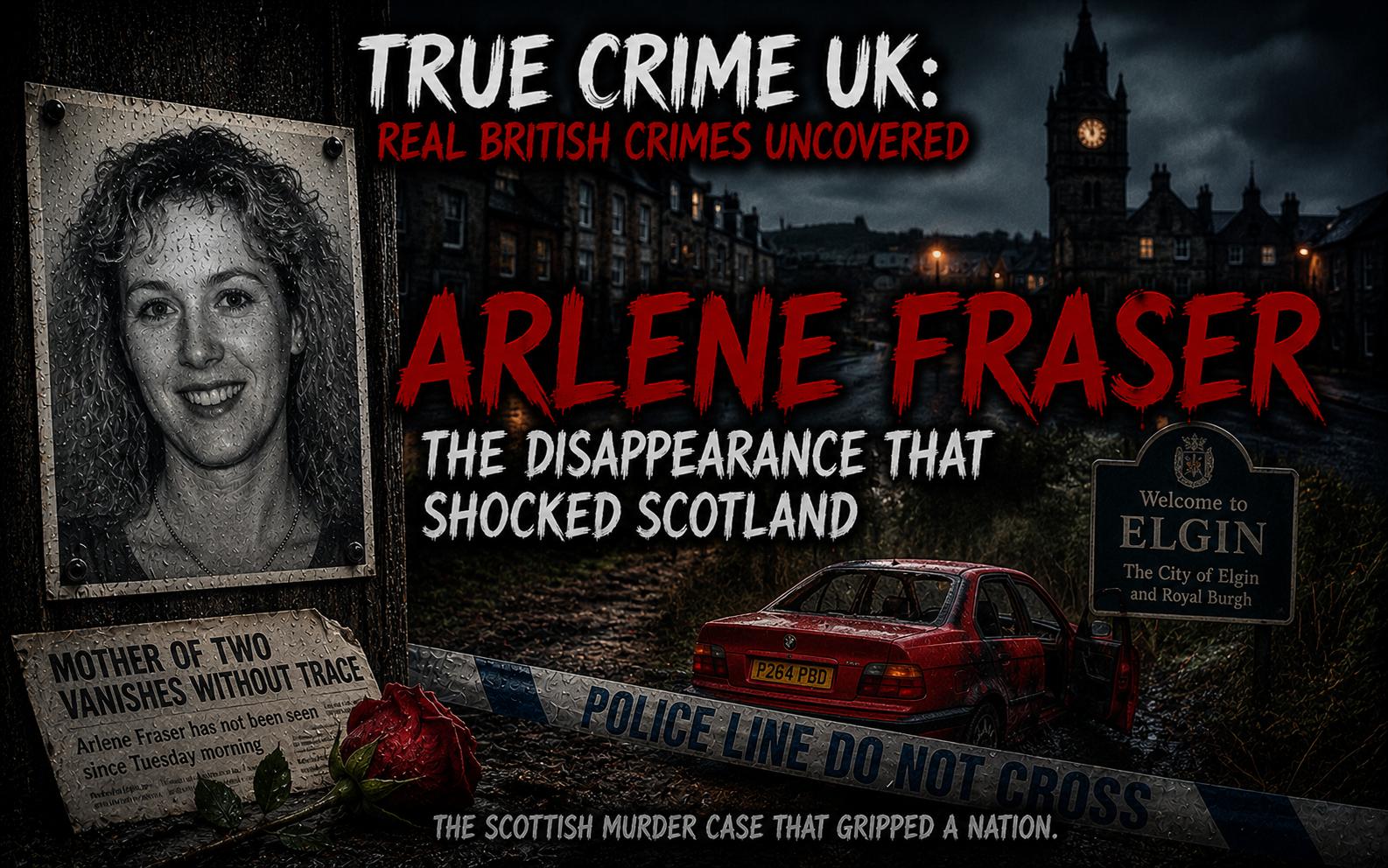
On a cold spring morning in April 1998, 33-year-old Arlene Fraser vanished from the quiet Scottish town of Elgin without a trace. At first, her disappearance appeared mysterious but not necessarily sinister. Friends and family hoped she had simply left to clear her head after ongoing marital difficulties.
But as days turned into weeks, and weeks into years, investigators became convinced something far darker had happened.
The Arlene Fraser case would eventually become one of the most high-profile murder investigations in Scottish criminal history. Despite the absence of a body, police believed Arlene had been murdered, and suspicion quickly centred on her husband, Nat Fraser.
What followed was a legal saga involving covert surveillance, dramatic trials, appeals, allegations of conspiracy, and one of the most haunting unsolved disappearances Britain has ever seen.
More than two decades later, the mystery surrounding what happened to Arlene Fraser continues to fascinate true crime readers across the UK.
Who Was Arlene Fraser.
Arlene Fraser was widely described as a warm, caring, and fiercely devoted mother. Friends said she was deeply involved in her children’s lives and maintained close relationships with relatives throughout Moray.
Born and raised in Scotland, Arlene built a stable life in Elgin with her husband Nat Fraser and their two sons. Outwardly, the family appeared relatively ordinary, but beneath the surface serious tensions had reportedly been developing for years.
Those close to Arlene later claimed she had grown increasingly unhappy in her marriage. Friends alleged she felt trapped and emotionally exhausted by constant arguments and controlling behaviour within the relationship.
In the months before she vanished, Arlene reportedly discussed the possibility of separating from her husband permanently.
Investigators would later believe those conversations may have placed her in grave danger.
The Morning Arlene Fraser Vanished.
Arlene Fraser disappeared on April 28, 1998, after dropping her two young children off at school in Elgin, Moray.
Witnesses later confirmed seeing her driving her distinctive red BMW shortly after the school run. But after that morning, she was never seen again.
Almost immediately, loved ones sensed something was wrong.
Arlene was known as a devoted mother who remained closely connected to her family and friends. She had made plans for the future, and there was no indication she intended to walk away from her children or disappear voluntarily.
Her handbag, personal belongings, and everyday possessions remained untouched.
Police launched a missing persons investigation, but concern escalated rapidly when officers discovered signs suggesting Arlene’s disappearance may not have been voluntary.
As investigators examined her personal life, attention quickly turned toward her troubled marriage.
A Marriage Under Strain.
By the time Arlene vanished, her relationship with husband Nat Fraser had reportedly deteriorated badly.
Friends later described constant arguments, emotional tension, and allegations of controlling behaviour within the marriage. Arlene had allegedly confided in several people that she feared for her future and was considering separation.
Investigators also uncovered evidence suggesting Nat Fraser had become increasingly angry over the breakdown of the relationship.
According to police, financial disputes and jealousy may have fuelled growing resentment inside the household.
Several witnesses later claimed Fraser struggled to accept the possibility of losing control over the family dynamic. Prosecutors would eventually argue this frustration developed into murderous intent.
As detectives pieced together the couple’s final weeks together, suspicions surrounding Nat Fraser intensified.
Then investigators discovered something even more concerning.
The Discovery of the Burned BMW.
Just days after Arlene disappeared, her red BMW was found abandoned and partially burned in a remote woodland area near Elgin.
The discovery marked a major turning point in the investigation.
Forensic teams examined the vehicle carefully and concluded the fire had likely been started deliberately in an apparent attempt to destroy evidence. Although the blaze damaged much of the interior, investigators believed the vehicle had been moved after Arlene vanished.
The scene deeply disturbed detectives.
Abandoned cars linked to missing persons cases often suggest attempts to conceal crimes, and officers increasingly suspected Arlene had been murdered.
Investigators spent countless hours examining the surrounding woodland, searching for footprints, fibres, discarded items, or signs of a struggle.
Despite extensive searches across woodland, rivers, and remote Scottish countryside, no trace of Arlene herself was ever found.
The absence of a body would become one of the defining challenges of the entire case.
The Investigation Begins to Narrow.
As police focused attention on Nat Fraser, detectives began building what would become an enormous circumstantial case.
Investigators examined Fraser’s movements before and after Arlene’s disappearance, interviewed friends and associates, and carried out extensive surveillance operations.
One of the most dramatic moments in the investigation came when police secretly recorded conversations involving Fraser and alleged associates. Prosecutors later claimed Fraser had attempted to arrange the murder and disposal of Arlene through criminal contacts.
Police believed the killing had been carefully planned.
According to prosecutors, Arlene was likely attacked shortly after returning home on the morning she disappeared. Although the precise details were never established publicly, investigators believed her body had been removed and hidden somewhere remote.
The lack of physical remains complicated the case enormously.
Without a body, prosecutors faced the difficult challenge of proving murder beyond reasonable doubt.
Still, investigators remained convinced Arlene Fraser would never return alive.
The Emotional Toll on Arlene’s Family.
As the years passed without answers, the emotional devastation suffered by Arlene’s family became painfully clear.
Her parents and siblings repeatedly appealed for information, urging anyone with knowledge about her disappearance to come forward. Media interviews often revealed the exhaustion and heartbreak caused by years of uncertainty.
For Arlene’s children, the loss was especially tragic.
They were forced to grow up in the shadow of one of Scotland’s most notorious murder investigations, surrounded by constant media attention and legal battles.
Family members described birthdays, holidays, and anniversaries as deeply painful reminders of the absence left behind.
The fact Arlene’s body was never recovered only intensified the grief.
Without a grave to visit or definitive answers about her final moments, loved ones remained trapped in a state of emotional limbo.
The First Trial.
In 2003, five years after Arlene vanished, Nat Fraser stood trial accused of her murder.
The proceedings attracted massive media attention across Scotland and the wider UK. Newspapers described the case as one of the country’s most complex and emotionally charged murder investigations.
During the trial, prosecutors argued Fraser orchestrated the murder because he could not accept the collapse of his marriage.
Jurors heard evidence regarding Fraser’s alleged controlling behaviour, suspicious activity after Arlene disappeared, and attempts to destroy evidence linked to the BMW.
The prosecution also claimed Fraser had discussed plans involving violence against Arlene before her disappearance.
Witness testimony painted a picture of a deeply fractured relationship filled with resentment and tension.
Despite the absence of a body, the jury ultimately found Nat Fraser guilty of murder.
He was sentenced to life imprisonment.
For Arlene’s family, the verdict brought some relief. However, major twists in the case still lay ahead.
The Appeal and Retrial.
In 2011, Scotland’s High Court overturned Fraser’s conviction after concerns emerged regarding undisclosed evidence during the original trial.
The decision stunned many people following the case.
Suddenly, one of Scotland’s most notorious murder convictions was thrown back into uncertainty.
A retrial was ordered, and prosecutors once again prepared to argue that Fraser had murdered his wife despite the continuing absence of her body.
The second trial began in 2012.
This time, prosecutors presented a more refined case focused heavily on Fraser’s alleged motive, suspicious behaviour, and witness testimony regarding the state of the marriage.
Once again, the jury convicted Nat Fraser of murdering Arlene.
He received another life sentence with a lengthy minimum term before parole eligibility.
Even after the second conviction, Fraser continued maintaining his innocence.
The Challenges of a “No Body” Murder Case.
One reason the Arlene Fraser case remains so heavily discussed within true crime circles is because it demonstrated the extraordinary difficulty of prosecuting murder without physical remains.
Traditionally, murder investigations rely heavily on forensic evidence recovered from a body. In Arlene’s case, prosecutors had to convince jurors using behaviour patterns, witness statements, circumstantial evidence, and investigative findings instead.
Legal experts closely followed both trials because the outcome had major implications for future Scottish murder prosecutions.
The successful convictions showed courts could still reach guilty verdicts even when no body was recovered, provided the surrounding evidence painted a compelling enough picture.
At the same time, critics argued the absence of definitive forensic proof left room for lingering doubt.
Those debates continue even today.
The Mystery of Arlene’s Body.
One of the most haunting aspects of the Arlene Fraser case remains the fact that her body has never been recovered.
Over the years, police carried out numerous searches across remote parts of Scotland, including woodland, coastal areas, and farmland connected to people linked to the investigation.
Despite these efforts, no confirmed trace of Arlene has ever been found.
The lack of physical remains continues to fuel public fascination with the case.
Some investigators believe her body may have been hidden permanently in isolated rural terrain. Others suspect additional individuals may have helped conceal evidence after the murder.
Without definitive answers, the mystery surrounding Arlene’s final moments remains unresolved.
For her family, the absence of a burial site has added another layer of pain to an already devastating tragedy.
Public Fascination With the Case.
The Arlene Fraser murder case continues attracting enormous interest among true crime audiences in the UK.
Part of the fascination comes from the extraordinary complexity of the investigation itself. Unlike many murder cases, the prosecution relied almost entirely on circumstantial evidence rather than forensic proof or eyewitness testimony.
The emotional nature of the story also deeply affected the Scottish public.
At its heart, the case involved a mother who vanished seemingly without warning, leaving behind two children and a family desperate for answers.
The repeated trials, appeals, and unanswered questions only intensified public attention over the years.
Documentaries, newspaper investigations, podcasts, and television crime programmes have repeatedly revisited the case, keeping Arlene Fraser’s story firmly within Britain’s true crime consciousness.
For many people, the mystery surrounding Arlene Fraser represents one of Scotland’s most haunting unsolved disappearances.
The Lasting Legacy of the Arlene Fraser Case.
Today, the disappearance of Arlene Fraser remains one of the most infamous true crime stories in British legal history.
Although Nat Fraser was convicted twice of her murder, significant questions surrounding the exact circumstances of Arlene’s death continue to linger.
The case also highlighted the challenges prosecutors face when pursuing so-called "no body" murder trials, where physical remains are absent but investigators believe overwhelming circumstantial evidence points to guilt.
More than twenty-five years later, Arlene Fraser’s disappearance still casts a long shadow across Scotland.
Her family continues hoping one day the final missing piece of the mystery will finally be uncovered.
For many true crime readers, the story remains deeply unsettling precisely because of what is still unknown. There is no confirmed crime scene, no recovered remains, and no complete explanation of what happened after Arlene vanished that April morning in 1998.
Yet despite those unanswered questions, investigators, prosecutors, and juries remained convinced that Arlene Fraser was the victim of a calculated murder.
The mystery surrounding her disappearance continues to endure as one of the darkest and most emotionally haunting cases in Scottish criminal history.
Do you believe enough evidence existed to convict Nat Fraser despite Arlene Fraser’s body never being found?
Crime News
Arlene Fraser Murder Case - The Disappearance That Shocked Scotland
Warning: This article contains discussion of abduction, murder, violence, and other themes that some of our readers may find distressing.
Advertisement



Comments (0)
You must be logged in to post comments.
Don't have an account? Register here
No comments yet. Be the first to share your thoughts!