
Boundary disputes are the classic example of a small problem that becomes an expensive one. Two neighbours who disagree about six inches of ground can spend more on legal fees than the entire garden is worth, and the resulting bad feeling frequently outlasts both of them.
Most of it is avoidable, and most of it comes from misunderstandings about a handful of rules that are not widely known.
Your deeds do not show the exact boundary.
This is the fundamental point that surprises almost everyone.
Land Registry title plans operate under what is called the general boundaries rule. The red line on the plan shows the general position of the boundary, not its precise legal location, and the plans are based on Ordnance Survey mapping at a scale where the line itself represents a significant width on the ground.
Measuring off a title plan to determine whether a fence is six inches out is therefore not evidence of anything. It is one of the most common causes of disputes that need not have started.
Determining an exact boundary requires either agreement between the neighbours, or an application to the Land Registry to determine the exact boundary, which requires a professional survey and is not cheap.
The T marks tell you who maintains what.
Older deeds and transfer documents frequently include T marks on the plan. A T drawn on one side of a boundary line indicates that the owner of that side is responsible for maintaining that boundary. An H shape, two Ts joined, indicates shared responsibility.
Where such marks exist, they are the best evidence of responsibility.
Where they do not, there is no general legal rule that you own the boundary on any particular side. The widely repeated belief that everyone is responsible for the fence on their left, or their right, or facing the road, has no basis in law whatsoever. It is a myth.
There is usually no obligation to fence at all.
Unless the deeds impose a positive obligation, a landowner is generally not required to erect or maintain a fence between properties.
That means a neighbour who removes a rotten fence and does not replace it is frequently within their rights, however unhelpful it may be. The remedy is to erect your own fence on your own land, entirely within your own boundary.
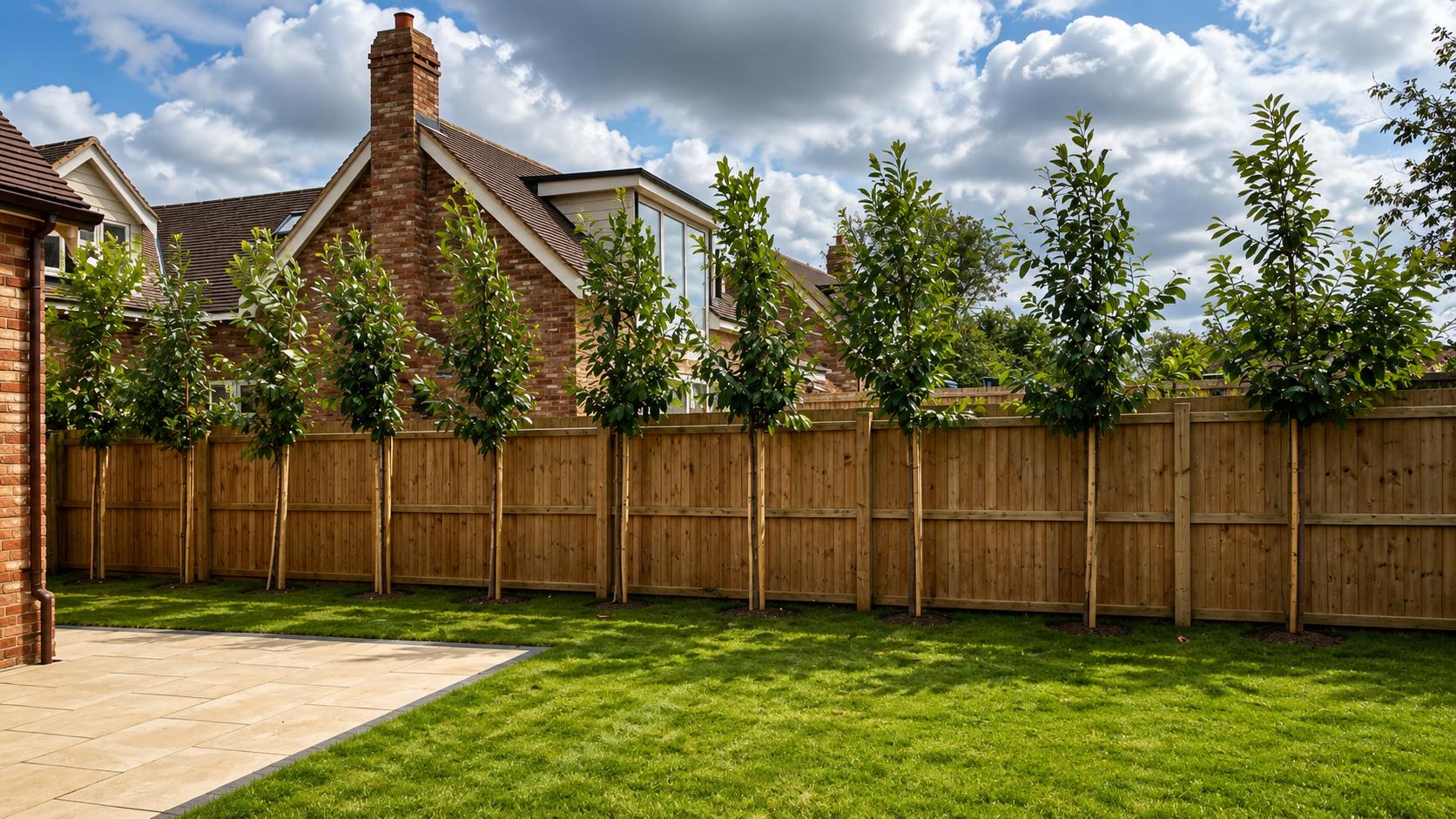
Fences erected without planning permission are limited in height. The general position is that a fence, wall or gate can be up to two metres high, reduced to one metre where it adjoins a highway used by vehicles, without planning permission. Listed buildings and conservation areas have additional restrictions.
Overhanging branches: you can cut, but there are conditions.
If branches from a neighbour's tree overhang your property, you are generally entitled to cut them back to the boundary line, without asking permission.
Three conditions apply. You may only cut back to the boundary and not beyond, so reaching over to prune the tree properly is not permitted. You must not enter the neighbour's land without permission to do it. And the cuttings, along with any fruit, remain the neighbour's property, so you should offer them back rather than disposing of them, and certainly should not throw them over the fence.
Roots follow the same principle, with the same caution that severing major roots can destabilise a tree, for which you could be liable if it then falls.
Critically, check first whether the tree is protected. A tree preservation order or a location within a conservation area means work requires consent from the council, and unauthorised work is a criminal offence carrying a substantial fine. This applies regardless of whose land the tree is on and regardless of the overhang.
High hedges have their own legislation.
The specific problem of a tall evergreen hedge blocking light has its own statutory remedy under anti-social behaviour legislation.
The provisions apply to a line of two or more evergreen or semi-evergreen trees or shrubs, over two metres in height, that acts as a barrier to light or access and adversely affects the reasonable enjoyment of a neighbouring property.
Deciduous hedges are not covered, nor is a single tree however large.
The council can be asked to intervene, but only after you have made genuine and documented attempts to resolve the matter with your neighbour first. There is a fee for a complaint, which can be substantial, and the council can issue a remedial notice requiring the hedge to be reduced, though it cannot require removal or a reduction below two metres.
Party walls are a separate regime.
Work affecting a shared wall, a boundary structure or excavation near a neighbour's foundations falls under party wall legislation, which requires formal notice to the adjoining owner before work begins.
Failing to serve notice does not stop the work being lawful in itself but leaves you badly exposed if damage occurs, and it is a common cause of expensive disputes during extensions and loft conversions.
How to avoid the whole thing.
Talk first, in person, before anybody instructs anybody. An enormous proportion of boundary disputes escalate because the first communication was a solicitor's letter.
Put agreements in writing, even informally, and keep photographs and dates.
Consider mediation, which is far cheaper than litigation and has a good success rate in neighbour disputes.
Remember that you have to declare disputes with neighbours when you sell, which affects both the sale and the price. That alone is a strong practical reason to settle rather than to win.
This article is general information rather than legal advice, and anyone facing a serious dispute should take proper advice from a solicitor or Citizens Advice.
Share your thoughts.
Have you had a boundary or hedge disagreement, and how did it end?
Lifestyle News
Hedges, Fences and Boundaries: The Neighbour Rules
Advertisement




Comments (0)
You must be logged in to post comments.
Don't have an account? Register here
No comments yet. Be the first to share your thoughts!