
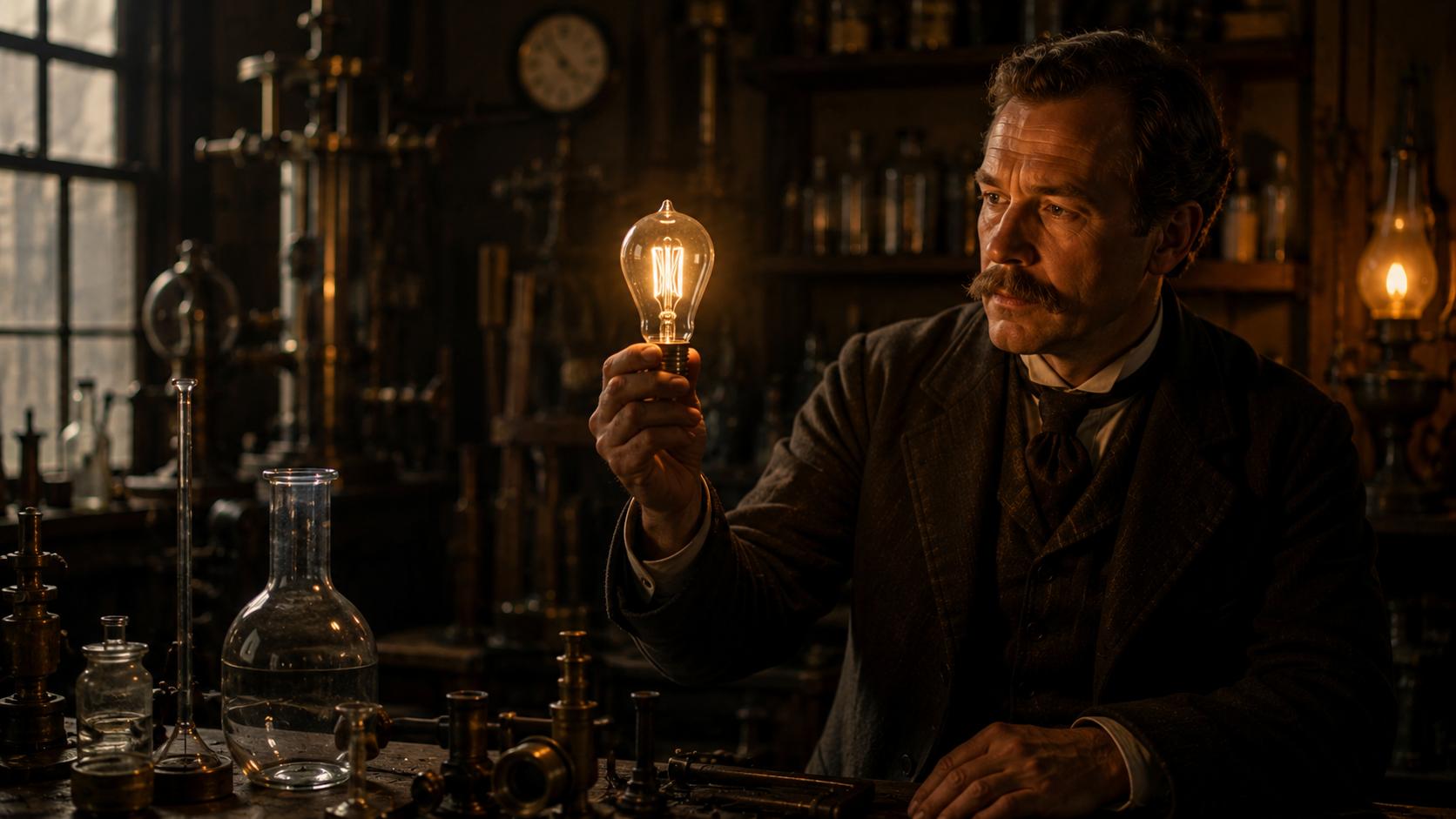
Every time you flick a switch and a room floods with light, you are using an invention that owes an enormous debt to the North East of England. Joseph Wilson Swan, a chemist working on Tyneside, was the man who developed the first practical incandescent electric light bulb, and in doing so he helped to light up the modern world. Thanks to his genius, Newcastle and the surrounding region became the setting for a remarkable string of electrical world firsts that still amaze people today.
A Chemist on Tyneside.
Joseph Swan was born in 1828 in Sunderland and moved as a young man to Tyneside, where he became a partner in a firm of manufacturing chemists in Newcastle. A brilliant and curious experimenter, Swan was fascinated by the problem of producing light by electricity, a challenge that had defeated inventors for decades. The difficulty was creating a filament that would glow brightly when an electric current passed through it without simply burning away in moments. Swan returned to the problem again and again over many years, combining his deep knowledge of chemistry with relentless persistence in his Tyneside laboratory.
The Quest for the Light Bulb.
The key to a workable light bulb lay in two things: a suitable filament and a good vacuum. Swan experimented for years with carbonised materials, eventually developing treated threads that could glow steadily inside a glass bulb from which the air had been removed. Improvements in vacuum technology finally allowed him to make a lamp that burned brightly and lasted, solving the puzzle that had frustrated so many before him. His work showed, for the first time, that electric lighting was not just a scientific curiosity but a genuinely practical proposition that could one day replace gas and candles in ordinary homes.
A Lecture That Changed History.
One of the most famous moments in Swan's story came at the Literary and Philosophical Society in Newcastle, the celebrated Lit and Phil. There, in early 1879, Swan demonstrated a working incandescent lamp to an audience of some seven hundred people, a spectacular public unveiling of the new technology. The Lit and Phil itself went on to become the first public building in the world to be lit by electric light, during a Swan lecture, an extraordinary distinction for a Newcastle institution. To the people who witnessed it, the steady, flickerless glow of Swan's lamp must have seemed almost magical after a lifetime of gaslight and candle flame.
The First Electric Street in the World.
Newcastle's connection to the dawn of electric light went even further. In 1880, Mosley Street in the city centre became the first public street anywhere in the world to be lit by incandescent electric lighting, a genuine global milestone achieved right in the heart of the city. It was a direct and dramatic challenge to the gas companies of the day, and a vivid demonstration of where the future lay. That a quiet Newcastle shopping street should hold such a place in the history of technology is a source of enormous and well-deserved local pride, even if many who walk along it today have no idea of its significance.
Cragside and a Factory of Firsts.
Swan's lamps soon found their way into some remarkable settings. In 1880 they were installed at Cragside, the Northumberland mansion of the industrialist Lord Armstrong, which became the first house in the world to be lit by hydroelectric power using Swan's bulbs. To meet the rapidly growing demand for his invention, Swan opened what is regarded as the world's first light bulb factory in the Benwell district of Newcastle in 1881, employing skilled glassblowers brought in from Germany alongside local workers. From this Tyneside base, the light bulb began its journey out into the wider world, transforming homes, streets, theatres and ships.
Swan, Edison and a Lasting Legacy.
Across the Atlantic, the American inventor Thomas Edison was working on his own version of the incandescent lamp at almost the same time, which led to a patent dispute between the two men. Rather than fight a costly legal battle, they sensibly joined forces, establishing the Edison and Swan United Electric Light Company, commonly known as Ediswan. While Edison is often the name most people remember, Swan's contribution was fundamental, and the Tyneside chemist is rightly honoured as a co-inventor of the device that banished the darkness. From the Lit and Phil to Mosley Street and beyond, Newcastle can claim a genuine and glorious place in the story of how the world first learned to switch on the light.
A Name Remembered in the City.
Joseph Swan's connection to Newcastle is still marked across the city for those who know where to look. He was once a partner in the well-known firm of Mawson, Swan and Morgan, whose handsome premises stood on Grey Street, close to Grey's Monument, and his name lived on there for many decades. Plaques and memorials around the city centre commemorate his achievements, quietly reminding passers-by that a figure of world importance once worked these very streets. Swan was knighted for his contribution to science and received many honours in his lifetime, yet he remained, at heart, a careful and methodical experimenter rather than a self-promoter. It is partly for this reason that his name is less universally famous than that of his American counterpart, even though his role in the invention of the light bulb was absolutely fundamental. For the people of Tyneside, however, there is no doubt about his significance, and there is enormous pride in claiming Joseph Swan, and the very dawn of electric light, as part of the region's extraordinary story of innovation.
Have your say.
Let us know what you think in the comments, as we read every single one, and tell us if you knew Newcastle could claim so many electric world firsts.
Were you aware that the first street in the world lit by electric light was right here in Newcastle?
Newcastle History
Joseph Swan: How Newcastle Lit Up the World
Sunderland-born chemist Joseph Swan invented the practical incandescent light bulb on Tyneside, making Newcastle the home of a string of electric world firsts, including the first street ever lit by electric light.
Advertisement

Comments (0)
You must be logged in to post comments.
Don't have an account? Register here
No comments yet. Be the first to share your thoughts!