
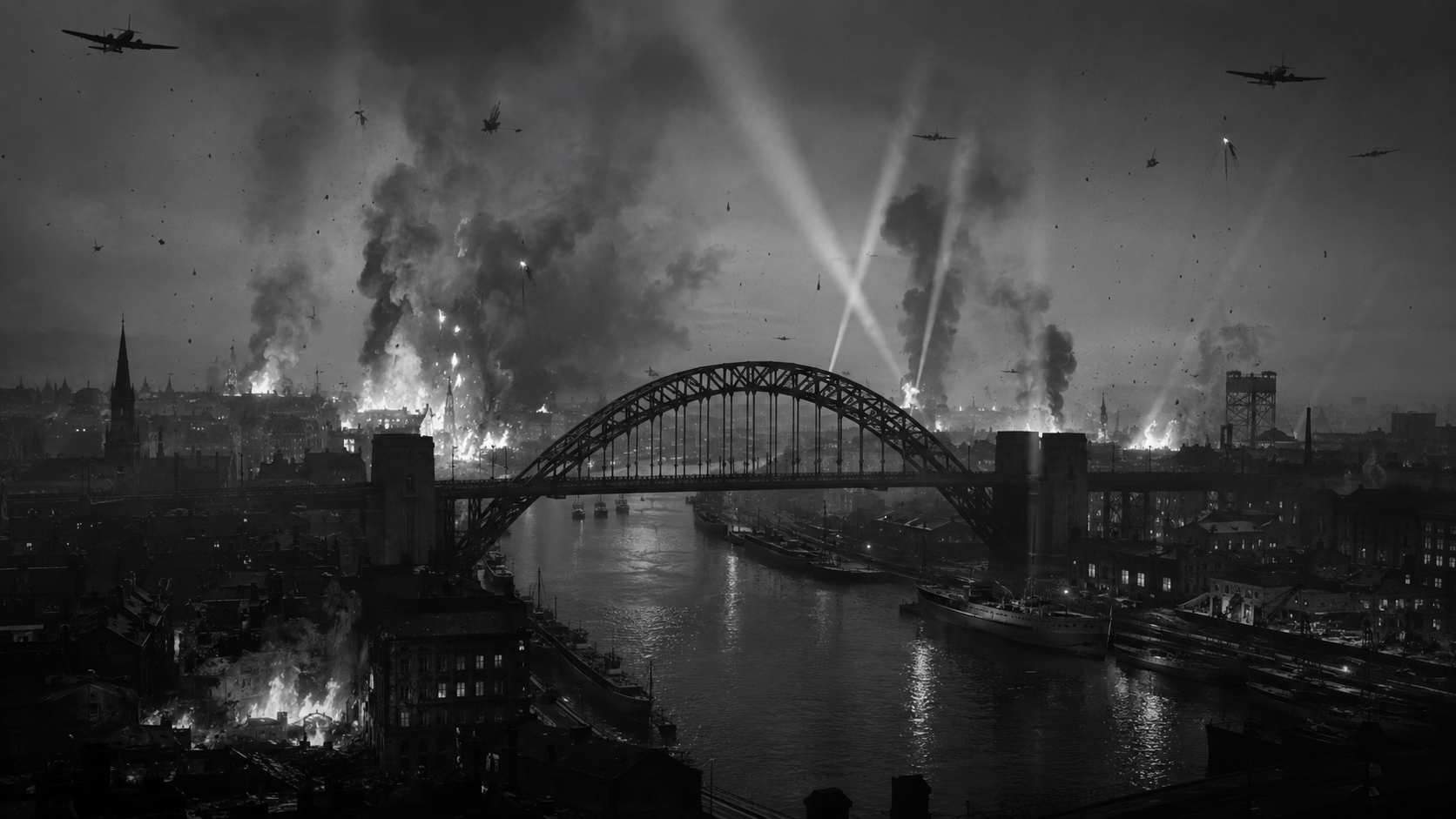
Newcastle upon Tyne is remembered around the world for its engineering, coal trade and shipbuilding heritage. During the Second World War, however, those same strengths placed the city and surrounding communities directly in the sights of German bombers.
Factories along the Tyne produced weapons, ships and other materials needed by Britain’s armed forces. The river also provided access to important docks, while Newcastle’s railway connections helped move workers, equipment and supplies around the country. Attacking Tyneside offered Germany an opportunity to damage several parts of Britain’s war effort at once.
The resulting Newcastle Blitz never received the same national attention as the destruction of London or Coventry, but its consequences were deeply felt. Families lost relatives, homes disappeared overnight and familiar streets were transformed by fire and high explosives.
Newcastle’s industry made it a target.
Newcastle and the wider Tyneside area formed one of Britain’s most important industrial centres. Shipyards, engineering works, steel production and coal shipments all contributed to the national economy and military supply network.
Potential targets included the docks, rail facilities, river crossings and large industrial sites such as the Vickers Armstrong works at Elswick. Shipyards further along the Tyne were also at risk because they constructed and repaired naval vessels.
The spread of industry across Newcastle, Wallsend, North Shields, South Shields and Gateshead made the area difficult to disable with one concentrated attack. It also meant that many residential neighbourhoods stood close to factories, railway yards and transport routes. Even when bombers were aiming for industrial infrastructure, nearby families faced an immediate threat.
Thousands left Newcastle before the raids.
Preparations began before Britain formally entered the war. According to a Newcastle Local Studies factsheet, 31,222 Newcastle schoolchildren were evacuated on 1 September 1939. Another 12,818 mothers and younger children left the following day.
For many families, evacuation meant a hurried goodbye at a railway station and an uncertain journey to rural Northumberland, Cumbria or another area considered less vulnerable. Some children returned when the expected bombing failed to begin immediately, but the changing military situation soon made the danger more apparent.
A second evacuation programme started on 7 July 1940, when another 4,300 Newcastle schoolchildren departed by train. By then, the first major raid had already demonstrated that the North East would not escape the conflict.
The first major bombs fell in July 1940.
On 2 July 1940, German aircraft carried out a major afternoon attack involving Newcastle and Jarrow. The High Level Bridge was believed to be one of the intended targets, but the nearby Spillers factory was hit.
Local records state that 13 people were killed and 123 were injured. The attack ended any lingering belief that distance from southern England might protect Newcastle from the Luftwaffe.
Further bombs fell on 18 July, killing three people and damaging Heaton Secondary School. A larger attack followed on 15 August as German aircraft targeted locations across the North East. Air-raid warnings, blackout curtains and journeys into public or household shelters became familiar parts of Newcastle life.
The raids intensified during 1941.
The bombing became more destructive in 1941. On the night of 9 and 10 April, more than 50 German aircraft caused widespread damage around Newcastle. Fires required the assistance of 300 troops, while homes, schools and St Michael’s Roman Catholic Church were among the buildings affected.
Another devastating raid began at about 9.45pm on 25 April. Nine high-explosive bombs, numerous incendiaries and a parachute mine fell on areas including Shields Road, Jesmond Vale, Heaton Park, Grace Street, Heaton Road and Guildford Place.
The official local history account records 47 deaths, with 23 people seriously injured and another 47 suffering lesser injuries. Sixteen homes and shops were demolished, while approximately 300 properties were damaged. For residents of Heaton and neighbouring districts, the destruction was not a distant piece of military strategy. It was a disaster unfolding in their streets.
September brought one of Newcastle’s worst raids.
One of the most destructive nights of the Newcastle Blitz came on 1 September 1941. Between 10pm and midnight, around 100 bombs fell across Shieldfield, Jesmond, Byker, St Peter’s, Walker and New Bridge Street.
New Bridge Street Goods Station was set on fire and continued burning for a week. The size of the blaze demonstrated how quickly attacks on transport and industrial infrastructure could threaten surrounding neighbourhoods.
Figures held by Newcastle Local Studies record 50 deaths, 71 serious injuries and 140 people with less serious wounds. An estimated 1,000 residents were left homeless in that raid alone.
Those numbers offer only a partial picture of the night. Survivors also faced lost possessions, separation from relatives and the difficulty of finding somewhere to live while wartime shortages were already affecting daily life.
Newcastle responded through civil defence.
Air-raid precautions depended on thousands of residents, wardens, firefighters, medical staff, soldiers and volunteers. Rescue teams searched unstable buildings, while emergency workers dealt with unexploded devices and fires.
Newcastle introduced a communal feeding scheme in October 1940 to support people made homeless by bombing. Temporary accommodation, food distribution and donated clothing helped families who had escaped with little more than what they were wearing.
The Royal Family toured Tyneside’s shipyards and armament factories in June 1941. Winston Churchill visited the region later that year, inspecting industrial sites and bomb-damaged communities. These visits reflected Tyneside’s continuing national importance despite the attacks.
The final major attack came in December.
The last substantial raid of 1941 struck between 8pm and 9pm on 29 December. Ten bombs fell around Holderness Road, Byker and Matthew Bank. Nine people were killed, 16 were seriously injured and 64 suffered minor injuries.
Smaller attacks continued later in the war, but the most concentrated period of bombing had passed. Its physical legacy remained visible in cleared sites, repaired buildings and the urgent demand for replacement housing.
The Newcastle Blitz is now beyond living memory for many families, yet its mark remains part of the city’s story. Remembering it means looking beyond aircraft and military targets to the residents who entered shelters, fought fires, treated casualties and rebuilt their lives.
Share your experience.
Does your family have photographs or memories connected to the Newcastle Blitz?
Newcastle History
Newcastle at War: Inside the Forgotten WWII Blitz
Advertisement


Comments (0)
You must be logged in to post comments.
Don't have an account? Register here
No comments yet. Be the first to share your thoughts!