
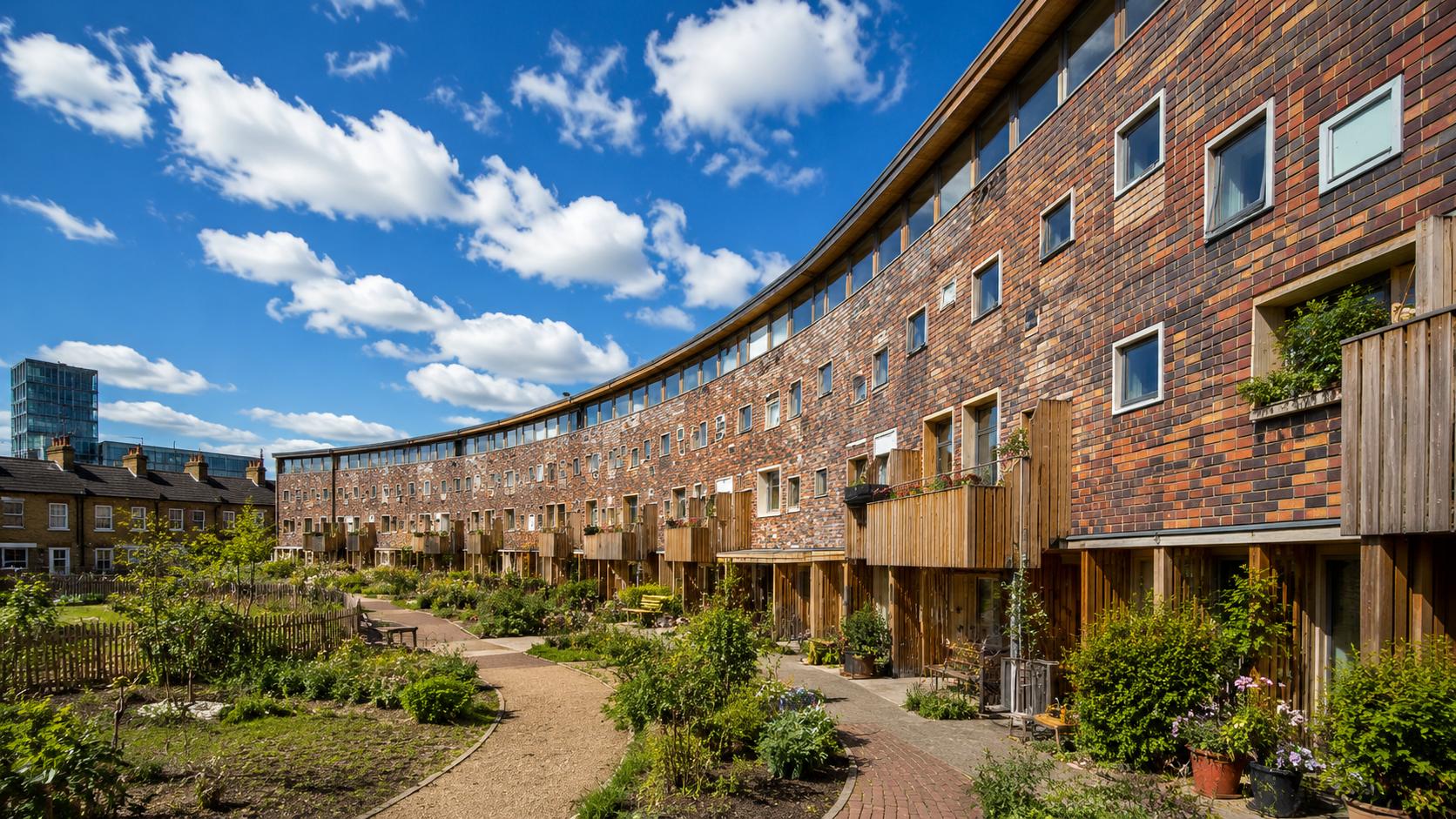
Snaking across the east end of Newcastle is one of the most remarkable and internationally admired pieces of architecture in the whole city. The Byker Wall is a vast, undulating block of homes, painted in cheerful colours, that has become a celebrated landmark of modern social housing. Bold, controversial and genuinely groundbreaking, the Byker Wall and the estate it shelters tell a fascinating story about community, design and the changing face of the city.
Replacing the Old Terraces.
By the middle of the twentieth century, the Victorian terraced housing of Byker had fallen into serious decline. Much of it had been condemned as unfit for human habitation, and it was clear that the area needed wholesale redevelopment. The challenge was how to rehouse a large, close-knit working-class community without destroying the bonds and sense of belonging that held it together. The answer that emerged would prove to be one of the most ambitious and thoughtful housing schemes of its age, and one that would attract attention from around the world.
A Wall Against a Motorway.
One of the most distinctive features of the design has a very practical origin. A major road, even a motorway, had been planned to run alongside the estate, and the long, high block that gives the Byker Wall its name was designed in part to act as a shield, protecting the lower-rise homes behind it from traffic noise and the cold winds off the river. Although the planned road was ultimately never built, the great curving wall remained as the dramatic centrepiece of the scheme. Its serpentine form, winding across the landscape, is utterly unlike the rigid tower blocks that dominated so much housing of the era.
Ralph Erskine's Vision.
The estate was the creation of the architect Ralph Erskine, working with his colleague Vernon Gracie, and it was designed and built across the 1960s, 1970s and into the early 1980s. Erskine rejected the cold, uniform, high-rise approach that was fashionable at the time, instead favouring lower-rise, high-density housing with warmth, colour and character. The result was a development described as Functionalist Romantic, full of textured facades, timber balconies, varied rooflines and bright, welcoming colour. It represented a genuine and deliberate break with the architectural orthodoxy of its day.
Building With the Community.
What truly set the Byker scheme apart was its pioneering approach to involving the people who would live there. Erskine famously set up an office right in the heart of the area, so that his team could communicate directly with residents and build trust. The redevelopment was carefully phased to help keep the existing community together as much as possible, and a number of old, familiar buildings such as churches and baths were deliberately retained to provide points of reference and continuity. This commitment to consultation and to preserving community ties was remarkably ahead of its time.
Colour, Character and Acclaim.
The finished estate, with its colourful brickwork, its gardens and its human scale, won admiration far beyond Newcastle. It collected a string of awards and was recognised internationally as a landmark in the design of social housing, even being placed on a list of outstanding twentieth-century buildings. Not everyone has loved it, and like all bold architecture it has had its critics, but its influence on housing design across Europe has been profound. The Wall demonstrated that public housing could be imaginative, colourful and genuinely pleasant to live in, rather than bleak and uniform.
A Listed Landmark.
In recognition of its significance, the Byker estate was granted listed status in 2007, with the listing praising its groundbreaking design and its pioneering model of public participation. This protection has helped secure the future of a place that is both a working community and a celebrated work of architecture. Today the Byker Wall remains home to thousands of people, its bright colours and flowing form continuing to surprise and delight visitors who come across it. It stands as proof that Newcastle has not only a proud industrial heritage but also a bold and forward-looking story to tell in the realm of modern design.
Lessons for Modern Housing.
The Byker Wall continues to fascinate architects, planners and students of housing from around the world, precisely because it tried to answer questions that remain urgent today. How do you rehouse a community without destroying it. How do you build at high density while keeping homes humane, welcoming and full of light. How do you involve ordinary residents in decisions about the places they will live. Erskine's answers, with their emphasis on consultation, colour, variety and human scale, offered a powerful alternative to the bleak uniformity of so much post-war housing, and they still feel strikingly relevant. The estate has not been without its challenges over the years, and like any large development it has needed care, investment and refurbishment to keep it in good order. Yet the fact that it remains a sought-after place to live, decades after it was built, is perhaps the clearest possible measure of its success. For all the debates it has provoked, the Byker Wall demonstrated that imagination and humanity have a place in social housing, and that the homes ordinary people live in deserve every bit as much thought and creativity as grander and more celebrated buildings.
Get involved.
Leave a comment with your own take and pass this story on to someone who would enjoy it, particularly if you have ever lived in or visited the Byker estate.
Do you think the Byker Wall is a masterpiece of design or simply a bold experiment?
Newcastle History
The Byker Wall: Newcastle's Bold Estate
Ralph Erskine's Byker Wall is one of the most celebrated pieces of modern social housing in Britain, a colourful, curving landmark built with its community and now protected as a listed building.
Advertisement


Comments (0)
You must be logged in to post comments.
Don't have an account? Register here
No comments yet. Be the first to share your thoughts!