
Few pieces of animal legislation have provoked as much argument as the addition of the XL bully to the list of prohibited dog types in England and Wales. Owners describe well-behaved family pets subject to blanket restriction, campaigners point to a series of serious and fatal attacks, and both sides can produce evidence that supports their position.
Whatever view you take, the law is now in force and the consequences of getting it wrong are severe. Owners in Newcastle who are unclear about their obligations are risking prosecution and, in the worst case, the destruction of their dog.
It is a type, not a breed.
This is the point that causes the most confusion and the most distress. The legislation does not work by pedigree or paperwork. It works by conformation, meaning that a dog is assessed against a published standard describing physical characteristics including height, build, head shape and musculature.
A dog can therefore be caught by the definition regardless of what its parents were called, what a breeder said, or what is written on a receipt. Conversely a dog marketed as an XL bully may fall outside the standard. What matters is whether the individual animal substantially conforms to the description.
That approach follows the model used for other prohibited types since the original dangerous dogs legislation, and it has always been controversial for exactly this reason. Owners cannot be certain from the outset, and the assessment is ultimately a matter for a court where it is disputed.
The restrictions came in two stages.
The first stage introduced restrictions on the dogs themselves. It became an offence to breed from them, to sell or exchange them, to advertise or gift them, or to abandon them. Dogs of the type were required to be kept on a lead and muzzled in public places.
The second stage made it an offence to own one at all without a certificate of exemption, and the window to apply for exemption closed at the end of January 2024. Owners who missed that deadline are in a genuinely difficult position and should take legal advice rather than hoping the matter goes away.
Scotland introduced equivalent rules on a later timetable, which created a period during which the position differed either side of the border and led to dogs being moved. Anyone acquiring or transporting a dog across the border should check the current position in both jurisdictions.
What exemption actually requires.
A certificate of exemption is not a one-off formality. It carries continuing obligations, and failure to maintain any of them can invalidate it.
The dog must be neutered, with deadlines that varied according to the dog's age at the time the rules came in. It must be microchipped and the details kept up to date. Third-party public liability insurance covering the dog must be held and maintained continuously, which in practice most owners achieve through membership of a scheme run by a national dog welfare organisation.
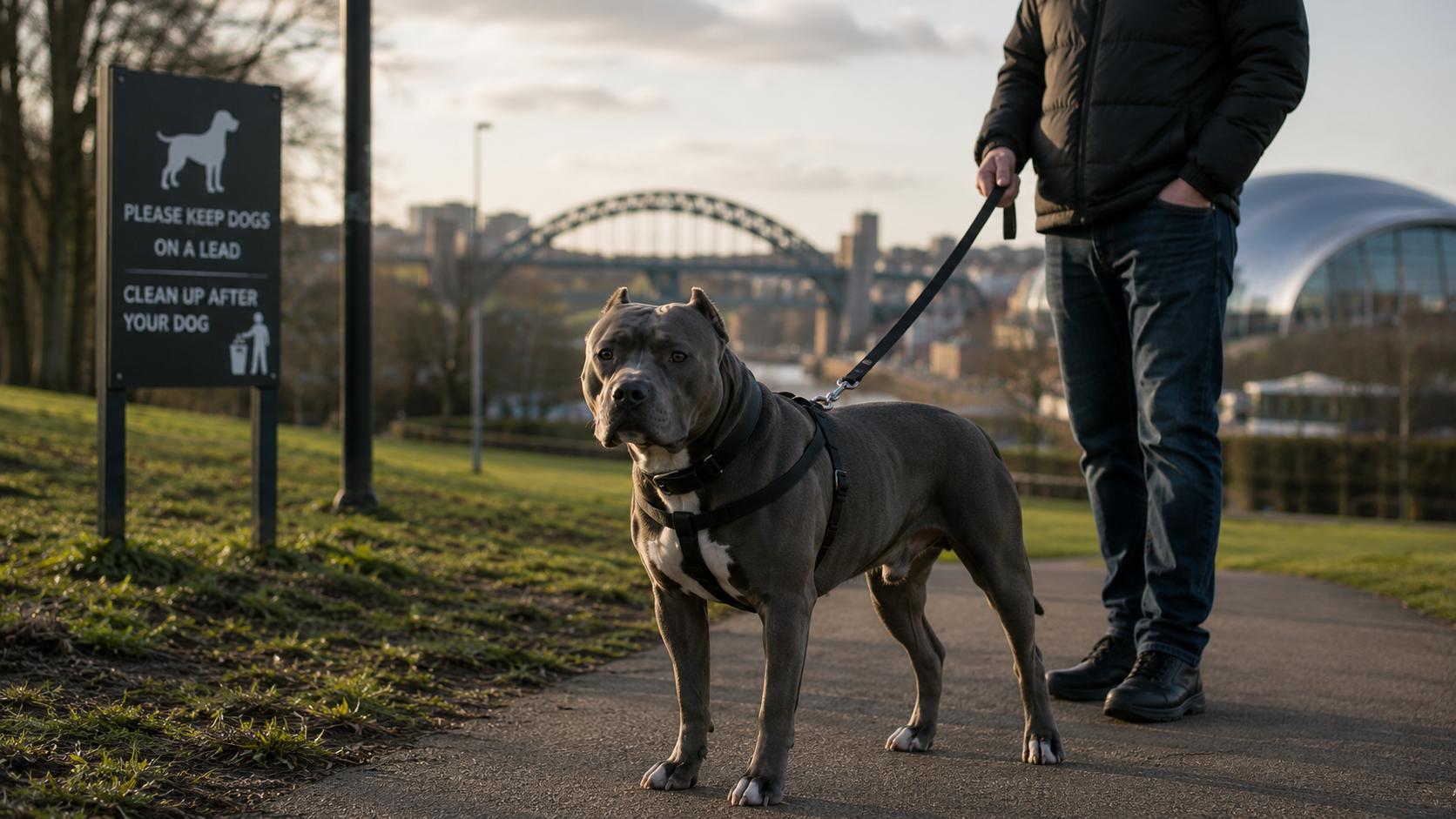
The keeper must be at least sixteen. The dog must be kept in secure conditions at home so that it cannot escape, and must be muzzled and on a lead whenever it is in a public place. That includes the street outside the house, communal areas of flats, and the inside of a vehicle in some circumstances.
Owners must notify the relevant authorities of changes of address, and of the death or export of the dog. The certificate must be produced to a police officer or council dog warden on request, or within a short period afterwards.
Muzzle training is not optional and takes time.
A dog that has never worn a muzzle will not tolerate one immediately, and forcing it produces a distressed animal that associates the muzzle with something unpleasant. Proper muzzle conditioning is a gradual process using a correctly fitted basket muzzle that allows panting, drinking and treat-taking.
A muzzle that prevents a dog from panting properly is dangerous in warm weather, because panting is how dogs regulate temperature. Fit matters as much as compliance.
What happens if a dog is seized.
Police can seize a dog they believe to be of a prohibited type. The dog may be kennelled while the matter is resolved, which can take months and is distressing for dog and owner alike.
Where the type is disputed, expert evidence about conformation becomes central. Where the dog is found to be of the type and is exempt and compliant, it should be returned. Where it is of the type and not exempt, the court has power to order destruction, though there is a route to a contingent destruction order allowing the dog to live subject to conditions where the court is satisfied it does not present a danger.
Owners in this position should get specialist legal advice immediately. There are solicitors who deal specifically with dangerous dogs legislation, and the outcome frequently depends on evidence prepared properly and early.
The wider law still applies to every dog.
It is worth remembering that the offence of allowing a dog to be dangerously out of control applies to all dogs of any breed, including in the owner's own home, and carries serious penalties where injury results.
Community protection notices and dog control orders can also be used by councils in response to problem behaviour regardless of breed, and the majority of dog-related enforcement in Newcastle has nothing to do with prohibited types at all.
Share your thoughts.
Is breed-specific legislation the right approach, or should the law focus entirely on owners and individual dog behaviour?
Crime News
XL Bully Rules: What Newcastle Dog Owners Must Do
Advertisement





Comments (0)
You must be logged in to post comments.
Don't have an account? Register here
No comments yet. Be the first to share your thoughts!