
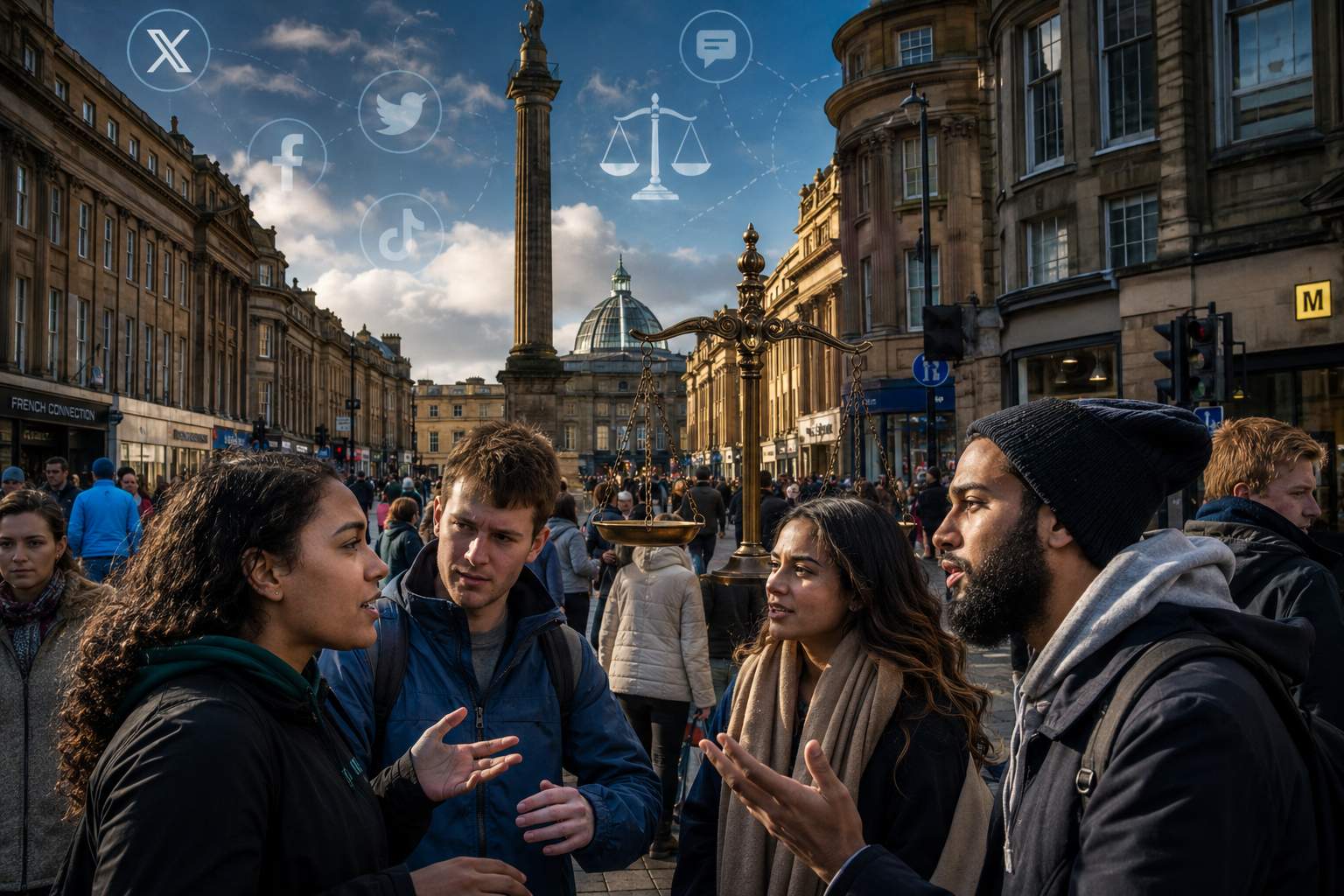
Freedom of speech is one of the most discussed and misunderstood rights in modern Britain. Social media debates, political arguments and high-profile court cases have led many people to believe that freedom of speech means they can say whatever they like without restrictions.
The reality is far more complicated.
Across the UK, including cities such as Newcastle upon Tyne, people regularly debate where free expression ends and where the law begins. While the UK protects freedom of expression through legislation and human rights law, there are also clear legal boundaries around certain types of speech.
One of the biggest misconceptions is that freedom of speech guarantees freedom from consequences. In reality, the law, employers, educational institutions and even the public can respond to speech in various ways, depending on the circumstances.
Understanding what the law actually says can help people avoid legal trouble while also protecting their right to express opinions.
Freedom Of Speech Is Protected In The UK.
The UK does not have a written constitution like the United States, but freedom of expression is protected through Article 10 of the Human Rights Act 1998.
This gives individuals the right to hold opinions and express ideas without interference from public authorities. However, Article 10 is not absolute. The law allows restrictions when they are necessary to protect public safety, national security, public order, the rights of others or the prevention of crime.
This means that while people have a legal right to express opinions, that right can be limited when speech crosses certain legal thresholds.
For many people, this is where confusion begins.
Myth One: You Can Say Anything You Want.
One of the most common misconceptions is that freedom of speech means there are no limits.
In reality, several categories of speech can result in criminal investigations or prosecution.
Examples include:
Threatening violence.
Encouraging terrorism.
Harassment.
Malicious communications.
Certain forms of hate crime.
Incitement to racial or religious hatred.
Defamation in civil courts.
Communications deemed grossly offensive in specific circumstances.
The law does not criminalise speech simply because it is unpopular or controversial. However, speech that threatens, intimidates or unlawfully targets others can fall outside legal protections.
This distinction is often lost during heated online discussions.
Myth Two: Hate Speech Is Always Legal Because It Is An Opinion.
Many people believe that opinions are automatically protected regardless of how they are expressed.
The reality is that UK law distinguishes between expressing an opinion and committing a criminal offence.
For example, legislation including the Public Order Act contains offences relating to incitement of racial hatred. Courts examine context, intent and the likelihood of harm when assessing such cases.
Police recorded approximately 115,990 hate crimes in England and Wales during the year ending March 2025, excluding Metropolitan Police figures. Race-related offences remained the largest category, accounting for the majority of recorded hate crimes.
The Crime Survey for England and Wales also estimated around 176,000 hate crime incidents annually, indicating that many incidents may never be formally reported to police.
These figures demonstrate why lawmakers continue to balance free expression against protecting individuals from targeted abuse and intimidation.
Myth Three: Online Posts Are Not Subject To The Same Laws.
The rise of social media has created another widespread misunderstanding.
Many people assume comments posted online carry fewer legal risks than statements made in public.
In reality, the internet has become one of the primary areas where speech-related offences are investigated.
The Communications Act 2003 and the Malicious Communications Act 1988 both contain provisions that can apply to threatening, obscene or grossly offensive messages sent electronically.
Recent reporting based on police data found that more than 12,000 arrests were made annually under communications legislation covering offensive or malicious messages, equating to roughly 30 arrests per day across participating police forces.
While many of these cases do not result in conviction, they highlight the growing focus on online behaviour and digital communications.
For residents in Newcastle and across the North East, this serves as a reminder that social media activity is not exempt from legal scrutiny.
Freedom Of Speech Does Not Mean Freedom From Consequences.
Perhaps the most misunderstood aspect of free speech is the difference between government censorship and social consequences.
Freedom of speech protects individuals from unlawful restrictions by public authorities. It does not guarantee protection from criticism, disagreement or reputational damage.
For example:
Employers may discipline staff whose public comments breach workplace policies.
Businesses may terminate commercial relationships.
Social media platforms can remove content that violates their terms.
Members of the public may choose to criticise or boycott individuals.
These responses are often described as consequences rather than restrictions on free speech.
A person may have the right to express an opinion, but others also have the right to respond to that opinion.
This distinction is central to many modern debates surrounding free expression.
Newcastle's Place In The National Conversation.
Newcastle has long been known for its strong civic identity, passionate political discussions and active community engagement.
From city council debates to discussions in local pubs, universities and workplaces, free speech issues regularly emerge in everyday life.
The city is home to a large student population, diverse communities and growing digital industries. These factors create an environment where discussions about expression, identity and social responsibility often intersect.
Like many cities across Britain, Newcastle faces the challenge of balancing robust public debate with efforts to reduce harassment, intimidation and hate-motivated behaviour.
Local residents are increasingly encountering these issues online, where disagreements can escalate rapidly and attract legal attention.
Hate Crime Statistics Show Why The Debate Matters.
Arguments about free speech often intensify whenever hate crime figures are released.
Police data shows hate crime remains a significant issue across England and Wales.
According to Home Office figures, police recorded more than 115,000 hate crimes in the year ending March 2025, with race-related offences accounting for over two-thirds of cases.
There was also a notable increase in religious hate crime targeting Muslims during periods of heightened social tension.
Meanwhile, previous data showed over 145,000 hate crimes were recorded in 2022-23.
Critics argue some speech laws risk limiting legitimate expression. Supporters argue legal protections remain necessary to safeguard vulnerable communities.
The ongoing debate reflects the difficulty of balancing competing rights in a democratic society.
The Difference Between Being Offensive And Being Criminal.
Another important misconception is that offensive speech automatically becomes criminal.
This is not the case.
UK courts have repeatedly recognised that freedom of expression protects speech that may shock, offend or disturb.
The threshold for criminal liability is generally higher than mere offensiveness.
Police, prosecutors and courts typically examine factors including:
Intent.
Context.
Audience.
Potential harm.
Whether threats were involved.
Whether harassment occurred.
This means that while many offensive comments remain lawful, others may cross legal boundaries depending on the circumstances.
The distinction is not always straightforward, which is one reason speech-related cases frequently attract public controversy.
Why Arrest Statistics Cause Concern.
Free speech campaigners often point to communications offence arrests as evidence of excessive policing.
Recent analysis suggested more than 16,000 arrests were made during 2024 and 2025 for speech-related offences under various communications laws, although enforcement varied significantly between police force areas.
Critics argue these disparities create uncertainty about what may trigger police intervention.
Supporters of the legislation counter that many investigations involve harassment, stalking, domestic abuse and targeted intimidation rather than simple political opinions.
This disagreement continues to shape discussions about whether current laws strike the right balance.
Non-Crime Hate Incidents And The Free Speech Debate.
Another controversial issue involves non-crime hate incidents.
These are reports of perceived hostility or prejudice that do not meet the threshold of a criminal offence.
Supporters argue recording such incidents helps police identify emerging patterns before more serious offences occur.
Critics argue the practice risks creating a chilling effect on lawful speech.
The issue has generated significant debate across England and Wales, with governments and police forces reviewing how these incidents should be recorded in future.
For many observers, the controversy illustrates the broader challenge of balancing public safety with individual liberty.
Understanding Your Rights In Practice.
For most people in Newcastle and elsewhere in the UK, the practical reality is relatively straightforward.
You are generally free to:
Express political opinions.
Criticise governments.
Debate public policy.
Challenge prevailing ideas.
Discuss controversial issues.
However, you are not free to:
Threaten violence.
Harass individuals.
Encourage terrorism.
Incite hatred unlawfully.
Send certain malicious communications.
Defame others without consequence.
Understanding these distinctions helps people engage confidently in public debate without accidentally crossing legal boundaries.
Why The Misconceptions Persist.
Much of the confusion stems from comparisons with the United States, where constitutional free speech protections are broader in some areas.
Social media has also amplified misunderstandings.
Short clips, viral posts and misleading headlines often reduce complex legal questions to simplistic slogans.
As a result, many people mistakenly believe every police investigation involving speech represents censorship, while others assume offensive comments should automatically be criminalised.
The truth usually lies somewhere between those extremes.
The UK's legal framework attempts to protect open debate while also addressing speech that causes serious harm.
Whether that balance is correct remains a matter of ongoing public discussion.
The Ongoing Challenge For A Democratic Society.
Freedom of speech remains one of the cornerstones of a democratic society. It allows people to challenge authority, question institutions and express unpopular views.
At the same time, modern Britain continues to wrestle with difficult questions about online abuse, hate crime and public safety.
For communities across Newcastle and the wider UK, the challenge is not deciding whether free speech matters. Most people agree that it does.
The real challenge is deciding where society should draw the line between protecting expression and preventing harm. That debate is unlikely to disappear any time soon, and understanding the law is the best place to start.
Share your views.
Do you think the UK has the right balance between freedom of speech and public protection, or have the laws gone too far?
Political News
Can You Really Say Anything in Britain? The Truth About Free Speech
Advertisement


Comments (0)
You must be logged in to post comments.
Don't have an account? Register here
No comments yet. Be the first to share your thoughts!