
Racism in modern Britain is not always obvious. While overt abuse and violence continue to make headlines, many people experience a quieter form of prejudice that rarely attracts the same attention. It can be an assumption about where somebody "really" comes from, a joke about their name, a comment about their accent or religion, or being repeatedly overlooked for opportunities without any explicit explanation.
Known as subtle, covert or implicit racism, these experiences often fall outside the criminal justice system but can have a lasting impact on people's confidence, wellbeing and sense of belonging. In Newcastle and across the North East, recent research suggests many residents believe racism remains a significant issue, with growing concern that discrimination is becoming more common in everyday life.
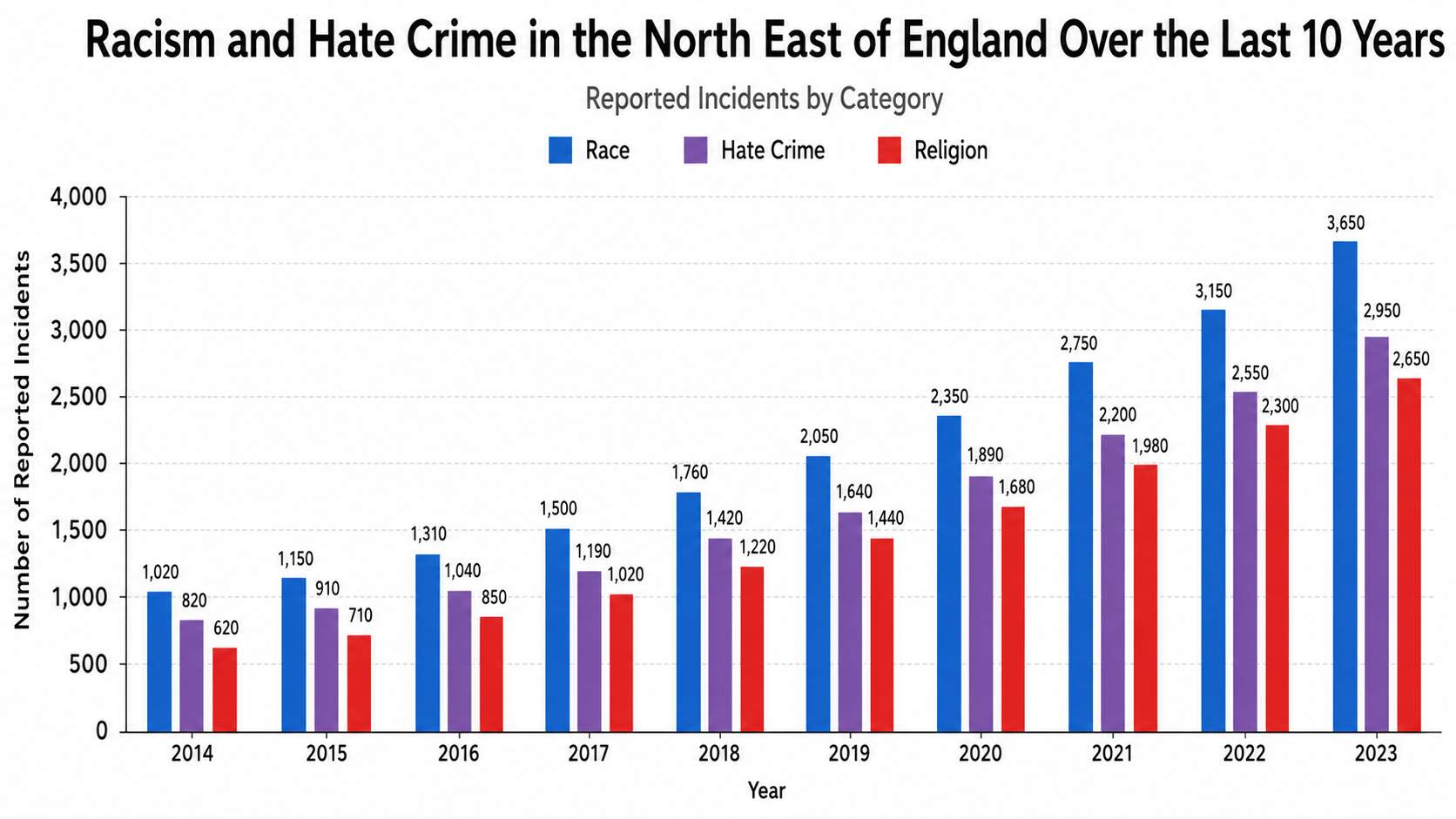
The latest Home Office figures show police recorded race hate crimes in England and Wales increased by 6 per cent in the year ending March 2025, excluding the Metropolitan Police from year-on-year comparisons because of changes to its crime recording system. Race continued to account for around 71 per cent of all police recorded hate crimes, making it by far the largest category.
While police statistics do not measure subtle racism directly, they offer an indication that race-related hostility remains a serious issue across the country.
The changing face of racism.
Britain has changed significantly over the past few decades. Society has become more diverse, workplaces are increasingly multicultural and discrimination laws have strengthened. At the same time, openly racist language has become less socially acceptable in many settings.
That has not necessarily removed prejudice. Instead, researchers have long argued that racism often presents itself in less obvious ways.
Rather than explicit insults, discrimination may appear through assumptions about somebody's intelligence, comments about their English, questioning whether they belong in Britain or treating somebody differently because of their ethnicity, surname or perceived background.
For many victims, it is not one isolated incident that causes the greatest harm. It is the repeated accumulation of smaller experiences that gradually affect confidence, career progression and everyday life.
Newcastle and the North East are not immune.
A study carried out by Newcastle University alongside the North East Anti-Racism Coalition provides one of the clearest pictures of how racism is experienced across the region.
Among 639 respondents, 78 per cent said racism was an everyday or regular issue in the North East, while 69 per cent believed racism had become worse.
More than half of respondents said they had personally experienced racism. Of those, 85 per cent reported verbal abuse, while many also described discrimination in workplaces, education, public transport, shops and hospitality venues.
Perhaps most concerning was that almost three quarters of those who experienced racism said they had never reported the incident to police, suggesting official figures may only capture part of the picture.
Although the survey represents the views of those who took part rather than every resident across the North East, it highlights concerns that many people continue to experience discrimination in situations that rarely make the headlines.
Religion has become part of the conversation.
Race is no longer the only characteristic driving prejudice.
Religion increasingly plays a role in how people are targeted, particularly when assumptions are made about somebody because of their appearance, clothing or cultural background.
The latest Home Office data recorded a 3 per cent increase in religious hate crime during the year ending March 2025. Within those figures, offences targeting Muslims rose by 19 per cent, particularly following the Southport murders and the disorder that followed in several towns and cities.
Jewish communities have also experienced significant levels of hostility in recent years, while Sikhs and Hindus have at times reported abuse based on mistaken identity or assumptions about their faith.
For many victims, race, religion and nationality overlap, making it difficult to separate one form of discrimination from another.
Country of origin and nationality.
Another increasingly common issue is discrimination linked to country of origin or perceived nationality.
People born overseas, or whose families originated elsewhere, often report being asked where they are "really from", even after explaining they were born and raised in Britain.
Others describe being judged because of their accent, surname or first language, with assumptions made about their education, immigration status or ability to contribute to society.
While these comments may appear harmless to the person making them, repeated questioning can leave individuals feeling they are viewed as permanent outsiders regardless of how long they have lived in the UK.
Researchers describe these experiences as microaggressions - subtle behaviours or comments that reinforce stereotypes or make people feel excluded.
Immigration and public debate.
Immigration remains one of Britain's most debated political issues.
Successive governments have introduced new immigration policies, while public debate has intensified around asylum, border security and legal migration.
Discussing immigration policy is not, in itself, racist. It is a legitimate political issue that attracts a wide range of views.
However, experts have warned that periods of heightened public tension, misinformation and emotionally charged debate can sometimes coincide with increases in hate crime directed towards people because of their race, nationality or religion.
The Home Office recorded its highest monthly total of racially or religiously aggravated offences in August 2024 following the Southport murders and the disorder that spread to several parts of England. Police and community leaders warned that misinformation circulating online contributed to hostility towards minority communities during that period.
The distinction is important. Criticism of government immigration policy is part of democratic debate. Targeting individuals because they look foreign, speak another language or belong to a particular ethnic or religious group is discrimination.
Why subtle racism matters.
Unlike overt abuse, subtle racism often leaves victims questioning whether they have actually experienced discrimination.
A joke may be dismissed as harmless banter. An employer may claim another candidate was simply a better fit. A customer may insist they were "only curious" when repeatedly questioning somebody's nationality.
Individually, these incidents may appear insignificant.
Collectively, they can influence mental health, career progression, educational achievement and community trust.
The Newcastle University research found many respondents believed racism had affected employment, healthcare, education and access to public services, while almost half said fear of racism had changed how they behaved in public.
Those findings suggest the consequences extend far beyond isolated incidents.
Building stronger communities.
The North East has long been recognised for its strong sense of community and welcoming reputation.
Maintaining that reputation means recognising that racism does not always involve criminal offences or openly hostile behaviour.
Sometimes it appears through assumptions, stereotypes or unequal treatment that becomes so routine it is rarely challenged.
Greater awareness, better education, improved reporting systems and open conversations within schools, workplaces and communities can all help reduce discrimination before it escalates into more serious abuse.
The latest figures show race and religious hate crime remain a significant issue across England and Wales, while research from Newcastle suggests many people in the North East believe racism continues to shape everyday life.
Addressing those concerns does not require abandoning honest debate about immigration, integration or public policy. Instead, it means ensuring those debates never become a justification for prejudice against individuals because of their race, religion, nationality or country of origin.
As Newcastle and the wider North East continue to grow as diverse communities, tackling subtle racism may prove just as important as confronting the more obvious forms that are already recognised by the law.
The question now is whether the North East can continue building stronger, more inclusive communities while many people still believe there is a long way to go when it comes to acceptance, understanding and bringing people together.
What can the North East do to tackle racism and build more inclusivity?
Local News
Inside the North East’s Growing Racism Problem
Advertisement



Comments (0)
You must be logged in to post comments.
Don't have an account? Register here
No comments yet. Be the first to share your thoughts!