
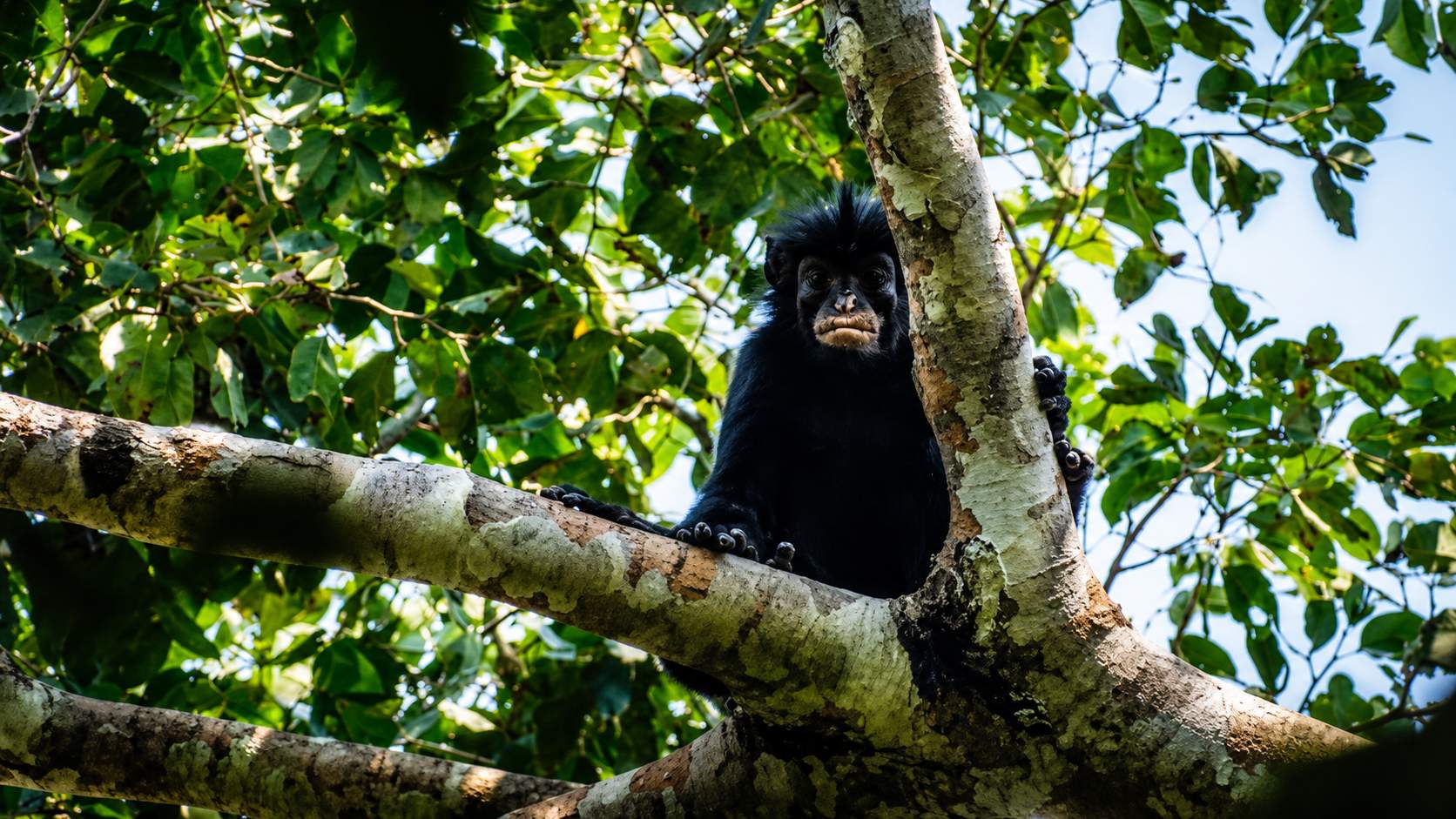
A remarkable new species of monkey has officially been confirmed by scientists after years of mystery in the dense rainforests of the Democratic Republic of Congo. The striking primate, recognised by its black face and distinctive pinkish-orange lips, has been hiding high in the forest canopy of Lomami National Park, making it one of the most significant wildlife discoveries in recent years.
The newly identified species, known scientifically as Colobus congoensis and locally as the Likweli, has generated excitement among conservationists around the world. Experts say discoveries like this are becoming increasingly uncommon, making the find especially important for science and global conservation efforts.
A discovery nearly two decades in the making.
The story began in 2008 when conservationists photographed an unfamiliar monkey deep within the forests of central eastern Congo. The image was not clear enough for researchers to determine whether it represented a known species or something entirely new.
A second confirmed sighting in 2018 prompted an international team of scientists to launch an extensive field study. Between 2018 and 2022, researchers recorded 114 sightings across an estimated 1,700 square kilometre range, while collecting behavioural observations, vocal recordings and genetic evidence. The findings confirmed that the monkey was unlike any other recognised African colobus species.
Scientists believe the monkey's unusual facial markings, glossy black fur and unique vocalisations help distinguish it from its closest relatives. The species also lives in relatively small family groups, adding to its elusive reputation.
Why this discovery matters.
Although new insects and plant species are identified every year, discovering a previously unknown primate is exceptionally rare. Researchers say the Likweli is only the fifth new species of African monkey to be formally identified in the past 75 years.
The discovery also highlights how much of Earth's biodiversity remains undocumented, particularly within remote tropical forests that have received relatively little scientific attention.
Unfortunately, the excitement is matched by concern. Scientists are already recommending that the monkey receives an Endangered conservation status because its known range is limited and faces growing threats from habitat destruction and hunting.
Newcastle's growing interest in wildlife conservation.
While the discovery took place thousands of miles from the North East, stories like this continue to resonate with people in Newcastle, where interest in wildlife conservation and environmental protection continues to grow.
Institutions including Newcastle University regularly contribute to international research covering ecology, biodiversity and climate change, while organisations across the region encourage residents to support conservation projects both locally and overseas.
Many families visiting attractions such as the Great North Museum: Hancock also take a growing interest in endangered species and global ecosystems, making discoveries like the Likweli an opportunity to inspire future generations of scientists closer to home.
Fascinating statistics behind the discovery.
Several figures from the research underline just how extraordinary this discovery is.
Researchers documented 114 confirmed sightings of the monkey during four years of fieldwork across an area of around 1,700 square kilometres.
The Likweli is also recognised as only the fifth new African monkey species discovered in the past 75 years, demonstrating how unusual it is for scientists to identify an entirely new primate in modern times.
Scientists believe protecting Lomami National Park will be critical if the newly identified species is to survive for future generations.
A reminder that nature still holds surprises.
Despite advances in technology, satellite mapping and DNA analysis, discoveries like this prove that parts of the natural world remain largely unexplored.
For researchers, the confirmation of Colobus congoensis represents far more than naming another species. It reinforces the importance of protecting vulnerable ecosystems before rare animals disappear before they are even documented.
As conservation challenges continue to grow across the globe, this remarkable monkey serves as a powerful reminder that there are still incredible discoveries waiting to be made.
Share your thoughts below.
What do you think about this incredible wildlife discovery?
Lifestyle News
New Monkey Species Found In DRC After 18-Year Mystery
Advertisement





Comments (0)
You must be logged in to post comments.
Don't have an account? Register here
No comments yet. Be the first to share your thoughts!