
When the weather turns cold and a hearty, warming meal is in order, few dishes deliver more comfort for less effort than pan haggerty. This traditional North East favourite, made from layered potatoes, onions and cheese cooked together in a pan until golden, is the very essence of simple, satisfying home cooking. Humble in its ingredients but generous in its flavour, pan haggerty is a true taste of the region.
A Dish of Simple Layers.
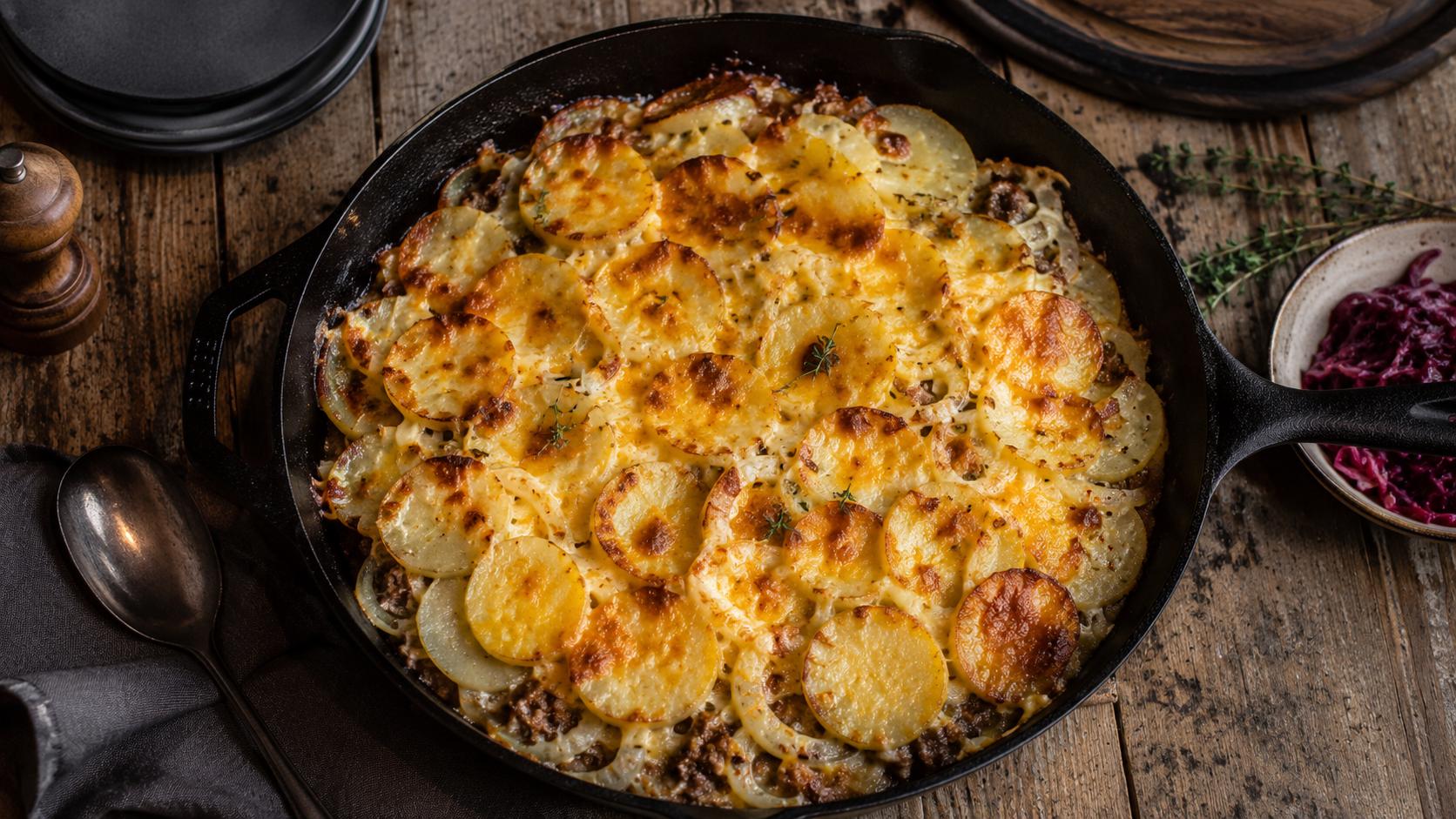
Pan haggerty could hardly be more straightforward. It consists of thinly sliced potatoes and onions, layered up in a frying pan or skillet, generously seasoned and interleaved with grated cheese, usually a good strong cheddar. The dish is cooked slowly so that the potatoes soften and the flavours meld, then finished off, often under a grill or by browning the top, until the cheese is bubbling and golden. The result is a rich, comforting dish with crisp, savoury edges and a soft, melting middle. It can be served as a hearty main course or as a substantial side alongside meat.
Honest, Affordable Ingredients.
The enduring appeal of pan haggerty lies partly in its thrift. Potatoes, onions and cheese were affordable, readily available staples in North East households, and combining them in this way created a filling, nourishing meal from very little. In the region's mining and industrial communities, where money was often tight and appetites were large, a dish like pan haggerty made perfect sense, stretching simple ingredients into something genuinely satisfying. This practical, make-the-most-of-what-you-have spirit is at the heart of much of the North East's traditional cooking, and pan haggerty is one of its tastiest expressions.
The Origins of the Name.
The unusual name pan haggerty is part of the dish's charm, and like many old food names its precise origins are a little hazy. The pan part is obvious enough, referring to the way the dish is cooked. The haggerty element is thought by some to derive from old words connected to chopping or hacking, perhaps a nod to the slicing of the potatoes and onions, though the true source is lost to time. Whatever its roots, the name has a homely, characterful ring to it that suits the dish perfectly, and it has become firmly associated with the North East in particular.
A Versatile Comfort Dish.
One of the great strengths of pan haggerty is its versatility. At its most basic it needs only potatoes, onions and cheese, but cooks have long adapted it to suit their tastes and what they have to hand. Some add a layer of bacon or other meat, others vary the cheese or add herbs and seasonings to ring the changes. It works beautifully as a vegetarian main course, as a side dish to accompany sausages or a Sunday roast, or as a warming supper in its own right. This adaptability has helped keep the dish relevant, allowing it to fit into modern kitchens just as easily as it did into those of the past.
Cooking It the Traditional Way.
Traditionally, pan haggerty is cooked entirely on the stovetop in a heavy frying pan, with the layers building up and cooking gently in a little fat until the potatoes are tender. The top is then browned, either by careful turning or by finishing the pan under a hot grill, to achieve that irresistible golden, cheesy crust. The slow cooking allows the onions to sweeten and the potatoes to take on all the savoury flavour around them. Patience is rewarded with a dish that is crisp on top, soft beneath and thoroughly comforting throughout, ideal for a cold North East evening.
A Lasting Regional Favourite.
Pan haggerty has endured because it does something very well: it turns the simplest of ingredients into a meal that genuinely satisfies. It speaks of a tradition of resourceful, unfussy home cooking that has long been a feature of life in the North East, where good food never had to be expensive or elaborate to be loved. In recent years, as interest in regional and traditional British dishes has grown, pan haggerty has rightly enjoyed renewed attention, appearing on menus and in cookbooks as a classic worth celebrating.
For anyone looking to taste the comforting heart of North East home cooking, pan haggerty is an excellent place to start. Easy to make, kind to the budget and deeply satisfying to eat, it is a dish that captures the warmth and good sense of the region's food traditions in every golden, cheesy forkful.
A Dish for Cold Northern Nights.
There is something about pan haggerty that makes it the ideal food for a cold North East evening. As the nights draw in and the weather turns harsh, a steaming, golden pan of layered potatoes, onions and cheese offers exactly the kind of warming, sustaining comfort that the season demands. It is the sort of dish that fills the kitchen with an inviting aroma as it cooks, and that brings people gladly to the table. Its frugal, make-do origins mean it has always been a sensible choice for stretching a modest budget, turning cheap staples into a genuinely satisfying meal. In recent years, as appreciation for traditional British cooking has grown, pan haggerty has enjoyed a welcome revival, appearing on restaurant menus and in cookbooks as a regional classic worth rediscovering. Yet it remains, at heart, honest home cooking, the kind passed down through families and made without fuss. That combination of thrift, comfort and simple deliciousness is exactly why it has endured for so long in the kitchens of the North East.
We want to hear from you.
Share your memories and opinions with fellow readers below, especially your own twist on the classic pan haggerty recipe.
Do you add bacon to your pan haggerty, or keep it purely potatoes, onions and cheese?
Food & Drink News
Pan Haggerty: Humble North East Comfort Food
The story of pan haggerty, the simple, satisfying North East dish of layered potatoes, onions and cheese cooked in a pan until golden.
Advertisement

Comments (0)
You must be logged in to post comments.
Don't have an account? Register here
No comments yet. Be the first to share your thoughts!