
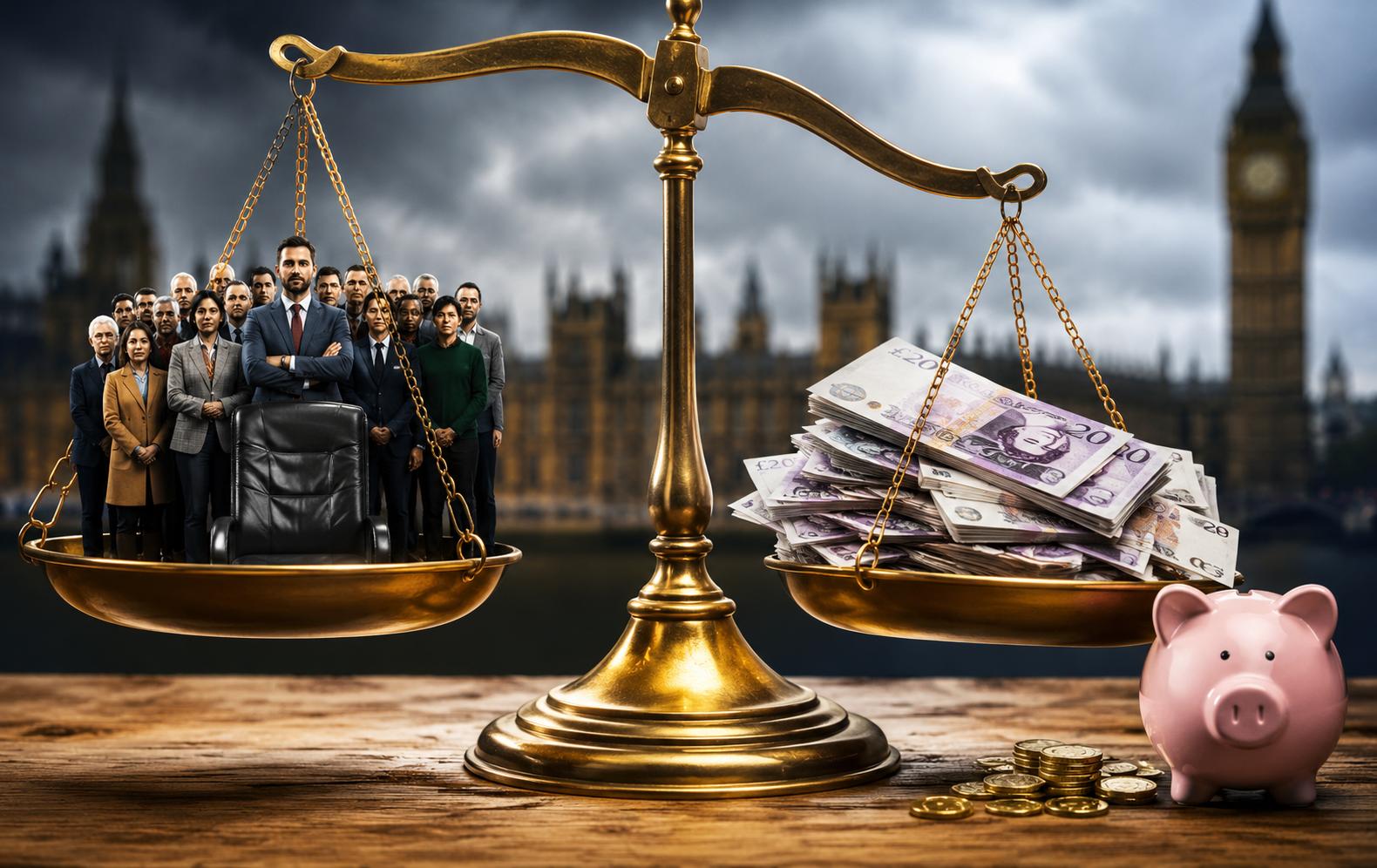
Local councils across the UK are under growing financial pressure, with authorities warning about shrinking budgets, rising service demands and increasing administrative costs. Against that backdrop, some campaigners and political observers are beginning to ask whether one area of local government spending has escaped serious scrutiny for too long - the cost of by-elections.
Under current UK law, when a councillor resigns, dies, becomes disqualified or steps down before the end of their term, councils are usually required to hold a by-election to fill the vacant seat. While the process is seen as an important democratic safeguard, critics argue that it has also become an expensive and outdated system in many cases.
One proposal beginning to attract attention is a simple but controversial idea. Instead of automatically triggering a by-election, the council seat could pass to the candidate who finished second at the previous local election.
Supporters say the change could save millions of pounds over time while reducing voter fatigue and easing pressure on local authorities. Opponents argue it could weaken democratic accountability and install candidates voters explicitly rejected.
The debate raises wider questions about how local democracy should function in an era of tight budgets and falling election turnout.
How council by-elections currently work.
The rules governing local council vacancies in England and Wales are largely set out under the Local Government Act 1972 and the Representation of the People Act 1983.
If a councillor leaves office before the end of their term, the seat becomes vacant. A by-election can then be triggered if enough local electors request one within a specified period. In practice, most vacancies result in a by-election unless they occur very close to the next scheduled local election.
The process mirrors a standard election. Councils must arrange polling stations, print ballot papers, hire election staff, process nominations and oversee vote counting. Police resources are also sometimes involved depending on the size and profile of the vote.
While by-elections are usually smaller than nationwide polls, they still carry significant costs for local authorities.
According to Electoral Commission figures and local authority spending reports, a typical council by-election in England can cost anywhere between £8,000 and £30,000 depending on ward size, staffing requirements and postal vote demand. Larger urban wards can cost considerably more.
When multiple by-elections occur across a financial year, the bill can quickly rise.
Several councils have already warned that repeated by-elections place additional strain on overstretched election teams, particularly since the introduction of voter ID rules under the Elections Act 2022.
Why by-election costs are rising.
Election administration has become more expensive over the past decade due to a combination of inflation, staffing pressures and legal requirements.
Postal voting has expanded significantly, increasing printing and verification costs. Security and compliance requirements have also grown more complex. The introduction of mandatory voter ID checks in England added further operational costs for councils during local elections.
Recruiting polling station staff has also become harder in some parts of the country. Councils often rely on temporary workers who must now receive additional training to comply with modern election law.
At the same time, local authority budgets remain under intense pressure.
Research from the Local Government Association has repeatedly warned that councils face mounting financial challenges linked to adult social care, housing demand and inflationary pressures. Critics of the current by-election system argue that spending tens of thousands of pounds on low turnout local contests is becoming increasingly difficult to justify.
In some council by-elections, turnout can fall below 20 percent.
That has prompted questions over whether there may be cheaper ways to maintain democratic representation without requiring full-scale elections every time a seat becomes vacant.
The runner-up replacement proposal.
Under a runner-up replacement system, the candidate who finished second at the most recent local election would automatically inherit the seat if the elected councillor stepped down during a defined period.
For example, if a councillor resigned within 12 months or 18 months of being elected, the second-placed candidate could take office for the remainder of the term.
Supporters argue that voters have already expressed a clear preference order at the ballot box, making an additional election unnecessary in some situations.
The proposal is not entirely without international precedent.
Several countries using proportional representation systems already use replacement mechanisms instead of by-elections. In some cases, political parties nominate the next candidate from an approved electoral list. Other systems use recount procedures known as countbacks.
In the UK, forms of automatic replacement already exist in certain devolved and proportional electoral systems, including parts of the London Assembly and Scottish Parliament structures.
However, local council elections in England primarily use the first-past-the-post system, meaning there is no established mechanism for transferring seats to runner-up candidates.
Any change would therefore require new legislation passed by Parliament.
How much money could councils save.
Calculating the exact savings is difficult because by-election costs vary significantly between authorities and election cycles. However, available figures suggest the savings could be substantial over time.
Hundreds of council by-elections are held across the UK during a typical electoral cycle.
Data compiled by election monitoring groups shows that England alone often records more than 150 council by-elections annually, with spikes occurring after major local elections or periods of political instability.
If the average by-election costs £15,000 to administer, eliminating even 100 contests per year could theoretically save councils around £1.5 million annually.
Some estimates place the figure even higher once staffing overtime, security arrangements and indirect administrative costs are included.
Supporters of reform argue that the money could instead be redirected into frontline council services such as road maintenance, housing enforcement or social care provision.
Critics counter that democracy should not be evaluated purely through a financial lens.
They argue that by-elections provide an important opportunity for public accountability, especially if political circumstances have changed significantly since the previous election.
Concerns over democratic legitimacy.
The biggest challenge facing any runner-up replacement proposal is the question of legitimacy.
Opponents argue that second-placed candidates lost the election and therefore do not possess a direct democratic mandate to govern.
Political loyalties can also shift rapidly. A candidate who narrowly lost an election two years earlier may no longer reflect local opinion by the time a vacancy occurs.
There are also practical complications.
A runner-up candidate may have moved away, changed political parties or no longer wish to serve. In some cases, the second-placed candidate may have secured only a small share of the vote in a fragmented contest.
Multi-member wards could create further complexity because several candidates may have stood under the same party banner.
Electoral reform specialists say any future legislation would likely require strict eligibility conditions and time limits to address these concerns.
One compromise model being discussed by some academics would allow automatic replacement only during the first year after an election. Vacancies arising later in the term would still require traditional by-elections.
Could political support emerge.
At present, there is no major government-backed proposal to introduce runner-up succession for local councils in England.
However, wider debates around electoral reform, council funding and democratic modernisation continue to evolve.
Some local government figures privately acknowledge frustration with the cost and frequency of by-elections, particularly when turnout is low and outcomes are considered predictable.
There is also growing public discussion around political efficiency and reducing administrative spending.
Reform advocates believe the issue could gain traction if councils face deeper financial pressures in the coming years.
Others remain deeply sceptical.
Election law experts note that the UK political system has historically favoured fresh public votes when vacancies occur. Westminster traditions place strong emphasis on direct electoral mandates, even if by-elections are expensive or poorly attended.
For that reason, any attempt to change the system would almost certainly trigger fierce political debate in Parliament.
A wider debate about local democracy.
The discussion surrounding by-election reform reflects a broader national conversation about how local democracy should operate in modern Britain.
Many councils are already experimenting with digital consultation systems, remote meetings and new forms of public engagement. At the same time, turnout in local elections often remains significantly lower than in general elections.
Some reformers believe the current vacancy system belongs to an older political era and no longer reflects modern expectations around efficiency and public spending.
Others argue that reducing opportunities for voters to return to the ballot box risks weakening democratic accountability at precisely the moment public trust in politics remains fragile.
For now, the idea of replacing councillors with the previous election's runner-up remains politically controversial. Yet as councils continue searching for savings, proposals once considered radical may begin receiving more serious attention.
Whether voters would support such a change is another question entirely.
What do you think about replacing costly council by-elections with runner-up candidates? Could the UK save money without weakening democracy?
Political News
Could Runner-Up Councillors Cut UK By-Election Costs?
Advertisement


Comments (0)
You must be logged in to post comments.
Don't have an account? Register here
No comments yet. Be the first to share your thoughts!