
For generations, the St George’s flag was simply seen as England’s national flag.
It flew outside pubs during major football tournaments, appeared in street parties during royal celebrations and hung from bedroom windows during St George’s Day celebrations across the country. For many people, it represented little more than English identity, football culture and national pride.
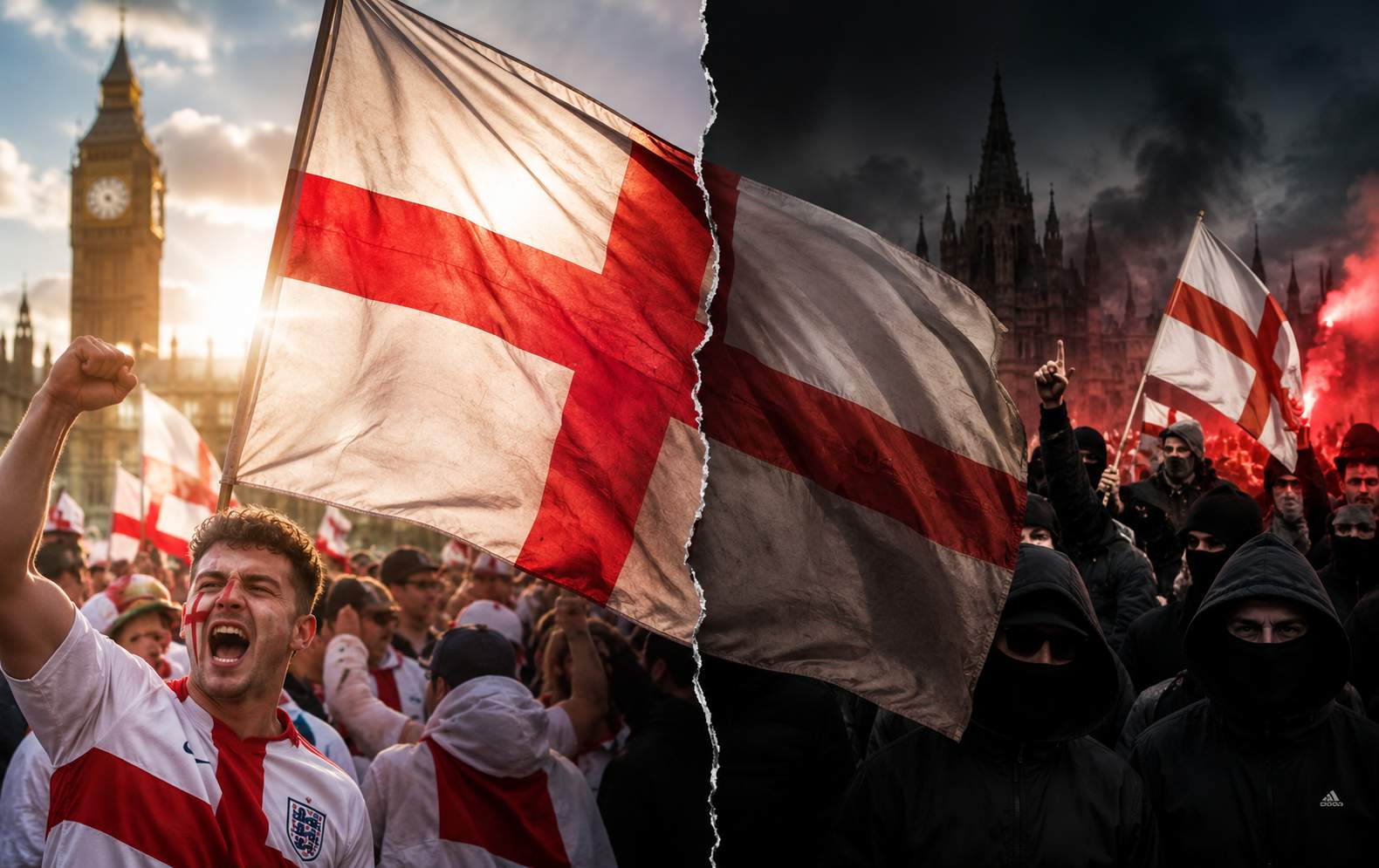
Yet over the past few decades, the red cross on a white background has become one of the most politically and culturally divisive symbols in modern Britain.
To some people, it still represents heritage, patriotism and pride in England. To others, it has become associated with racism, anti-immigration politics and far right nationalism.
That shift did not happen overnight. Instead, it developed gradually through politics, football culture, media coverage and the actions of extremist groups who increasingly adopted the flag as part of their public image.
Today, debates around the St George’s flag often reflect wider arguments about English identity, immigration, multiculturalism and nationalism in modern Britain.
The flag originally had little political meaning.
The St George’s cross has existed for centuries and was historically linked to England’s patron saint, Saint George.
For much of modern British history, however, the Union Jack was the dominant national symbol used across England, Scotland, Wales and Northern Ireland.
The St George’s flag was relatively rare in everyday life until the late twentieth century. Outside of official ceremonies or certain sporting events, many English people rarely displayed it publicly.
That began changing during the 1990s, particularly through football culture.
As major international tournaments such as Euro 96 captured public attention, the St George’s flag suddenly became far more visible across England. Fans placed it on cars, outside homes and inside pubs as support for the national football team grew.
At the time, many people viewed the flag as a more specifically English symbol compared with the Union Jack, which represented the United Kingdom as a whole.
For a period, it largely carried positive associations linked to sport, celebration and national identity.
Football culture played a major role.
Football was arguably the biggest reason the St George’s flag returned to public life on such a large scale.
During tournaments involving England, the flag became almost unavoidable. Streets filled with hanging banners, pubs decorated windows and supporters wrapped themselves in the cross of St George while following the national team.
The rise of England football culture during the 1990s and early 2000s helped normalise the flag in everyday public spaces.
However, football culture also carried problems.
English football during parts of the 1970s, 1980s and early 1990s was heavily associated with hooliganism, racism and far right activity. Groups connected to the National Front and other extremist organisations actively recruited among football supporters during that era.
Although most England fans had nothing to do with racism or extremism, media coverage of football violence and racist chanting helped create negative associations around overt displays of English nationalism.
As a result, the St George’s flag slowly became linked in some people’s minds with aggressive nationalism rather than simple patriotism.
Far right groups increasingly adopted the flag.
One of the biggest reasons the flag became politically controversial was its adoption by far right and nationalist organisations.
Groups such as the English Defence League, Britain First and various anti-immigration movements frequently used the St George’s flag during marches, demonstrations and online campaigns.
Television coverage often showed crowds draped in England flags while chanting anti-immigration slogans or protesting against multiculturalism and Islam.
Over time, repeated exposure to those images had a significant cultural impact.
Many people, particularly within minority communities, began associating the flag less with football or national pride and more with hostility towards immigrants and ethnic minorities.
Political commentators have frequently argued that extremist groups effectively hijacked the symbolism of the St George’s flag by making it central to their public identity.
The same thing has happened in various countries where national symbols become tied to extremist political movements.
English identity became increasingly complicated.
Part of the debate surrounding the St George’s flag also reflects uncertainty around English identity itself.
Scottish, Welsh and Irish national identities are often discussed openly and celebrated culturally without attracting the same political tension. English identity, however, became more sensitive partly because England represents the dominant nation within the United Kingdom.
Some people argue that expressions of English nationalism are viewed differently because of Britain’s colonial history, the legacy of empire and modern debates around immigration and race.
Others believe English identity became politically neglected for years, creating frustration among some communities who felt uncomfortable expressing patriotism without fear of being labelled racist.
That tension has become increasingly visible during debates surrounding Brexit, immigration and cultural identity in Britain.
For some people, displaying the St George’s flag remains a harmless expression of national pride. For others, it can feel politically loaded depending on the context in which it appears.
Social media intensified the divide.
Social media has played a major role in reshaping how national symbols are perceived.
Online political movements increasingly use imagery and symbolism to create strong emotional reactions and the St George’s flag has frequently appeared within highly divisive debates online.
Images of the flag are regularly used alongside arguments about immigration, asylum seekers and British identity, particularly by politically nationalist accounts.
At the same time, many ordinary England supporters argue the flag is unfairly judged because of a vocal minority online.
This has created a strange cultural divide where some people feel uncomfortable displaying the England flag publicly while others believe reclaiming it from extremists is important.
The argument now extends far beyond football tournaments or St George’s Day celebrations. It has become part of a wider national conversation about identity and belonging in modern England.
Many people reject the idea the flag is racist.
Despite the controversy, millions of people across England still see the St George’s flag purely as a symbol of heritage and patriotism.
During football tournaments, the flag continues appearing across homes, pubs and city centres throughout the country without political intent.
Many England supporters strongly reject suggestions that displaying the flag automatically carries racist connotations.
Some ethnic minority England fans have also spoken publicly about reclaiming the flag and refusing to allow extremist groups to define English identity.
Campaigns promoting inclusive patriotism have attempted to separate the flag from far right politics by emphasising multicultural versions of English identity.
For these groups, the answer is not abandoning national symbols but broadening who feels represented by them.
The media helped shape public perception.
Media coverage has also played a significant role in changing how the flag is viewed.
News reports frequently connect the St George’s flag to protests, political demonstrations or extremist groups because those situations naturally generate headlines and television images.
As a result, some people now instinctively associate large displays of England flags with political anger or anti-immigration sentiment even when no extremist connection exists.
Critics argue this has unfairly damaged perceptions of English patriotism and created double standards compared with other national identities.
Others argue the concerns are understandable given the flag’s repeated use by far right groups over many years.
Either way, media imagery has undeniably influenced public perceptions surrounding the flag.
Younger generations often see the flag differently.
Attitudes towards the St George’s flag can vary significantly by age and background.
Older generations who associate the flag primarily with football or national celebrations may view it more positively.
Younger people who grew up seeing it linked to divisive online debates or anti-immigration protests may interpret it very differently.
In multicultural cities especially, reactions to overt displays of English nationalism can be mixed depending on the context and location.
For some people, seeing multiple St George’s flags outside houses feels no different from support during the World Cup. For others, it can carry more political or cultural tension.
That difference in interpretation reflects how symbols constantly evolve depending on social and political events.
The flag now represents different things to different people.
Perhaps the biggest reason debates around the St George’s flag continue is because the symbol itself no longer carries one universally accepted meaning.
To some people, it represents football, patriotism and English culture.
To others, it symbolises exclusion, nationalism or anti-immigration politics.
In reality, both interpretations now exist simultaneously depending on context, history and personal experience.
A St George’s flag hanging outside a pub during the Euros may feel entirely different from the same flag carried during an extremist political march.
That complexity explains why conversations around the flag often become emotional and politically charged.
Can the flag ever fully lose its controversy?
Whether the St George’s flag can ever completely shake off its political baggage remains uncertain.
Some campaigners believe inclusive patriotism and broader cultural representation can help separate English identity from far right politics over time.
Others believe the associations created over decades of political tension are now too deeply embedded for some communities to ignore.
Football tournaments often temporarily restore more positive associations around the flag, particularly when England supporters from diverse backgrounds celebrate together.
Yet political flashpoints regularly pull the symbol back into cultural arguments about nationalism and race.
For now, the St George’s flag remains one of the most emotionally complicated national symbols in modern Britain.
It is still capable of representing pride, celebration and identity for millions of people across England. But for others, its meaning has changed dramatically over the last few decades.
That tension says as much about modern England itself as it does about the flag.
Do you think the St George’s flag has been unfairly associated with racism in modern Britain? Share your views in the comments
Political News
How Far Right Groups Changed Perceptions of the St George’s Flag
Advertisement



Comments (0)
You must be logged in to post comments.
Don't have an account? Register here
No comments yet. Be the first to share your thoughts!