
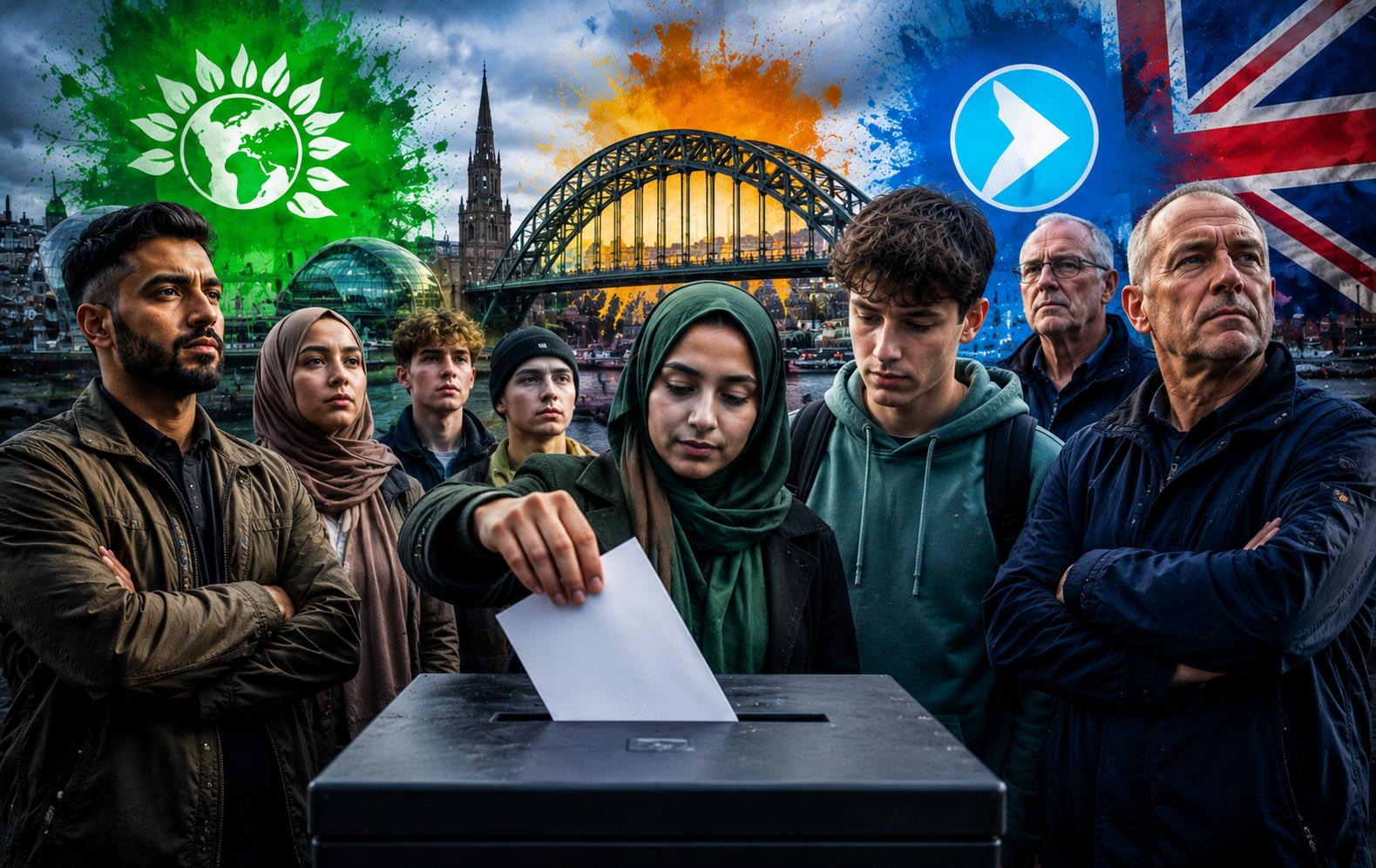
A major political realignment unfolded across Newcastle upon Tyne during the recent election, with Muslim voters, students and many older residents abandoning traditional Labour loyalties in favour of tactical voting, the Green Party and Reform UK.
What emerged on Newcastle’s streets and polling stations was not a single protest movement, but several very different voter rebellions happening simultaneously across the city.
In the West End, Muslim communities and younger progressive voters shifted heavily towards Green candidates, driven by frustration over Gaza, disillusionment with Labour leadership and growing concern about racism, climate change and local decline.
In student-heavy areas such as Jesmond, Heaton and parts of Shieldfield, Labour also lost support among younger voters who increasingly viewed the Greens as the party more closely aligned with their values on housing, climate issues and international justice.
At the same time, across Newcastle’s East End and older working-class neighbourhoods, many voters aged over 40 either backed Reform UK directly or voted tactically in an attempt to punish Labour after years of frustration surrounding immigration, the cost of living crisis and deteriorating local services.
The result was one of the clearest signs yet that Newcastle’s political map is changing rapidly.
Muslim voters in Newcastle moved decisively away from Labour.
For decades Labour benefited from strong support among Newcastle’s Muslim communities, particularly in areas such as Elswick, Arthur’s Hill, Benwell and Fenham.
But during the latest election cycle, many Muslim voters openly turned away from the party.
While Gaza became the most emotionally charged issue during campaigning, local organisers say the shift reflected much deeper frustrations that had been building for years.
Residents repeatedly described feeling ignored by Labour despite generations of loyalty.
Many believed the party no longer reflected the priorities or concerns of working-class Muslim communities across Newcastle upon Tyne.
The conflict in Gaza ultimately became the tipping point that pushed many previously loyal Labour supporters towards the Greens.
Campaigners described conversations where voters said they could no longer justify supporting a party they believed had failed to strongly condemn the humanitarian crisis or adequately represent Muslim concerns nationally.
But conversations on doorsteps were rarely limited to foreign policy.
Muslim voters also raised issues surrounding rising living costs, poor housing, anti-social behaviour, crime and declining local services throughout Newcastle’s West End.
The feeling among many was that Labour had become disconnected from everyday community concerns.
Green candidates benefited from strong local community links.
One reason the Greens performed strongly among Muslim voters in Newcastle was because many of their candidates already had deep community connections.
Several Green campaigners were known locally through youth work, charity projects, small businesses, mosques or community activism long before election season began.
That mattered enormously.
Residents often spoke about voting for individuals they trusted personally rather than simply backing a political party.
This grassroots visibility gave Green candidates credibility in communities where Labour was increasingly viewed as distant or establishment-focused.
Many voters also appreciated that Green campaigners spent time speaking directly with residents rather than relying heavily on traditional party messaging.
In Newcastle’s West End, local visibility became one of the defining factors shaping voting behaviour.
Student voters also shifted heavily towards the Greens.
Alongside Muslim communities, Newcastle’s large student population also moved increasingly towards Green candidates.
Areas with high student populations, particularly Jesmond, Heaton and parts of the city centre, saw growing frustration among younger voters who felt Labour was failing to offer meaningful change on issues that mattered most to them.
Climate change played a major role.
Many younger Newcastle voters increasingly view environmental policy not as a secondary issue but as one of the defining political challenges of their generation.
The Greens successfully tapped into that mood.
But housing costs, rental conditions and economic insecurity also dominated conversations among students and younger renters across Newcastle upon Tyne.
Many students said they felt trapped between rising rents, insecure work and declining mental wellbeing.
For some, Labour no longer felt radical enough to address those pressures.
Social media also played a significant role in shifting younger political loyalties.
Many students consume political content through TikTok, Instagram and independent online creators rather than traditional newspapers or television coverage.
That has helped smaller parties such as the Greens build stronger engagement with younger audiences.
Gaza became especially important among younger progressive voters.
While older political strategists sometimes underestimated the importance of Gaza to younger voters, campaigners across Newcastle repeatedly described it as a defining issue among students and progressive younger residents.
For many, the conflict represented broader concerns surrounding human rights, racism and international justice.
University students in Newcastle participated in protests, demonstrations and political discussions throughout the conflict, creating a highly engaged political atmosphere among younger voters.
That energy translated into voting behaviour.
Younger residents increasingly viewed Labour’s position as too cautious or politically calculated, while the Greens benefited from appearing more vocal and uncompromising.
Older voters increasingly voted tactically against Labour.
While younger and Muslim voters drifted towards the Greens, a very different political movement emerged among older Newcastle residents.
Across several traditionally Labour-supporting working-class areas, many voters aged over 40 voted tactically or backed Reform UK.
In communities such as Walker, Byker and parts of the East End, residents repeatedly described frustration with Labour after years of economic decline and deteriorating neighbourhood conditions.
Some did not necessarily identify strongly with Reform UK itself but saw voting for the party as a way to send a message to Labour.
Others voted tactically depending on which candidate they believed had the best chance of damaging Labour locally.
This tactical mindset reflected growing political dissatisfaction rather than ideological loyalty alone.
Many older residents said they no longer felt represented by mainstream parties altogether.
Cost of living concerns dominated among over-40 voters.
Unlike younger Green voters who often focused heavily on climate policy and international issues, many older Newcastle voters prioritised economic concerns.
Energy bills, food prices, council services and housing costs dominated discussions on doorsteps.
Older residents frequently expressed anger over rising living costs alongside a belief that Newcastle’s working-class communities had steadily declined over many years.
Many spoke nostalgically about stronger local identities, busier high streets and greater community pride in previous decades.
For some over-40 voters, Labour no longer felt connected to traditional working-class values.
Immigration also became a more prominent issue among some older voters, particularly in communities experiencing rapid social and economic change.
Reform UK successfully capitalised on those frustrations through anti-establishment messaging and promises to challenge mainstream politics.
Reform UK gained visibility among frustrated working-class voters.
Although Reform UK remains far smaller than Labour overall in Newcastle, the party succeeded in attracting attention among older working-class voters frustrated with traditional politics.
Campaigners reported strong reactions to Reform messaging focused on immigration, national identity and dissatisfaction with Westminster politics.
Some residents viewed Reform as the only party openly speaking about issues they felt other politicians ignored.
Others admitted they were not fully committed Reform supporters but wanted to punish Labour for years of perceived neglect.
That tactical protest vote became increasingly important in several wards.
The political divide between Newcastle’s East and West End became particularly visible during campaigning.
Newcastle’s political map is becoming increasingly fragmented.
Perhaps the biggest lesson from recent elections is that Newcastle upon Tyne no longer behaves politically as one unified Labour city.
Different demographics are now moving politically in completely different directions.
Muslim voters increasingly prioritise representation, anti-racism concerns and foreign policy issues.
Students focus heavily on climate policy, housing affordability and progressive politics.
Many over-40 working-class voters are driven by economic frustration, immigration concerns and declining trust in establishment parties.
This fragmentation makes Newcastle far more politically unpredictable than it once was.
Traditional voting loyalties are weakening rapidly across multiple communities at the same time.
Community identity shaped voting behaviour across the city.
One of the clearest patterns throughout the election was the growing importance of community identity.
Many Muslim voters supported candidates who they believed genuinely understood their lived experiences.
Students backed parties they felt reflected their generational concerns.
Older working-class residents increasingly voted based on whether they believed politicians respected their frustrations and understood local decline.
In many cases, trust in individual candidates mattered more than party branding itself.
Local visibility, authenticity and personal reputation became increasingly important factors shaping voter decisions.
Labour still retained support across Newcastle.
Despite significant losses among some groups, Labour still maintained strong support across many parts of Newcastle upon Tyne.
The party continues to benefit from decades of political infrastructure, trade union links and loyal working-class support in several communities.
Many residents still view Labour as the most realistic party capable of governing effectively or protecting public services nationally.
However, what has clearly changed is the assumption that Newcastle voters will automatically remain loyal.
That loyalty is now conditional in ways it was not previously.
Many residents who once voted Labour without hesitation are increasingly open to alternatives depending on local candidates and national political developments.
Newcastle reflects wider changes happening across Britain.
Political analysts increasingly believe Newcastle mirrors broader national trends reshaping British politics.
Across the country, traditional party loyalties are weakening as voters become more fragmented by identity, generation and social priorities.
Labour now faces pressure from multiple directions simultaneously.
The party is losing some younger progressive voters and Muslim communities to the Greens while also facing growing dissatisfaction among older working-class voters vulnerable to Reform UK messaging.
Holding those coalitions together politically is becoming increasingly difficult.
Newcastle upon Tyne may therefore offer one of the clearest examples yet of how rapidly British political identities are changing.
Tactical voting may become even more important in future elections.
The rise of tactical voting across Newcastle suggests future elections could become even more unpredictable.
Many residents no longer vote out of long-term loyalty to one party.
Instead, they increasingly vote strategically depending on which party they want to weaken or block.
That creates fluid political conditions where local campaigns, candidate reputations and short-term issues can dramatically influence results.
It also means parties can no longer assume historical support bases will remain secure automatically.
For Labour especially, the latest elections delivered a warning that different parts of Newcastle are drifting away for very different reasons.
And unless those concerns are addressed directly, the city’s political landscape may continue changing far faster than many expected.
Did Newcastle voters make the right decision by backing the Greens, Reform UK or tactical candidates over Labour? Share your thoughts on how politics is changing across Newcastle and which issues matter most to your community in the comments below.
Political News
Newcastle’s Political Earthquake - Who Really Turned Against Labour?
Advertisement


Comments (0)
You must be logged in to post comments.
Don't have an account? Register here
No comments yet. Be the first to share your thoughts!