
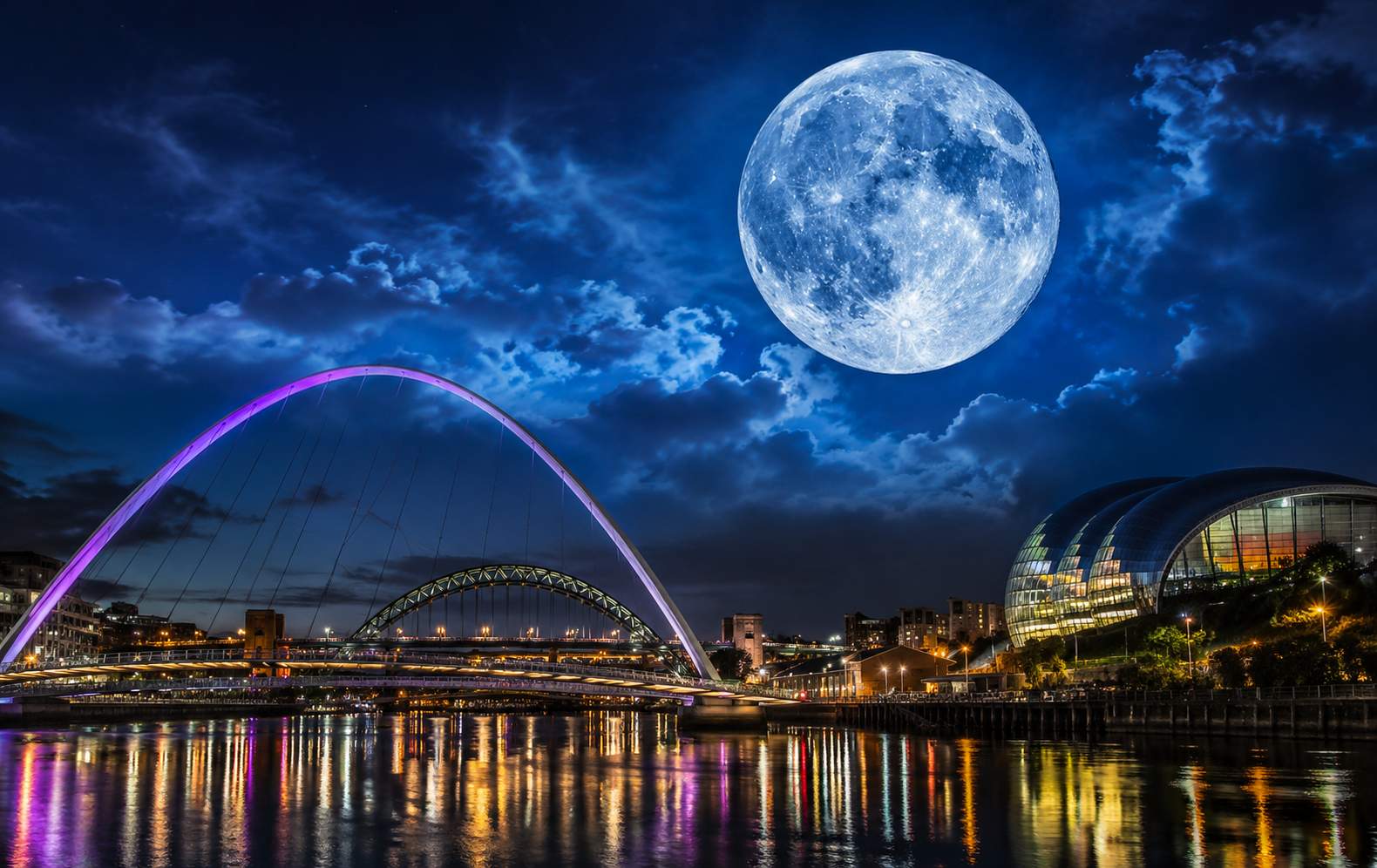
Skywatchers across the UK are preparing for one of the most talked-about lunar events of 2026 as a rare Blue Moon rises later this month. The unusual celestial event is expected to attract thousands of people outdoors to witness the full Moon shining brightly above towns and cities including Newcastle, London, Manchester and Edinburgh.
Although the name may suggest a glowing blue-coloured Moon, the truth behind the phenomenon is far more fascinating. A Blue Moon is not actually blue at all. Instead, the term refers to an uncommon timing event in the lunar calendar that only happens every few years.
This year's Blue Moon is especially notable because it will also be classified as a micromoon, making it appear slightly smaller and dimmer than a typical full Moon. Astronomers say the combination of a Blue Moon and micromoon in the same event is relatively unusual and offers a perfect opportunity for people to learn more about the night sky.
With interest in astronomy continuing to grow throughout the UK, many people are already searching online for the best time to see the Blue Moon in Newcastle and surrounding areas.
Why Is It Called a Blue Moon?.
The phrase "once in a blue moon" has been used for generations to describe something rare. That saying comes directly from astronomy, where a Blue Moon is considered an uncommon event due to the way the Moon's cycle lines up with the calendar year.
The Moon takes approximately 29.5 days to orbit Earth and complete a full lunar cycle. Because of this, a standard year usually contains 12 full moons. However, 12 lunar cycles add up to only 354 days, which is shorter than the 365-day calendar year.
Over time, this mismatch causes an additional full Moon to appear roughly every two or three years. When two full moons occur in the same calendar month, the second one is commonly referred to as a Blue Moon.
There is also another astronomical definition. Traditionally, a Blue Moon can describe the third full Moon in a season that contains four full moons instead of the usual three. Despite the different meanings, both definitions highlight the rarity of the event.
Astronomy experts say confusion over the term has existed for decades, but the monthly definition has become the most widely recognised version in modern times.
When Can You See the Blue Moon in the UK?.
The next Blue Moon will reach peak illumination on Sunday 31 May 2026. According to the Royal Observatory Greenwich, the Moon will officially become full at approximately 9.45am UK time.
While that timing falls during daylight hours, the Moon will still appear almost completely full during the evenings before and after the peak. This means stargazers in Newcastle and elsewhere in the UK should still enjoy excellent viewing opportunities across the weekend.
The best chance to see the Blue Moon will come shortly after sunset when the Moon rises above the eastern horizon. Clear skies and minimal light pollution will improve visibility, although the Moon should still be visible even from urban areas.
Residents in Newcastle are expected to have particularly good views if weather conditions remain dry. Popular viewing locations around the North East could include Tynemouth Longsands, the Quayside, Jesmond Dene and open countryside outside the city where darker skies allow the Moon to stand out more clearly.
Astronomy groups across the UK are also expected to host public observing sessions and photography events to mark the occasion.
What Is a Micromoon?.
Adding to the excitement, May's Blue Moon will also be a micromoon. This occurs when a full Moon takes place while the Moon is near the furthest point from Earth in its orbit.
Because the Moon's orbit is not perfectly circular, the distance between Earth and the Moon changes slightly throughout the month. When the Moon is further away, it appears marginally smaller and less bright in the sky.
A micromoon is essentially the opposite of a supermoon, which happens when a full Moon appears closer and larger than normal.
Despite the name, most people may struggle to notice the size difference with the naked eye. However, experienced photographers and regular moonwatchers often spot the subtle change, especially when comparing images from different lunar events.
Experts stress that even though the Blue Moon may look slightly smaller than usual, it will still provide a stunning sight in the night sky.
Why the Blue Moon Fascinates People Worldwide.
For centuries, full moons have captured human imagination through folklore, literature and science. Rare lunar events such as Blue Moons often generate additional excitement because they do not happen frequently.
Social media has also helped fuel growing interest in astronomy. Each time a major lunar event occurs, photographers from around the world share dramatic images online, inspiring others to look skyward.
Searches for terms such as "Blue Moon UK", "when is the next Blue Moon" and "Blue Moon Newcastle" have already increased significantly ahead of the event, reflecting strong public interest.
Astronomers say events like this can encourage younger people to develop an interest in science and space exploration. Schools and science centres often use rare lunar events as educational opportunities to explain how Earth's orbit and the Moon's movement work together.
In recent years, growing public interest in missions to the Moon, including NASA's Artemis programme, has also contributed to renewed fascination with lunar observation.
Can the Moon Ever Actually Turn Blue?.
Although the upcoming Blue Moon will not appear blue in colour, there are rare occasions when the Moon can genuinely take on a bluish appearance.
This usually happens after major volcanic eruptions or large wildfires. Tiny particles released into the atmosphere can scatter red light while allowing blue light to pass through, occasionally giving the Moon a blue tint.
One famous example occurred after the eruption of Krakatoa in 1883, when reports described blue and green-coloured moons appearing around the world.
However, such events are extremely uncommon and unrelated to the astronomical definition of a Blue Moon.
For the vast majority of people watching this month's lunar display in Newcastle and across Britain, the Moon will appear in its usual shades of silver, white or pale yellow depending on atmospheric conditions.
Best Tips for Watching the Blue Moon.
Anyone hoping to enjoy the Blue Moon should try to find a location with an unobstructed view of the horizon. Open spaces away from bright city lights usually offer the best experience.
Weather will also play a crucial role. Cloud cover can dramatically reduce visibility, so checking local forecasts before heading outdoors is recommended.
For people interested in photography, using a tripod and a camera with zoom capabilities can help capture clearer images. Smartphone cameras have improved significantly in recent years, meaning many people will still be able to take impressive lunar photographs without professional equipment.
Experts also suggest allowing your eyes time to adjust to the darkness and avoiding bright screens where possible.
In Newcastle, coastal areas and elevated viewpoints could provide particularly memorable views if skies remain clear on the night.
Why 2026 Is a Big Year for Stargazing.
The Blue Moon is just one of several exciting astronomy events taking place during 2026. Skywatchers are also anticipating meteor showers, planetary alignments and potential aurora displays later in the year.
Interest in stargazing has grown rapidly in the UK since the pandemic years, with many people discovering astronomy as an accessible and relaxing outdoor activity.
Retailers have reported increased sales of telescopes and binoculars, while local astronomy societies have welcomed large numbers of new members.
Newcastle and the wider North East remain popular locations for amateur astronomers due to relatively dark skies in nearby rural and coastal areas. Northumberland in particular is internationally recognised for its Dark Sky Park, attracting visitors from across Britain and beyond.
Events such as the Blue Moon continue to highlight how accessible astronomy can be for people of all ages without the need for expensive equipment.
A Rare Sight Worth Looking Up For.
Although Blue Moons may not be as visually dramatic as eclipses or meteor storms, their rarity gives them a special place in the astronomy calendar.
For many people, the upcoming lunar event will simply provide an excuse to pause, head outdoors and appreciate the night sky. Whether viewed from a city balcony, a countryside field or Newcastle's famous coastline, the Blue Moon promises to be a memorable sight for stargazers across the UK.
Astronomers say the event is also a reminder of the precise cosmic movements that shape our skies every month, even if most people rarely notice them.
With the next Blue Moon still years away after this event, many skywatchers will not want to miss the opportunity to witness one of the most talked-about lunar displays of 2026.
What are your thoughts on the rare Blue Moon arriving over Newcastle and the UK this weekend?
Local News
Rare Blue Moon Will Be Visible Across Newcastle This Weekend
Advertisement




Comments (0)
You must be logged in to post comments.
Don't have an account? Register here
No comments yet. Be the first to share your thoughts!