
Walk into almost any supermarket in Britain and it feels like consumers are surrounded by endless choice.
Rows of chocolate bars, cereals, crisps, soft drinks, sauces, frozen meals and snacks create the impression of fierce competition between hundreds of different brands all fighting for space in shoppers' baskets.
But behind many of those familiar names is a reality that most consumers never see.
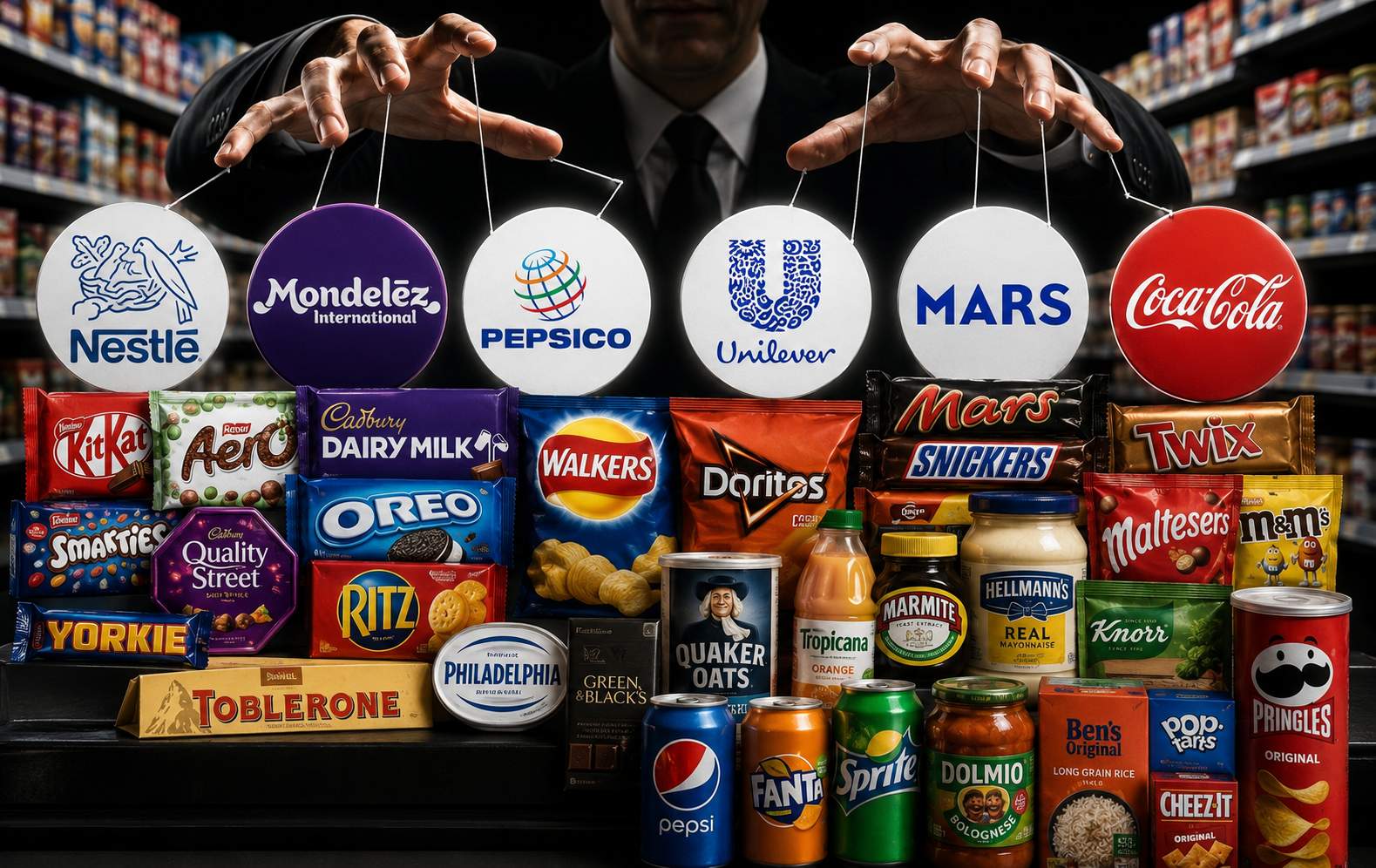
While supermarket shelves appear packed with competing products, a surprisingly small group of multinational corporations controls a huge percentage of the food and drink brands sold across the UK. From Cadbury chocolate and Walkers crisps to KitKat, Heinz products, Ben & Jerry's ice cream and Coca-Cola, many household favourites ultimately report back to a handful of global parent companies worth hundreds of billions of pounds.
Industry analysts have repeatedly highlighted how concentrated the food and beverage market has become, with around ten major corporations dominating much of the global consumer goods sector.
The result is a food industry where shoppers often believe they are choosing between rival brands, even though those products may be owned by the same company.
The Illusion Of Endless Choice.
Modern supermarkets are built around variety.
Consumers are presented with dozens of different products within every category, whether they are buying breakfast cereal, chocolate, crisps, bottled water or frozen meals.
Yet much of that apparent competition disappears once ownership structures are examined.
Research into the global food industry has consistently shown that a relatively small number of corporations control hundreds of major brands sold around the world.
These companies have expanded through decades of acquisitions, mergers and takeovers, steadily building vast portfolios that span multiple food categories.
Many shoppers remain unaware that brands marketed with completely different identities, logos and advertising campaigns often belong to the same parent company.
The strategy allows corporations to dominate supermarket shelves while maintaining the appearance of diversity and competition.
Nestlé Owns Far More Than Most People Realise.
Swiss food giant Nestlé is widely regarded as one of the most powerful companies in the global food industry.
While many people associate Nestlé primarily with chocolate, its reach extends far beyond confectionery.
The company owns KitKat, Aero, Smarties, Quality Street and Yorkie, but it also controls major coffee, cereal, pet food, bottled water and frozen food brands.
Nestlé products appear in millions of British homes every day, often without consumers realising how many purchases ultimately lead back to the same corporation.
Industry reports estimate Nestlé generates tens of billions in annual revenue and operates in almost every major consumer market worldwide.
Its scale has made it one of the most influential players in the international food sector.
Mondelez Controls Some Of Britain's Favourite Snacks.
Many British consumers still think of Cadbury as a traditional UK chocolate company.
While Cadbury remains one of Britain's most recognisable brands, it has been owned by Mondelez International since 2010 following a major takeover.
Mondelez also owns Oreo, Ritz, Philadelphia, Toblerone, Green & Black's and several other globally recognised brands.
The company has become one of the world's largest snack manufacturers, with products sold in supermarkets, convenience stores and petrol stations across Britain.
For many shoppers, the connection between Cadbury and Oreo is far from obvious, yet both brands ultimately sit under the same corporate umbrella.
This ownership structure has become increasingly common throughout the food industry.
PepsiCo Is Much More Than Soft Drinks.
Most consumers immediately think of Pepsi when they hear the name PepsiCo.
However, the company's influence stretches far beyond fizzy drinks.
PepsiCo owns Walkers Crisps, Doritos, Quaker Oats, Tropicana and several other major food brands sold throughout the UK.
Walkers alone dominates the British crisp market, while Doritos remains one of the country's most popular tortilla chip brands.
The company has spent decades acquiring businesses and expanding into new product categories.
Today, PepsiCo ranks among the largest food and beverage corporations in the world, generating billions in annual revenue and distributing products to more than 200 countries.
Unilever's Food Empire Remains Huge.
Although many consumers know Unilever for household and personal care products, the company also controls several major food brands.
Its portfolio includes Marmite, Hellmann's mayonnaise, Knorr and various other products commonly found in British kitchens.
Unilever has spent years reshaping its business through acquisitions and sales, but food remains a significant part of its operations.
Recent reports suggested the company has even explored major restructuring options involving its food division as global competition intensifies.
The scale of Unilever's reach highlights how interconnected the modern consumer goods market has become.
Mars Has Expanded Beyond Chocolate.
Mars remains best known for chocolate brands such as Mars bars, Snickers, Twix, Maltesers and M&M's.
Yet the company has grown into a far broader food and consumer goods powerhouse.
It owns Ben's Original rice, Dolmio pasta sauces and a large range of pet food products.
The company's influence expanded even further following its acquisition of Kellanova, the business behind Pringles, Pop-Tarts, Cheez-It and several cereal brands.
The takeover created one of the largest food and snack companies in the world and further concentrated ownership within the global food sector.
For critics of corporate consolidation, deals like this demonstrate how quickly major players continue expanding their control.
Coca-Cola Is No Longer Just A Soft Drinks Company.
The Coca-Cola Company remains one of the world's most recognisable businesses.
While the company built its reputation on cola, its portfolio now includes bottled water, fruit drinks, sports beverages and other products.
Brands such as Fanta, Sprite, Schweppes and various bottled water products all contribute to Coca-Cola's dominance of the drinks market.
The company has repeatedly expanded through acquisitions and partnerships to maintain its position as one of the most powerful beverage manufacturers globally.
For many consumers, the range of products linked to Coca-Cola comes as a surprise.
Why Food Industry Consolidation Matters.
Supporters of large food corporations argue that scale brings significant benefits.
Major companies can invest heavily in food safety, manufacturing efficiency, supply chains and research.
Their global networks allow products to be distributed widely while keeping costs relatively low.
However, critics argue that increasing consolidation creates risks for consumers.
When a small number of corporations control large portions of the market, concerns can emerge around pricing power, product diversity and consumer choice.
Some campaigners also argue that excessive concentration gives multinational corporations significant influence over food production, agricultural practices and retail markets.
Questions surrounding ultra-processed foods have added another layer to the debate.
Several major food corporations have faced criticism over the role highly processed products play in public health challenges, including obesity and diet-related illnesses.
The issue has fuelled growing scrutiny of how much power large food companies wield over consumer habits.
Most Shoppers Never Notice The Connections.
One reason food industry consolidation often goes unnoticed is branding.
Companies deliberately market products as distinct identities with separate packaging, advertising and brand histories.
A shopper choosing between two chocolate bars or two different snack products may assume they are supporting competing businesses.
In reality, those products may generate revenue for the same parent company.
This approach allows corporations to occupy more shelf space while creating the perception of greater competition.
Marketing experts describe the strategy as portfolio diversification, enabling companies to appeal to different demographics while maintaining control across multiple market segments.
The result is that many consumers remain unaware of how interconnected their shopping choices really are.
The Future Of Britain's Food Market.
Food industry consolidation shows little sign of slowing.
Competition for market share, rising production costs and pressure from investors continue driving mergers and acquisitions throughout the sector.
Large corporations increasingly view takeovers as a faster route to growth than launching entirely new products.
As a result, ownership of major food brands may become even more concentrated in the years ahead.
While regulators continue monitoring major deals, critics argue that consumers deserve greater awareness of who ultimately controls the brands they buy every week.
For many shoppers, discovering that favourite products belong to the same handful of multinational corporations can completely change how they view supermarket shelves.
What appears to be endless choice may actually be a market dominated by a surprisingly small group of global giants.
Who Owns The Brands On Your Shelf.
One reason this topic continues generating interest online is because many consumers are unaware of how extensive corporate ownership has become. Research into food industry consolidation has repeatedly shown that a small group of multinational corporations control hundreds of brands sold across supermarkets worldwide.
Shoppers interested in exploring ownership structures for themselves can often find parent company information on product packaging, corporate websites and investor reports. Looking beyond the branding reveals just how interconnected many household names have become.
As food prices, supermarket competition and consumer spending remain major issues across Britain, questions about who controls the nation's food supply are likely to remain firmly in the spotlight.
Were you surprised to learn how many of Britain's biggest food brands are owned by the same companies?
Food & Drink News
The Food Industry Secret Hiding In Plain Sight On UK Supermarket Shelves
Advertisement

Comments (0)
You must be logged in to post comments.
Don't have an account? Register here
No comments yet. Be the first to share your thoughts!