
For much of British history, homosexuality was not simply frowned upon but actively criminalised, with sexual acts between men punishable by imprisonment, and in earlier centuries, by death. The long, hard-fought process of changing that legal reality into something resembling genuine equality has unfolded almost entirely within living memory, shaped by decades of sustained campaigning and activism.
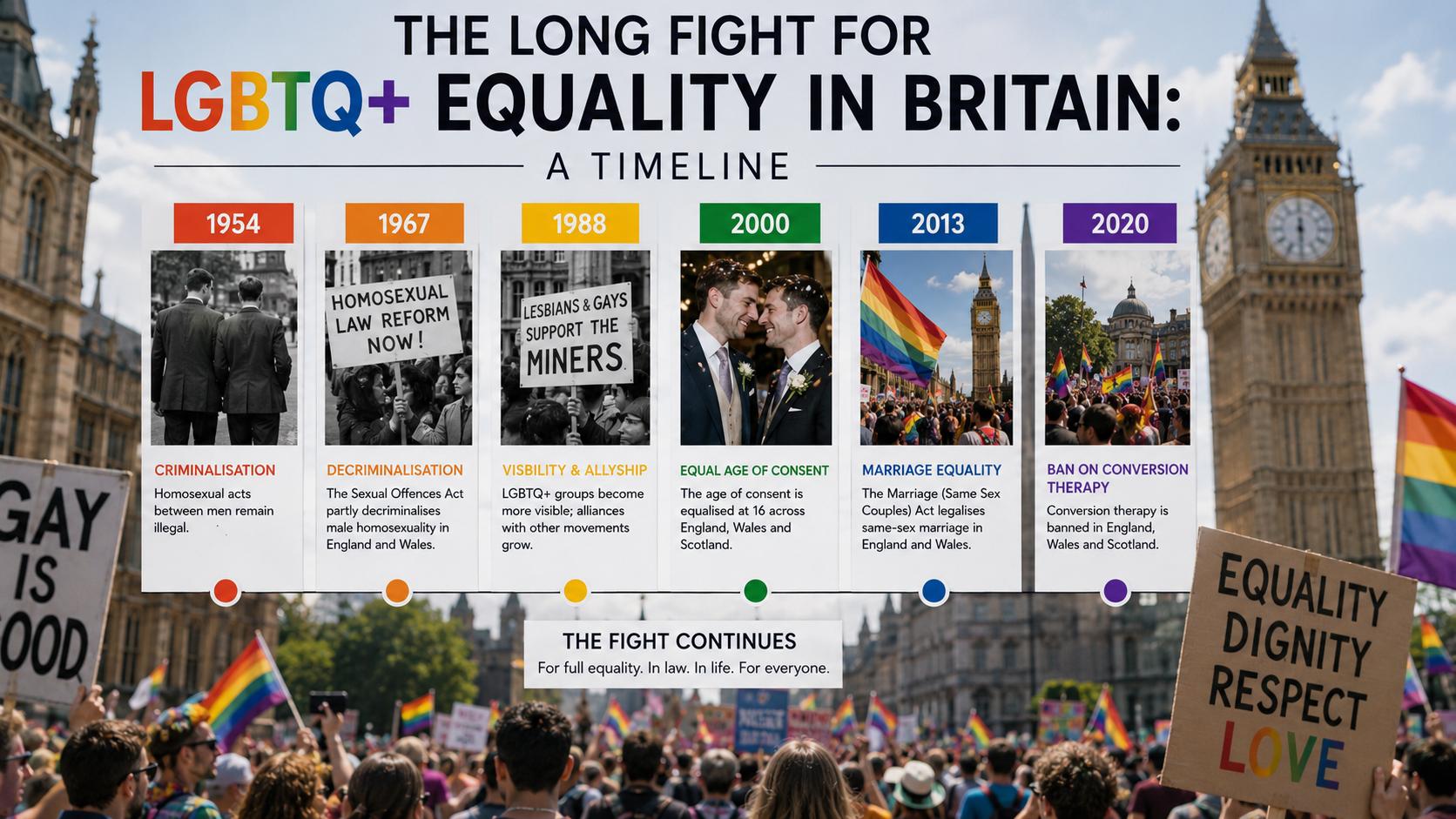
The first major legal breakthrough came with the Sexual Offences Act 1967, which received Royal Assent on 27 July that year and partially decriminalised private sexual acts between two consenting men aged twenty-one or over in England and Wales specifically. The change came with significant restrictions attached, excluding the armed forces and merchant navy entirely, and Scotland and Northern Ireland would not see equivalent reform for well over a decade afterward.
Progress through the following two decades remained genuinely slow and frequently contested. The age of consent for gay men was not equalised with the heterosexual age of consent until the year 2000, following years of campaigning, and Section 28 of the Local Government Act 1988 actively prohibited local authorities and schools from "promoting homosexuality", casting a genuinely chilling effect over LGBTQ+ visibility and education throughout the 1990s specifically.
The turn of the millennium brought a considerably faster pace of reform. Gay people were permitted to serve openly in the UK armed forces from 2000 onward, adoption rights for same-sex couples followed in 2002, and the Sexual Offences Act 2003 finally removed the last remaining discriminatory sexual offences from the statute book entirely, replacing them with orientation-neutral, consent-based law applying equally to everyone regardless of sexuality.
The Civil Partnership Act 2004 marked a genuinely landmark moment, granting same-sex couples in the UK legal recognition and rights broadly equivalent to marriage for the very first time, with the first civil partnerships taking place in December that year. The same year also saw the Gender Recognition Act pass into law, allowing transgender people to obtain full legal recognition of their gender for the first time in British legal history.
Full marriage equality followed a decade later. The Marriage (Same Sex Couples) Act 2013 came into force in England and Wales on 29 March 2014, with the very first same-sex marriages taking place at the stroke of midnight that day. Scotland followed with its own equal marriage legislation in December 2014, while Northern Ireland remained the final part of the UK to legalise same-sex marriage, only doing so in 2020 following direct intervention from Westminster.
The Equality Act 2010 further strengthened these protections, consolidating previous discrimination law into a single act and formally recognising both sexual orientation and gender reassignment as protected characteristics under UK law, giving LGBTQ+ people stronger legal grounds to challenge discrimination across employment, education and the provision of services more broadly than ever before.
Wider social recognition also progressed alongside these legal changes, if often considerably more slowly. Prime Minister Gordon Brown issued a posthumous apology to codebreaker Alan Turing in 2009 for his historic conviction under earlier anti-gay laws, while the government later allowed people convicted under those same discriminatory laws to apply to have their convictions formally disregarded from 2012 onward.
Devolved and international pressure also continued shaping the pace of change across different parts of the UK. Northern Ireland's own path to equal marriage came only after direct intervention from Westminster in 2019 and 2020, following years of the issue being repeatedly blocked at the Stormont Assembly, illustrating just how unevenly legal equality has actually been achieved across different UK nations and regions.
Despite this genuinely remarkable legal transformation across less than sixty years, campaigners consistently note that legal equality alone has not eliminated discrimination, prejudice or hate crime entirely. That ongoing gap between legal rights and lived experience remains precisely why events like Newcastle Pride continue describing themselves as both a celebration and a protest, marking real progress while insisting the wider fight for genuine equality is not yet fully complete.
Join the discussion.
Which of these legal milestones surprised you the most?
Lifestyle News
The Long Fight for LGBTQ+ Equality in Britain: A Timeline
From a criminal offence punishable by imprisonment to full marriage equality, the legal status of LGBTQ+ people in Britain has been transformed within a single living generation.
Advertisement




Comments (0)
You must be logged in to post comments.
Don't have an account? Register here
No comments yet. Be the first to share your thoughts!