
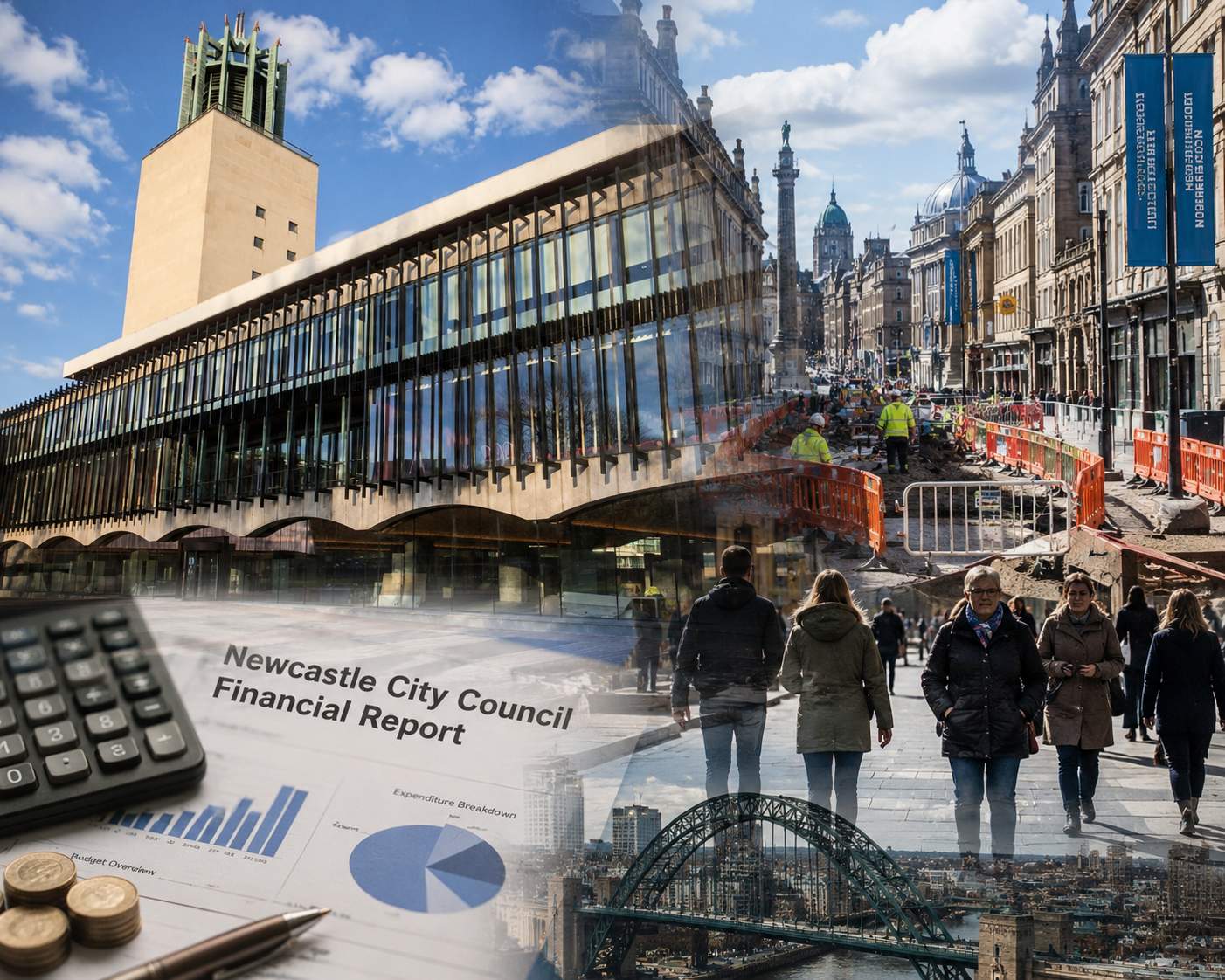
Fresh questions are being asked about the long-term financial health of Newcastle City Council after it emerged that a one-off payment from Newcastle International Airport helped prevent a significant budget overspend during the last financial year.
The revelation has sparked renewed debate about council spending priorities, financial planning and the growing pressures facing local authorities across the North East. While the council ultimately finished the year with a balanced position, newly released figures show that without an unexpected £7.2 million dividend from the airport, Newcastle would have recorded a deficit approaching £7 million.
The issue comes at a time when the authority is already facing rising costs across social care services, children's support programmes and several commercial property investments.
Airport Dividend Prevented Budget Overspend.
Documents presented to Newcastle City Council's cabinet revealed that the authority finished the 2025/26 financial year around £500,000 under budget. However, council officials acknowledged that this outcome was only possible because of an extraordinary dividend payment linked to refinancing arrangements at Newcastle International Airport.
The £7.2 million payment followed a wider £364 million refinancing deal involving the airport. Newcastle City Council is one of seven local authorities that collectively own a majority stake in Newcastle International Airport, making the dividend available to local government shareholders.
Without that additional income, council finances would have shown an overspend of approximately £6.7 million.
The figures have led to concerns about how sustainable Newcastle's finances could be if similar one-off payments are not available in future years.
Growing Pressure From Social Care Costs.
One of the biggest financial challenges facing Newcastle City Council continues to be adult social care.
According to the council's latest financial report, adult social care services overspent by £5.9 million during the last financial year. Officials pointed to increasing demand for support services, particularly among older residents requiring complex care packages, dementia support and specialist assistance.
The situation reflects a wider national trend. According to NHS England and the King's Fund, demand for adult social care has risen significantly over the past decade as the UK's population ages and people live longer with complex health conditions.
Children's services also experienced major budget pressures.
The council reported a £7.6 million overspend within Children's Social Care, largely driven by increased costs for residential placements, specialist foster care and support for children with disabilities.
Across England, spending on children's services has risen sharply. Local Government Association figures show that councils in England now spend more than £12 billion annually on children's social care, with demand continuing to increase year after year.
Commercial Property Investments Remain Under Review.
In addition to service pressures, concerns remain about several council-owned commercial properties.
Among the assets highlighted were Partnership House in Gosforth, the Core building at Newcastle Helix and Higham House in Newcastle city centre.
Each property has reportedly been operating at a loss, adding to wider concerns about the financial performance of council investments.
Local authorities across the UK have increasingly invested in commercial property over the last decade in an effort to generate revenue. However, changes in office working patterns since the pandemic have created challenges for many councils attempting to maintain occupancy rates and rental income.
As Newcastle continues to assess the performance of its property portfolio, questions remain over how those assets will contribute to future budgets.
Political Debate Over Financial Inheritance.
The council's financial position has quickly become a political talking point following May's local elections.
Newcastle's new Liberal Democrat administration has argued that the airport dividend masked underlying financial pressures that were inherited from the previous Labour leadership.
Deputy council leader Mark Mitchell suggested the city could have been left facing a significant funding gap had the airport payment not arrived when it did.
Council leader Colin Ferguson also acknowledged that Newcastle faces difficult financial decisions in the months ahead as the authority seeks to balance budgets while protecting frontline services.
However, Labour representatives have strongly rejected suggestions that they left the council in financial difficulty.
Labour group leader Ged Bell pointed out that the previous administration ultimately delivered a balanced budget and argued that the new leadership should focus on future challenges rather than revisiting decisions made by former administrations.
The debate is likely to continue as council leaders prepare future spending plans.
Regeneration Projects Under The Spotlight.
The discussion around council finances is also likely to increase scrutiny of major regeneration projects taking place across Newcastle.
One of the most visible schemes is the ongoing transformation of Northumberland Street, Newcastle's flagship shopping destination and one of the busiest retail streets in the North East.
The improvement project includes new paving, upgraded lighting, seating, planting, drainage systems and public realm enhancements designed to modernise the city centre experience. The construction value of the project has been reported at approximately £12 million, while the wider approved budget linked to the redevelopment has been reported at around £14.2 million. The scheme forms part of Newcastle's wider city centre regeneration programme and is supported largely through government funding rather than day-to-day council service budgets.
Northumberland Street attracts some of the highest visitor numbers in the region and remains a key economic asset for Newcastle city centre. The council has repeatedly argued that investment in major public spaces is essential to attracting shoppers, businesses and tourism.
However, at a time when local authorities are facing significant financial pressure, regeneration spending often attracts close public scrutiny.
Financial Challenges Reflect National Picture.
Newcastle is far from alone in facing budget pressures.
Research from the Local Government Association has repeatedly warned that councils across England are struggling with rising demand for services alongside increasing operational costs.
In recent years, several local authorities have issued warnings about their financial sustainability, while some councils elsewhere in England have effectively declared themselves unable to balance budgets without significant intervention.
According to government data, spending on adult social care accounts for one of the largest portions of local authority budgets nationwide, while children's services continue to absorb growing levels of expenditure.
The combination of inflation, staffing costs and increased demand has created an extremely challenging environment for councils of all political backgrounds.
Difficult Decisions Ahead For Newcastle.
While the £7.2 million airport dividend provided a welcome financial boost, it has also highlighted how dependent balanced budgets can sometimes become on exceptional circumstances.
Newcastle City Council now faces the challenge of controlling costs while maintaining vital services for residents.
Future decisions will likely focus on improving efficiency, reducing financial risks and finding new ways to manage increasing demand across social care and children's services.
For residents, the debate goes beyond political arguments and budget spreadsheets. It concerns how services are delivered, how public money is spent and how Newcastle balances investment in its future with the growing needs of its communities.
As council leaders prepare the next round of budget planning, many will be watching closely to see whether Newcastle can avoid similar financial pressures without relying on another unexpected windfall.
Share your thoughts below.
Do you think Newcastle City Council is spending enough on frontline services, or should more funding be redirected from regeneration projects into community support?
Local News
Newcastle Council Faces Fresh Financial Concerns
Advertisement




Comments (0)
You must be logged in to post comments.
Don't have an account? Register here
No comments yet. Be the first to share your thoughts!