
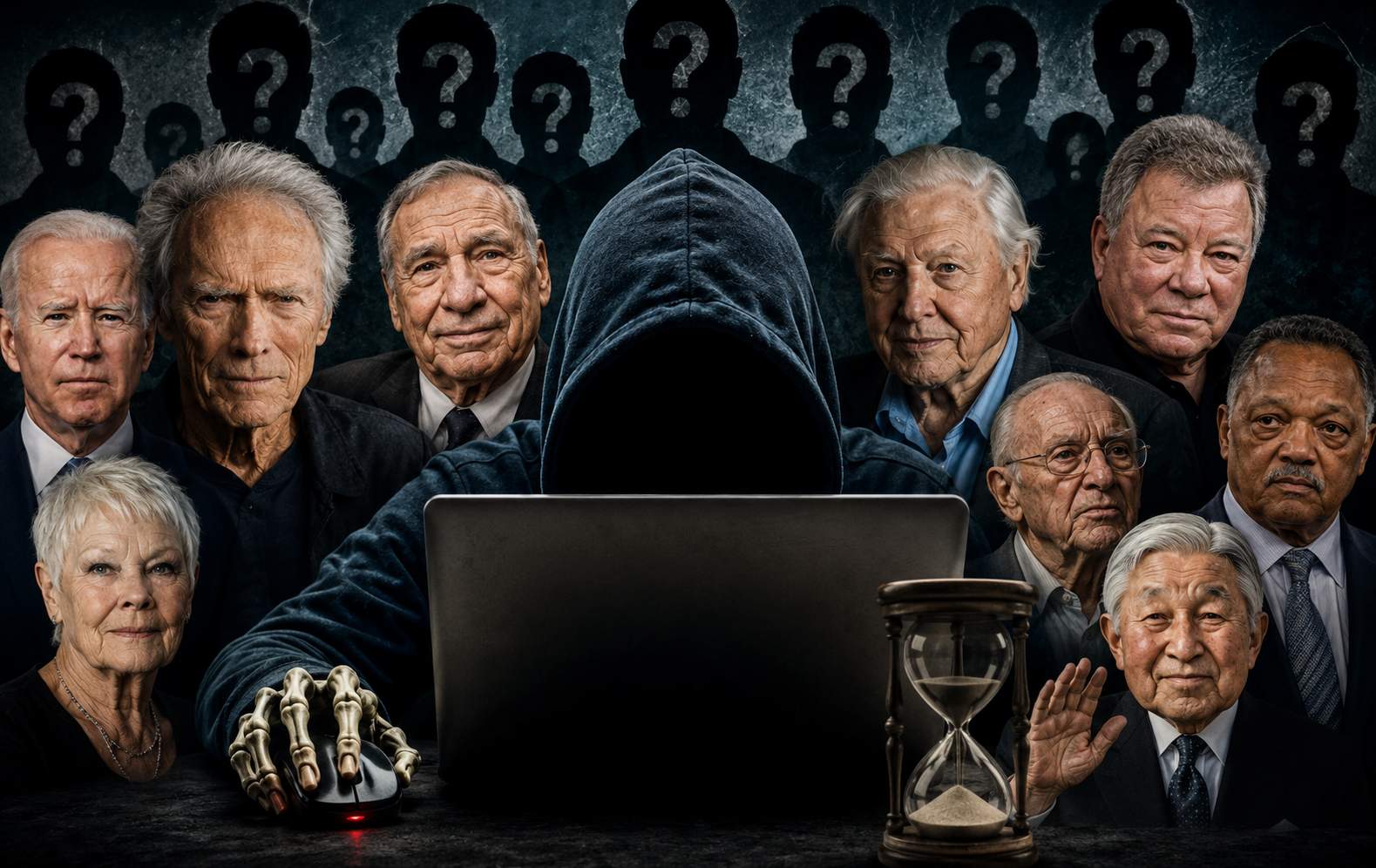
An online game that allows users to predict which celebrities may die within the next 12 months is once again facing backlash after revealing its controversial 2026 list featuring some of the world's most recognisable public figures.
The website, known as DeathList, publishes an annual list of 50 celebrities selected on the basis they may die during the coming year. Followers of the site track celebrity deaths throughout the year and score points when listed individuals pass away.
Critics have branded the concept offensive and deeply unethical, accusing the site of turning human death into online entertainment. Supporters, however, argue the project is rooted in dark humour and long-established British satire.
The release of the 2026 list has generated particularly strong reaction online because of the number of globally famous figures included this year, ranging from Hollywood actors and broadcasters to former political leaders and music legends.
Famous Celebrities Featured on the 2026 DeathList.
Among the highest-profile names included on the 2026 list is legendary broadcaster Sir David Attenborough, who turned 100 this year and remains one of Britain's most respected television personalities.
Hollywood icon Clint Eastwood, now aged 96, also appears on the list alongside Star Trek actor William Shatner, who is 95, and comedy director Mel Brooks, who also reaches 100 this year.
Former US President Joe Biden, aged 84, has also been included, as has civil rights activist Jesse Jackson and former Japanese Emperor Akihito.
British entertainment figures appearing on the list include Dame Judi Dench, Billy Connolly, Geoffrey Boycott, Julie Goodyear, Eileen Derbyshire, and veteran Doctor Who actor Tom Baker.
The site also names famous historical and political figures such as former Cuban leader Raul Castro, former Philippine First Lady Imelda Marcos, and Ayatollah Ali Khamenei.
Several music and film stars also feature, including singer Michael Bolton, actress Vanessa Redgrave, singer-songwriter Linda Ronstadt, and actor Robert Wagner.
Perhaps one of the most surprising inclusions is former James Bond actor George Lazenby, alongside astronaut Buzz Aldrin, who remains one of the last surviving Apollo moon landing crew members.
How DeathList Works.
DeathList describes itself as a darkly comic annual project built around celebrity mortality predictions.
According to the website's own rules, every person selected must be famous enough for their death to receive significant coverage from UK media outlets. The site also states that celebrities cannot simply be included because they are terminally ill or expected to die imminently.
Only 25 names from the previous year's list are allowed to return, forcing organisers to introduce fresh selections each year.
The website openly tracks annual scores based on how many listed celebrities die during the calendar year. According to the site's figures, 2025 produced 11 deaths, while 2020 remains the highest-scoring year with 20.
Critics argue that the competitive scoring system is one of the most disturbing aspects of the website because it treats celebrity deaths as a form of entertainment or sport.
Critics Say The Website Is Morally Wrong.
The inclusion of globally admired figures such as David Attenborough and Dame Judi Dench has intensified criticism of the website in recent days.
Many social media users described the concept as "sick", "disturbing", and "deeply disrespectful", particularly given the advanced age and health struggles of some people named on the list.
Others questioned how families of celebrities may feel knowing loved ones are being publicly discussed in terms of death predictions and annual scoring tables.
Mental health campaigners and online safety advocates have also raised concerns about how internet culture increasingly rewards shock value and controversy.
Critics argue that DeathList reflects a broader problem online where tragedy and suffering are transformed into viral content designed to generate clicks, discussion, and attention.
Some commentators have even called for tighter regulation surrounding websites focused on death-related entertainment.
Supporters Defend It As Dark British Humour.
Despite the backlash, DeathList continues maintaining a dedicated following online.
Fans of the site argue it represents a form of dark satire rooted in traditional British humour. Some supporters claim the project simply acknowledges the reality that ageing public figures eventually die and that no actual harm is being encouraged.
Others compare the site to office prediction games or fantasy football-style competitions that have circulated informally for years.
Supporters also point out that many celebrities featured on the list are already elderly public figures whose health is frequently discussed in mainstream media coverage.
However, critics say there is a clear difference between discussing celebrity health news and actively creating a public competition around predicting deaths.
Why Certain Names Spark Stronger Reactions.
Not every celebrity included on DeathList attracts the same level of controversy.
Names such as David Attenborough, Billy Connolly, and Dame Judi Dench have generated particularly emotional reactions because they are widely viewed as beloved national figures in Britain.
Attenborough, for example, remains hugely admired across generations due to his decades of nature broadcasting and environmental campaigning.
Similarly, Billy Connolly's public battle with Parkinson's disease has made him an especially sensitive inclusion for many people online.
The presence of former US President Joe Biden has also triggered political debate, particularly among American social media users who accused the site of exploiting public concerns surrounding ageing political leaders.
Meanwhile, the inclusion of controversial figures such as Holocaust denier David Irving and convicted child sex offender Sidney Cooke has created separate debate about whether public reaction changes depending on who appears on the list.
Celebrity Culture and Online Fascination With Death.
The popularity of websites like DeathList highlights society's complicated relationship with celebrity culture and mortality.
Public fascination with famous deaths is nothing new. Major celebrity deaths have historically dominated newspaper headlines, television coverage, and public conversation for decades.
However, social media has dramatically accelerated this phenomenon. Celebrity illnesses, hospitalisations, and death rumours can now trend globally within minutes.
Some experts believe DeathList reflects a wider online culture where public figures are increasingly viewed as permanent media content rather than private individuals with families and personal lives.
Others argue the internet has normalised increasingly extreme forms of humour and shock-based entertainment designed to attract viral attention.
Questions Around Online Regulation Continue.
The controversy surrounding DeathList has also reignited wider debate about internet moderation and online ethics.
While the site itself may not directly break laws in the UK, critics argue there should be greater oversight of websites built around death-related entertainment and exploitation.
Others warn that attempting to censor offensive humour could create dangerous free speech issues.
Technology experts note that websites built around controversy often benefit from public outrage because criticism itself drives additional traffic and attention.
This creates a cycle where shocking online content becomes financially and socially rewarding through visibility alone.
As internet culture continues evolving, governments and regulators face increasing pressure to decide where ethical boundaries online should exist.
The Debate Around DeathList Shows No Signs of Slowing Down.
The annual release of DeathList continues provoking strong reactions because it sits at the intersection of several sensitive issues including celebrity culture, online morality, free speech, humour, and public fascination with death.
For supporters, the site remains little more than dark satire built around ageing public figures. For critics, it represents a disturbing example of how online culture increasingly turns human suffering into entertainment.
The inclusion of famous names such as David Attenborough, Joe Biden, Clint Eastwood, Judi Dench, Billy Connolly, and William Shatner has ensured the 2026 edition receives far more public attention than many previous years.
Whether viewed as satire or exploitation, DeathList continues highlighting the uncomfortable relationship modern internet culture has with fame, ageing, and mortality.
Do you believe Celebrity Death List is simply dark humour, or does the website cross a serious ethical line by turning celebrity deaths into a public game? Share your thoughts in the comments.
Tech News
The Controversial Website Turning Celebrity Deaths Into An Online Game
Advertisement




Comments (0)
You must be logged in to post comments.
Don't have an account? Register here
No comments yet. Be the first to share your thoughts!