
In a museum in Newcastle sits one of the most important ships ever built, a sleek, narrow vessel that once raced across the water faster than anything else on earth. The Turbinia, designed by the North East engineer Charles Parsons and built on the Tyne, revolutionised the way ships were powered and announced its arrival to the world in one of the most audacious publicity stunts in maritime history. Its story is a perfect blend of Tyneside genius, daring and showmanship.
A Revolutionary Idea.
The genius behind the Turbinia was Charles Algernon Parsons, a brilliant engineer who had invented the modern steam turbine in the 1880s. Parsons realised that this new kind of engine, which spun continuously rather than relying on the back-and-forth motion of older steam engines, could drive a ship faster, more smoothly and more efficiently than anything that had come before. To prove his revolutionary idea, however, he needed to build a vessel that would demonstrate the turbine's astonishing potential beyond any possible doubt. That vessel would become the Turbinia.
Built on the Tyne.
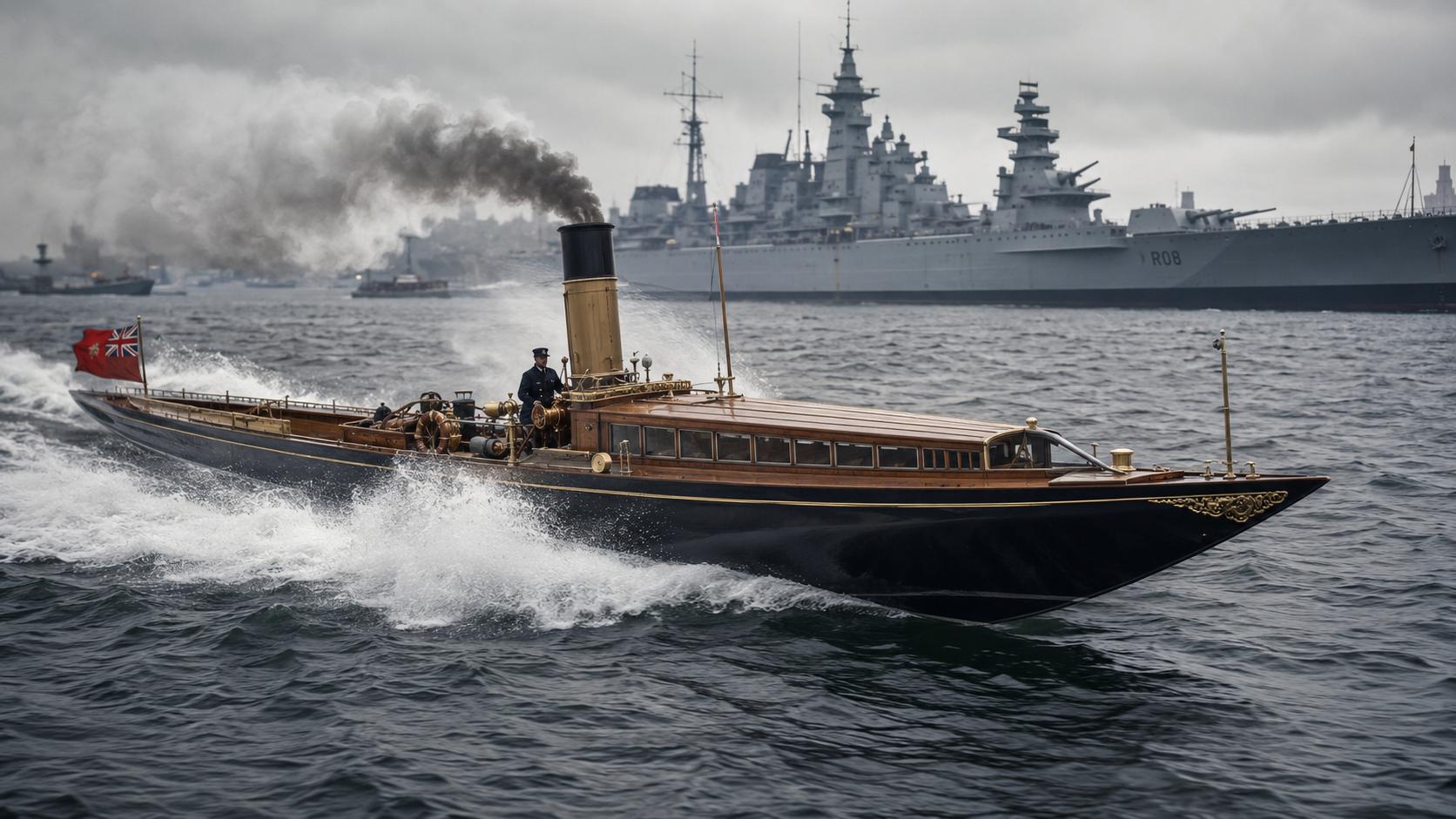
The Turbinia was built as an experimental craft, constructed of light steel by a Tyneside firm and launched at Wallsend on the river in 1894. Long, slender and purpose-built for speed, she was unlike any ship of her time. Parsons used her as a floating laboratory, testing and refining his turbine machinery in pursuit of ever greater performance. The early trials, however, did not go entirely to plan, and Parsons found himself wrestling with a baffling problem that was preventing the ship from reaching the speeds he knew should be possible.
Solving the Riddle of Speed.
The mystery that held the Turbinia back was a phenomenon called cavitation, in which the propellers spun so fast that they created pockets of vapour in the water, robbing them of grip and power. Parsons, with characteristic ingenuity, studied the problem in depth and even built special apparatus to investigate it, eventually arriving at a solution involving multiple shafts and propellers. With his redesign in place, the Turbinia was transformed, achieving a top speed of around thirty-four knots, a figure that made her comfortably the fastest ship in the entire world. Now Parsons needed a stage on which to reveal her to everyone who mattered.
Gatecrashing the Royal Review.
That stage presented itself in June 1897, when a great review of the Royal Navy was held at Spithead to mark Queen Victoria's Diamond Jubilee. Lined up were the mightiest warships of the age, watched by royalty, admirals and dignitaries from around the world. Without invitation or permission, Parsons fired up the Turbinia and sent her tearing through the assembled fleet at a speed no other vessel could hope to match, dancing between the great ships and easily outrunning the navy boats sent to stop her. It was an electrifying and utterly audacious display, and it instantly made the Turbinia famous across the globe.
The Future of Shipping.
The daring demonstration achieved exactly what Parsons had intended. The navies and shipbuilders of the world could no longer ignore the steam turbine, and within a remarkably short time the technology was being adopted for the fastest and most important ships afloat. Great warships and the magnificent transatlantic liners that followed, including some of the most famous vessels ever built, were powered by turbines descended from Parsons's invention. The Turbinia had not merely been fast; she had pointed the way to the future of marine propulsion, and the whole world had taken notice.
Preserved in Newcastle.
After her working life was over, the historic Turbinia was preserved for the nation, and today she takes pride of place in the Discovery Museum in Newcastle, where visitors can marvel at her sleek lines and learn the story of her triumph. To stand before her is to come face to face with a genuine piece of world history, a ship that changed the course of engineering and brought enormous credit to the North East. The Turbinia is a fitting symbol of the inventive brilliance of the Tyne, a small vessel that made an enormous impact and stunned the world.
A Symbol of Tyneside Ingenuity.
The Turbinia has come to stand for something larger than herself: the extraordinary inventive genius that flourished on the banks of the Tyne. Charles Parsons was one of a remarkable group of engineers and innovators whose work, in fields from electric light to artillery and shipbuilding, gave the region a global reputation for technical brilliance. The little ship embodies the spirit of bold experimentation that drove these men, the willingness to chase a difficult idea through years of patient work and then to stake everything on a single dramatic demonstration. Parsons himself went on to build great works and to see his turbines adopted across the world, in power stations as well as ships, transforming modern life in ways few inventions ever have. That the Turbinia survives, lovingly preserved for the public to see, means that each new generation can come face to face with this pivotal moment in engineering history. Standing beside her, visitors can appreciate not just the elegant lines of a record-breaking vessel but the courage and ingenuity that she represents. She is, in every sense, a fitting monument to the inventiveness of the Tyne and to a region that helped to build the modern world.
Over to you.
Drop your thoughts and local knowledge in the comments and share this with a friend, especially if you have stood beside the Turbinia at the Discovery Museum.
Can you picture the scene as the little Turbinia raced uninvited through the entire Royal Navy?
Newcastle History
The Turbinia: The Tyne Ship That Stunned the World
Charles Parsons' Tyne-built Turbinia became the fastest ship in the world and famously gatecrashed a royal naval review in 1897, changing shipping forever. Today she is preserved in a Newcastle museum.
Advertisement

Comments (0)
You must be logged in to post comments.
Don't have an account? Register here
No comments yet. Be the first to share your thoughts!