
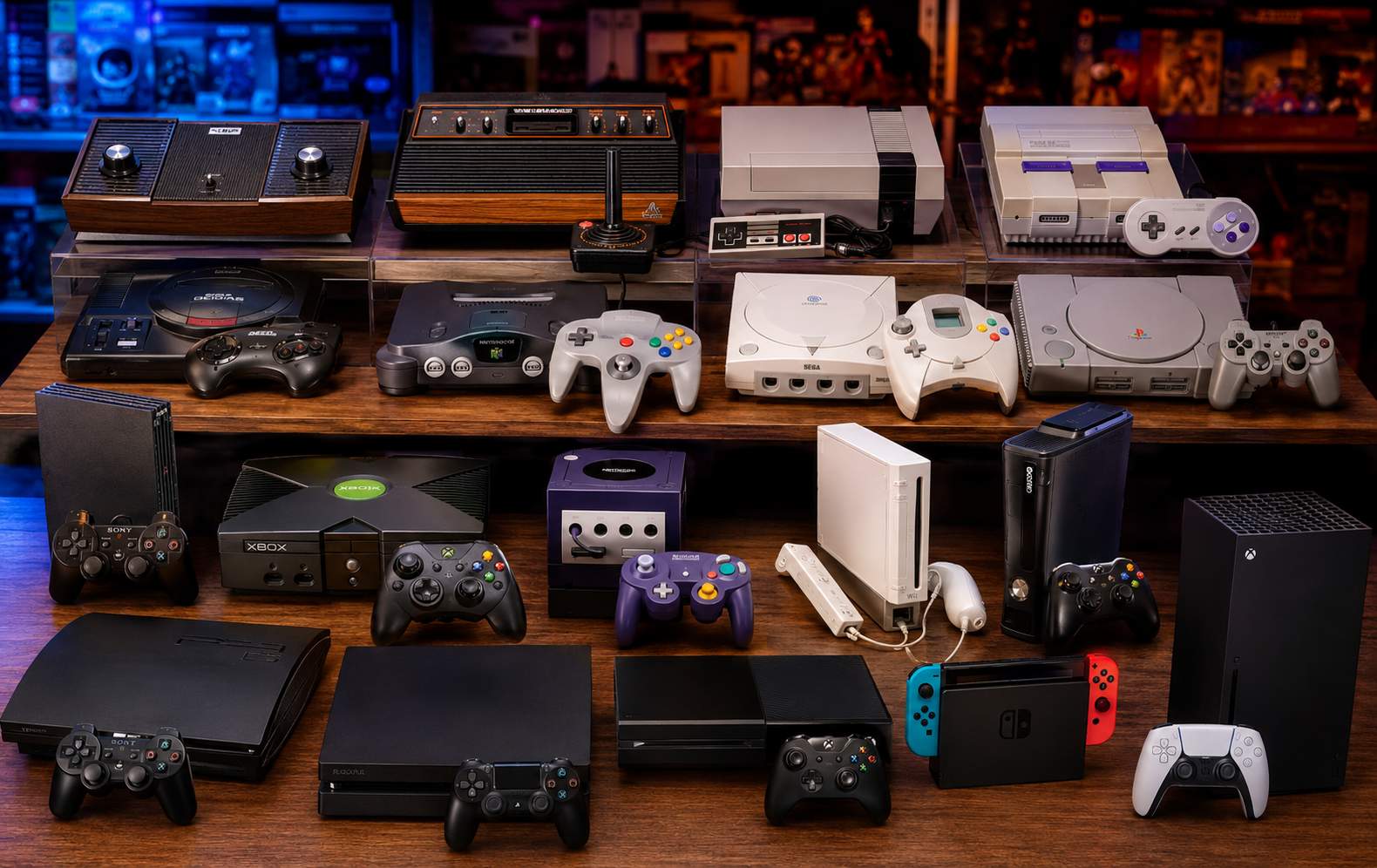
The history of video game consoles is a story of innovation, competition, and cultural change. What began as a simple electronic experiment in the early 1970s has grown into a global entertainment industry worth billions of pounds. Modern gaming systems are capable of producing cinematic graphics, online multiplayer worlds, and experiences that rival Hollywood productions, but the journey to reach this point has been filled with dramatic successes and spectacular failures.
Every generation of consoles introduced new technology that changed the way people played games. Some systems became legendary household names that defined childhoods for millions of players. Others disappeared quickly after poor sales, weak marketing, or lack of developer support.
From Pong machines and cartridge based consoles to online gaming networks and cloud streaming, the evolution of gaming hardware reflects broader changes in technology and popular culture. The console wars between major companies such as Nintendo, Sega, Sony, and Microsoft also shaped the industry into one of the most competitive entertainment markets in the world.
Today, gaming is no longer considered a niche hobby. It is mainstream entertainment enjoyed by people of all ages across the globe. However, the foundations of modern gaming were built decades ago by systems that now seem incredibly primitive compared to today’s machines.
Pong and the Birth of Home Gaming.
The first major breakthrough in home gaming arrived in the early 1970s with Pong. Developed by Atari, Pong was a simple table tennis style game that became a cultural phenomenon almost overnight.
The original arcade version was released in 1972 and quickly attracted huge crowds. Its popularity led to home versions that allowed families to play video games in their living rooms for the first time.
Pong consoles were extremely limited by modern standards. Most systems could only play one or two games and featured basic black and white graphics. Despite this, the novelty of interactive electronic entertainment captured public attention.
The simplicity of Pong actually helped make it popular. Players did not need instructions or complicated controls. Anyone could understand the game within seconds.
The success of Pong proved there was a commercial future for home gaming systems and inspired dozens of companies to enter the growing market.
Atari Changed Gaming Forever.
Atari took the gaming industry to another level in 1977 with the release of the Atari 2600. Unlike Pong systems, the Atari 2600 used interchangeable cartridges, allowing players to purchase multiple games for one console.
This innovation transformed gaming from a single game novelty into an expanding entertainment platform.
The Atari 2600 featured games such as Space Invaders, Pac Man, and Asteroids, many of which became iconic parts of gaming history. The console’s joystick controller also became one of the most recognizable gaming accessories ever created.
Atari dominated the early console market because it arrived before serious competition existed. However, the company’s rapid expansion eventually caused major problems.
By the early 1980s, the gaming market became flooded with poor quality games and cheaply made consoles. One of the biggest disasters came from Atari’s rushed adaptation of E.T. the Extra-Terrestrial, which is often blamed for contributing to the video game crash of 1983.
Consumer confidence collapsed, game sales plummeted, and many companies disappeared entirely.
Nintendo Revived the Industry.
After the video game crash, many believed home consoles were finished. Nintendo changed everything in 1985 with the release of the Nintendo Entertainment System, commonly known as the NES.
Originally launched in Japan as the Famicom, the NES introduced higher quality games, improved graphics, and stricter publishing standards. Nintendo carefully controlled which games appeared on the platform to avoid the quality issues that damaged Atari.
The NES became hugely successful thanks to titles such as Super Mario Bros., The Legend of Zelda, and Metroid. These games introduced memorable characters, deeper gameplay, and larger worlds than earlier consoles had offered.
Nintendo also marketed the NES as a family entertainment product rather than simply a gaming machine, helping rebuild trust among consumers after the industry crash.
The NES transformed Nintendo into one of the most powerful names in gaming and established many gameplay ideas still used today.
Sega Challenged Nintendo’s Dominance.
During the late 1980s and early 1990s, Sega emerged as Nintendo’s biggest rival.
The Sega Master System initially struggled against the NES in many markets, but Sega found enormous success with the Sega Genesis, known as the Mega Drive in Europe.
Sega positioned itself as the cooler and more rebellious alternative to Nintendo. Aggressive marketing campaigns targeted teenagers rather than younger children, and the company promoted faster gameplay and edgier titles.
The introduction of Sonic the Hedgehog gave Sega a mascot capable of competing directly with Mario. Sonic’s speed and attitude became symbolic of Sega’s brand identity.
The rivalry between Nintendo and Sega created one of the most famous periods in gaming history, often referred to as the console wars.
Although Sega achieved major success for several years, later consoles such as the Sega Saturn struggled due to confusing launches, limited game support, and strong competition from Sony.
Nintendo Continued to Innovate.
Nintendo remained highly influential throughout the 1990s with the Super Nintendo Entertainment System, or SNES.
The SNES improved graphics, sound, and gameplay depth while introducing classics such as Super Mario World, Donkey Kong Country, and Super Metroid.
Nintendo focused heavily on polished gameplay and memorable first party franchises. This strategy helped maintain its loyal fan base even as competition intensified.
The Nintendo 64 later introduced 3D gaming experiences with titles such as Super Mario 64 and The Legend of Zelda - Ocarina of Time. These games revolutionized movement, camera controls, and open world design.
However, Nintendo’s decision to continue using cartridges instead of CDs became controversial. Cartridges offered faster loading times but held less data and cost more to produce.
This decision allowed Sony to gain a major advantage in the gaming market.
Sony Entered the Console Wars.
Sony shocked the gaming industry in 1994 with the launch of the original PlayStation.
Initially, Sony had partnered with Nintendo on a CD based project before the relationship collapsed publicly. Sony then decided to create its own console, a decision that would change gaming history permanently.
The PlayStation became enormously popular due to its use of CD technology, strong third party developer support, and mature marketing approach.
Games such as Final Fantasy VII, Metal Gear Solid, Resident Evil, and Gran Turismo helped attract older audiences who viewed gaming as more than just children’s entertainment.
Sony also made game development easier and cheaper compared to cartridge based systems. This encouraged developers to create more ambitious projects.
The PlayStation sold over 100 million units worldwide and established Sony as a dominant force in gaming.
Sega’s Decline and the Dreamcast.
Sega attempted to recover from earlier struggles with the Dreamcast in 1998.
The Dreamcast was technologically advanced for its time and introduced features such as online gaming support before competitors adopted similar systems.
Critics praised games such as Shenmue, Jet Set Radio, and Soulcalibur, but the console struggled commercially.
Several factors contributed to the Dreamcast’s failure. Sega’s reputation had already been weakened by previous hardware disappointments, and anticipation for Sony’s PlayStation 2 overshadowed the system.
The PlayStation 2 also doubled as a DVD player at a time when DVD technology was becoming increasingly popular.
Sega eventually exited the console hardware market entirely in 2001 and shifted its focus to software development.
PlayStation 2 Became a Global Phenomenon.
The PlayStation 2 remains the best selling video game console of all time.
Released in 2000, the system combined powerful hardware, an enormous game library, and DVD playback functionality. Many consumers purchased the console partly because it was one of the cheapest DVD players available.
The PS2 offered games for nearly every audience imaginable, including action, sports, racing, horror, and role playing titles.
Franchises such as Grand Theft Auto, God of War, and Kingdom Hearts became defining parts of gaming culture during this era.
Sony’s dominance during the PS2 generation demonstrated how gaming had evolved into mainstream entertainment.
Microsoft Entered the Industry With Xbox.
Microsoft entered the console market in 2001 with the original Xbox.
The company recognized gaming’s growing importance and wanted to compete directly with Sony and Nintendo.
The Xbox introduced powerful hardware and online gaming features through Xbox Live, which became one of the most influential online gaming services ever created.
Halo became the console’s defining franchise and helped establish Xbox as a serious competitor.
Although the original Xbox sold fewer units than the PS2, it laid the foundation for Microsoft’s long term gaming strategy.
The Xbox 360 later became hugely successful thanks to strong online services, popular exclusives, and early release timing ahead of competitors.
Nintendo Reinvented Gaming With the Wii.
By the mid 2000s, Sony and Microsoft focused heavily on graphics and processing power. Nintendo took a completely different approach with the Wii.
Released in 2006, the Wii emphasized motion controls and accessibility rather than technical performance.
The console attracted families, casual players, and older audiences who had never considered themselves gamers before.
Games such as Wii Sports became massive cultural successes because they encouraged social and physical interaction.
The Wii’s popularity proved that innovation and accessibility could be more important than raw hardware power.
However, Nintendo struggled to maintain momentum with the Wii U, which suffered from confusing branding and limited third party support.
Modern Gaming Became Fully Connected.
Modern consoles such as the PlayStation 5 and Xbox Series X represent a dramatic leap from the simple Pong systems of the 1970s.
Today’s machines feature realistic graphics, digital downloads, cloud gaming, virtual reality support, and massive online multiplayer experiences.
Gaming has become deeply connected to the internet. Players now stream gameplay, join global communities, and compete in esports tournaments watched by millions of people worldwide.
Subscription services such as Xbox Game Pass and PlayStation Plus have also changed how consumers access games, shifting the industry closer to digital streaming models similar to Netflix and Spotify.
Nintendo continues to succeed with its hybrid Nintendo Switch console, which combines portable and home gaming into one system.
The Switch became popular because of its flexibility, strong exclusive games, and appeal to both casual and dedicated players.
Why Some Consoles Failed While Others Succeeded.
The history of gaming consoles shows that technical power alone does not guarantee success.
Some systems failed because they launched too early, lacked strong games, or confused consumers with poor marketing. Others succeeded because they understood changing player habits and introduced innovative ideas at the right moment.
Nintendo survived by focusing on gameplay innovation and beloved franchises. Sony succeeded by appealing to wider audiences and supporting developers. Microsoft built strength through online gaming infrastructure and subscription services.
Sega’s decline demonstrated how quickly fortunes can change in the gaming industry when hardware strategies fail.
The console wars also pushed companies to innovate constantly, leading to many of the gaming features now considered standard.
Gaming Continues to Evolve.
The evolution of video game consoles reflects more than technological progress. It also mirrors cultural changes, shifting entertainment habits, and advances in digital communication.
What started with simple Pong machines has become a global industry connecting hundreds of millions of players worldwide.
Modern gaming consoles are no longer just devices for playing games. They function as entertainment hubs, social platforms, streaming systems, and online communities.
As cloud gaming, artificial intelligence, and virtual reality continue developing, the next generation of gaming hardware may transform the industry once again.
The history of video game systems proves one thing clearly. Gaming technology never stands still for long.
Which video game console had the biggest impact on your childhood or gaming experience? Share your favourite gaming memories and let us know which system you believe changed the industry forever.
Entertainment News
From Pong to PlayStation - The Incredible Evolution of Gaming Consoles
Advertisement





Comments (0)
You must be logged in to post comments.
Don't have an account? Register here
No comments yet. Be the first to share your thoughts!